Blair was so weak from hunger that her back had begun to bend. Even walking seemed almost more than her exhausted body could manage. Yet somehow, this frightened dog found her way to a person who was willing to help. What followed began with something terribly simple: a hungry animal finally being given food.
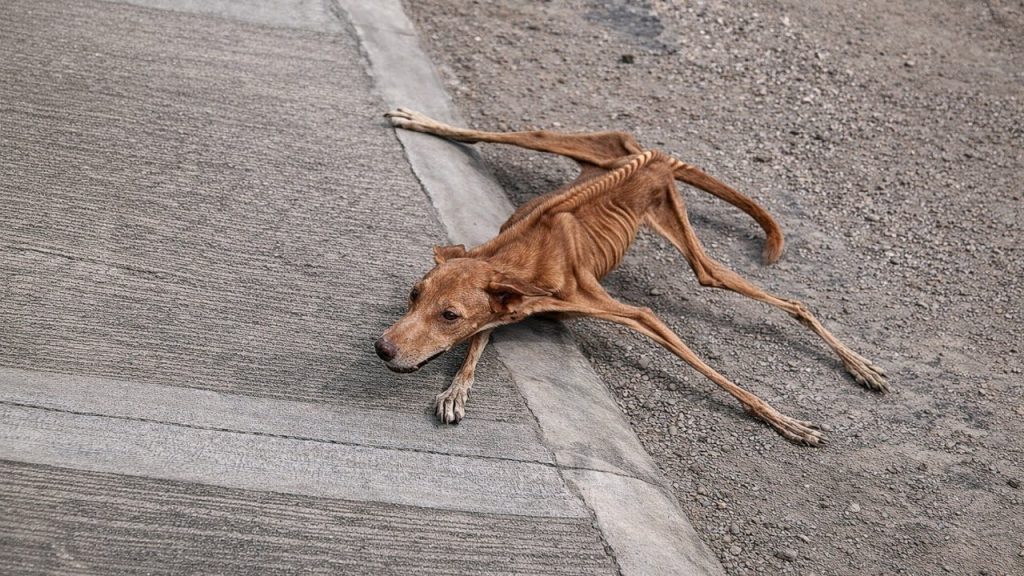
There is sadness in seeing a dog struggle with ordinary things. Walking should not require every ounce of strength. Eating should not feel like a desperate race against the possibility that a meal might disappear. For Blair, both revealed how much she had gone without. She had been abandoned, and her thin, depleted body showed the toll of prolonged neglect.
When Blair approached her rescuer, she was hunched over and unsteady. Her steps faltered, and she stumbled as she tried to move forward. The sounds she made seemed to plead for something to eat. She had so little strength left, but the need for food was unmistakable. Her condition spoke for her even when words never could.
The rescuer gave Blair food, and she began eating with the urgency of a dog who had known too much hunger. But even while she ate, she kept looking around. Her eyes were watchful and uneasy. The meal was right there, yet she could not simply relax and enjoy it. Fear lingered beside her hunger, as though kindness itself was unfamiliar and difficult to trust.
A basic act of care was reaching Blair, but she still reflected the life she had endured. Receiving food did not instantly erase her worry. It did, however, mean that someone had noticed her suffering and chosen to respond. For a dog in such a fragile state, that choice mattered enormously.
After Blair had eaten, her rescuer carried her to a veterinarian. She remained quiet and afraid, overwhelmed by what was happening around her. Her hunched back raised a troubling question: had the damage to her spine become permanent? The answer would determine so much about the road ahead. Blair needed more than a meal, and now she was where her condition could be examined and treated.
The veterinarian offered an important piece of good news. Blair’s spine had not suffered serious damage, and medication could help her recover. That relief came alongside a sobering assessment. She was severely dehydrated, and her body had been weakened by going without enough food for far too long. The danger was real, even though the outlook for her back was encouraging.
For Blair, recovery would have to be careful and consistent. Her treatment included a strict, nutritious feeding plan to rebuild her strength, along with regular medication. This was not something that could be fixed with one generous meal. Her body needed steady nourishment and time to heal. Every part of her care had a purpose: to help a dangerously weakened dog become healthy again.
There is something moving about the patience required here. Rescue is often remembered as the instant someone reaches out to help. But the work continues afterward, through repeated care and close attention to an animal who cannot explain what hurts. Blair depended on the people caring for her to understand her needs and give her a real chance to recover.
Gradually, signs of progress appeared. With rest, nutrition, and medication, Blair’s back began to straighten. Her health became more stable. The dog who stumbled was regaining the strength hunger had taken away. Nothing about that change made her earlier suffering acceptable. It simply showed what appropriate treatment and committed care could make possible.
Her rescuer regarded Blair’s survival as something close to a miracle. In the rescuer’s view, another week struggling on the streets might have been more than she could survive. It was a painful thought, especially when set beside the progress Blair was making. She had reached help at a point when her body was dangerously depleted, and the opportunity to heal had changed the course of her life.
As Blair grew stronger, her story began to hold more than worry. The focus shifted toward ordinary experiences she had long been denied. She no longer had to face hunger and exhaustion without help. There were people making sure she received the food, medicine, and attention she needed. Her future was beginning to look different from her past.
Eventually, Blair was well enough to leave veterinary care and go home with the person who had rescued her. It was a remarkable change from the frightened dog whose back had bent under the strain of starvation. She recovered fully, able to walk and play with energy and happiness. The simple sight of Blair moving freely now carried a meaning that would once have seemed almost impossible.
At home, Blair became deeply attached to her rescuer. She often slept close by and showed great affection for the person who had saved her life. That love was returned in daily care and tenderness. Her rescuer treated Blair not as a burden left behind by someone else, but as a cherished daughter, a beloved member of the family whose comfort and happiness truly mattered.
Blair’s journey is a reminder that recovery means more than surviving a difficult beginning. Her body needed veterinary treatment, nourishment, and rest. Her new life also offered the security of being wanted. The dog who once ate while anxiously watching her surroundings could now enjoy the companionship of someone devoted to her well being. She had been given not just help, but a place to belong.
No one can give Blair back the days she spent hungry and afraid. What her rescuer could give her was a different ending. Today, Blair’s life is defined by movement, play, closeness, and love rather than the weakness that nearly overcame her. Sometimes a second chance begins with a single meal. Its greatest gift is everything that comes after: a life where a gentle soul is finally safe, cared for, and loved.