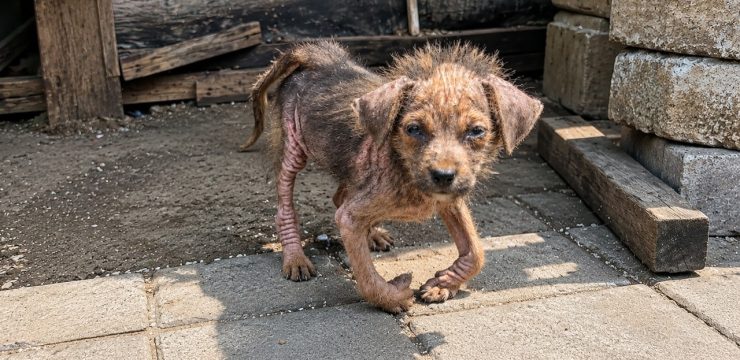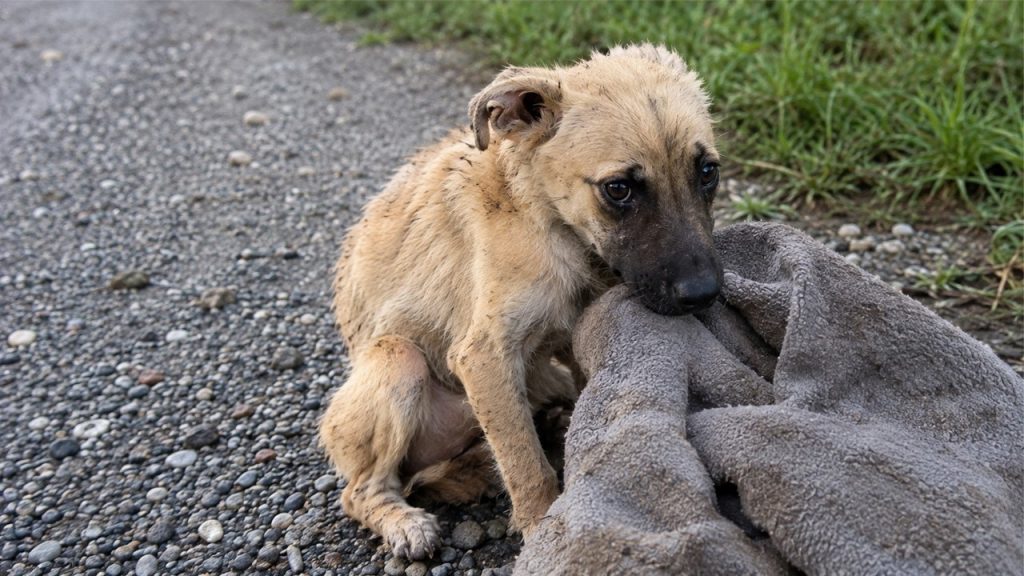
His name was Bambi, and his condition told a story that words never could. He seemed to have spent a long stretch of time struggling to get away from his former owner, driven onward despite overwhelming fatigue. Nobody could know exactly what he had endured along the way. What Victoria could see was a dog whose strength was gone.
The chain was impossible to ignore. It was not simply something Bambi wore; he had been dragging its weight while already terribly weak. For a dog in such condition, that burden made every effort harder. By the time Victoria discovered him, he could no longer keep going.
She was deeply moved by the sight of him. Instead of leaving the exhausted animal where he had fallen, Victoria gently lifted him and brought him home.
Yet being carried to safety did not make his fear disappear. Bambi remained completely withdrawn. He made no sound, and his silence was as troubling as his weakness. He seemed overwhelmed, almost unable to respond to the new world around him. The absence of obvious injuries could not explain everything that was happening inside this frightened little dog.
There was, however, one small sign that his longing for comfort had survived. Whenever Victoria came close, Bambi quietly sought affection. He did not need to make a sound to show that gentle contact mattered to him. Even while struggling to cope, he reached toward the kindness he had gone without for so long.
That contrast stayed at the heart of his rescue. He was deeply frightened, yet still wanted tenderness. He was too weak to do much, yet he could recognize the comfort of being cared for.
Victoria knew that love alone could not restore his health. She brought Bambi to a veterinary clinic, where his condition could be properly assessed. The examination brought both reassurance and concern. The veterinarians found no serious physical wounds, but Bambi was severely malnourished and extremely weak. His emotional trauma was also profound.
The recommendation was to keep him at the clinic for further care. The costs were high, but Victoria agreed without hesitation. Her priority was not the bill or the inconvenience. It was giving Bambi the help he needed and a genuine chance to recover. What mattered most was that Bambi would not have to face the hardest part of recovery alone.
Even with medical care and people looking after him, progress was painfully slow. Bambi retreated into himself. He refused meals, did not bark, and showed little interest in anything around him. Most of the time, he lay quietly on his small bed, as though the effort of taking part in ordinary life was simply too much.
Sometimes he tried to rise and walk. Those movements were difficult, and what little energy he had seemed to disappear almost immediately. His sad expression made his condition even harder to witness. He was no longer dragging a heavy chain, but he still carried the effects of what he had experienced.
The veterinary team continued caring for him, even when food was turned away again and again. They did not treat his silence or refusal to eat as a reason to abandon him. Recovery was not something they could demand from Bambi. He needed attention, patience, and the chance to begin responding in his own time.
For anyone hoping to see him improve, the smallest changes would matter. His body needed nourishment, yet he resisted the very meals that could help him regain strength.
Then came a moment that might have seemed ordinary in another dog’s life. Bambi finally accepted a bite of food.
It was only a small bite. It did not erase his weakness or undo everything he had lived through. But after so much refusal, that single mouthful was meaningful. The dog who had turned away from every meal was beginning to take something he desperately needed.
There was no sudden transformation. A frightened, malnourished dog does not become strong simply because he eats once. Still, the moment offered a reason to hope. It suggested that the patient care surrounding Bambi was beginning to reach him, and that there might be more steps forward.
Victoria remained devoted to him. Her compassion did not end when she carried him home, or when she agreed to the expense of veterinary care. She continued offering the steadiness and affection that Bambi needed as his body recovered and his confidence slowly returned.
Gradually, the dog who had seemed unable to engage with the world began to change. He regained strength, put on weight, and learned to trust people again. The improvement was physical, but it was also visible in the way he was able to meet life without the same crushing fear.
Today, Bambi is healthy and happy, living safely with Victoria. The chain that once weighed him down no longer defines his days. He has the security of someone who cares about his well-being and the freedom to enjoy a life that is no longer shaped by exhaustion and fear.
There is something unforgettable about the distance between those two versions of Bambi: the silent dog collapsed under an impossible burden, and the companion now living with love and safety. His recovery was not built on one dramatic gesture. It grew from veterinary care, patience, and a woman’s refusal to turn away.
Bambi could not explain what he had survived. He did not need to. His journey reminds us that a gentle hand, responsible care, and the willingness to keep showing up can help a frightened animal discover a different future. Sometimes a second chance begins when someone sees suffering and chooses compassion.