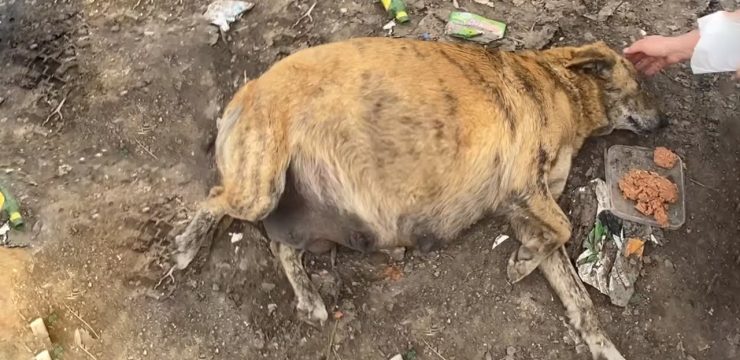
Every breath was a struggle. Juanita’s swollen belly had grown so large that the pressure inside her body made breathing difficult.

Abandoned and wandering the streets, she was exhausted, vulnerable, and in urgent need of help. People passed her by. Her suffering was visible, yet the care she needed had not arrived.
There is real sadness in seeing a dog who should be resting safely in a home trying to make it through another day. Juanita was carrying more than the burden of being alone. Fluid had collected inside her abdomen, stretching her stomach and pressing against her lungs. Even the basic act of breathing had become an ordeal. She could not explain what was happening or ask anyone to ease the pressure.
Her condition was not something a kind word or a little reassurance could fix. She needed medical attention, and she needed someone to recognize that her distress mattered. As pedestrians continued past her, the distance between what she needed and what she had seemed painfully wide. Yet her story did not end on those streets.
One compassionate person finally stopped and chose to help. That decision changed the direction of Juanita’s life. Instead of remaining alone with her swollen abdomen and labored breathing, she was taken to a veterinary clinic where professionals could respond to her condition. Rescue, in that moment, meant more than removing a dog from the street. It meant giving her access to the care she could not find on her own.
At the clinic, the urgent problem was the fluid filling her abdomen. The buildup was placing pressure on her lungs, leaving her struggling for air. The veterinary team performed fluid aspiration procedures to draw off the excess fluid and relieve that pressure. Juanita needed these procedures more than once. Her treatment was not a single simple gesture, but a series of medical efforts directed at helping her breathe more comfortably.
It is difficult to imagine how tiring those ordinary breaths must have been before she received help. Breathing is something most of us rarely notice until it becomes difficult. For Juanita, the ability to breathe without such pressure was a precious step toward recovery. The care at the clinic addressed the immediate physical burden that had left her so depleted.
Her progress came gradually. There was no reason to pretend that the exhausting condition she had endured could disappear from her story in an instant. What mattered was that she was receiving treatment and moving forward. Little by little, the dog who had been found in such distress began to regain her strength. Her recovery was not only about a swollen abdomen becoming less of a burden. It was also about having a chance to live more freely.
As Juanita became stronger, another side of her began to show. Beneath the exhaustion was a sweet, affectionate dog. She grew more active, welcomed affection, and wagged her tail again and again. Those changes offered a contrast to the image of her wandering alone, struggling for breath. The dog who had once needed urgent help was beginning to show the warmth and energy that had been hidden beneath her suffering.
A wagging tail cannot tell us everything a dog has experienced. But it can remind us how much room there is for joy when her breathing difficulties no longer dominate each moment. Juanita’s growing activity and affectionate nature gave the people caring for her a chance to know her as more than a patient. Her personality mattered just as much as her medical history. She was not defined only by the condition that brought her through the clinic doors.
Even with that encouraging progress, her caregivers understood the importance of recovery. The clinic arranged for Juanita to move into a foster home, where she could receive care in a loving environment while she grew stronger. It was another meaningful transition. The streets had offered her no dependable protection. Medical treatment had given her relief. Now a home could offer the steadiness and affection that are so important to a vulnerable animal finding her footing again.
Foster care is often described as temporary, but the kindness within it can have lasting meaning. It offers an animal space to recover while people learn who that animal truly is. For Juanita, the change was especially striking. The same dog who had once been visibly exhausted and struggling to breathe was becoming lively and joyful. Her transformation was something her foster family could witness.
And as they came to know her, affection grew into a decision. The family who had welcomed Juanita while she recovered fell in love with her. Rather than saying goodbye when the time came to consider her future, they chose to adopt her permanently. The foster home became her forever home. Juanita would not have to leave the people who had already made room for her in their lives.
It is a tender ending, made more meaningful by the difficult beginning. Juanita had once moved through public streets in obvious distress while others kept walking. Her swollen abdomen had made even breathing a challenge. Someone finally responded, veterinary professionals helped relieve the pressure, and patient care gave her strength the opportunity to return. From there, a foster family saw the joyful dog emerging and chose to keep loving her for good.
What makes Juanita’s story memorable is not that every hardship vanished without effort. It is that compassion led to practical help, and practical help opened the door to a better life. The rescue mattered. The medical procedures mattered. So did the commitment of a family willing to turn temporary care into a permanent promise.
Juanita was once an abandoned dog struggling for air. Now she is a beloved member of a family, with a home of her own. Her journey is a reminder that a life can change when someone sees suffering, refuses to look away, and makes room for love.