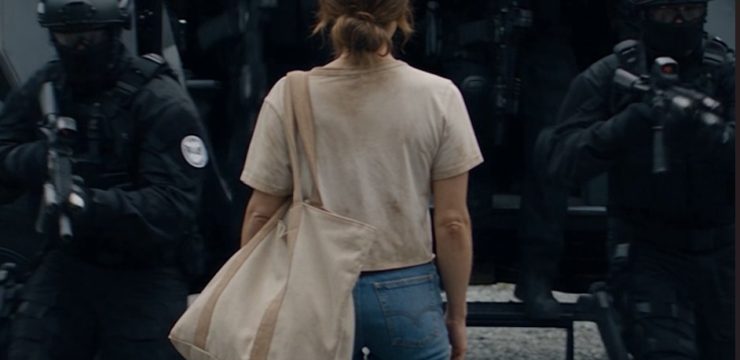
The scooter horn tore through the night like a scream ripping open the thick, humid air of the wet market. Lanterns swayed overhead, casting orange light across rows of steaming food stalls, and the crowd moved in its usual rhythm — until it didn’t.
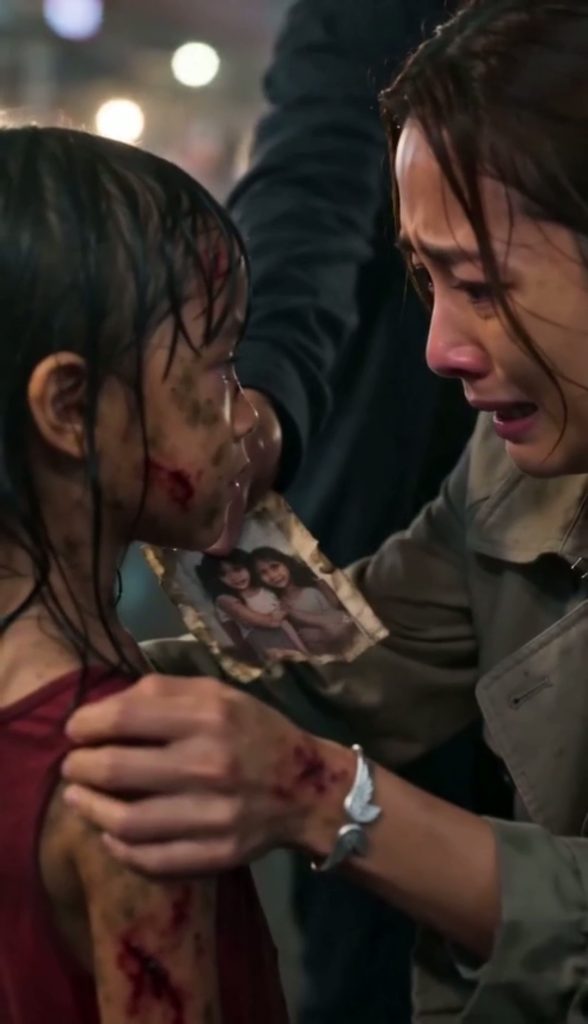
A tiny girl burst out from between two vendors, barefoot, her torn red dress soaked at the hem. She was running the way only a terrified child runs — arms wild, chest heaving, eyes already flooded with something beyond fear. She didn’t see the oncoming scooter. She couldn’t. She was too consumed by whatever she was fleeing.
The woman in the grey coat saw her with barely a second to spare.
There was no time to think. Only to move.
She lunged forward, her hand closing around the child’s thin arm, pulling her back so hard they both stumbled sideways into a nearby food stall. Paper cups scattered across the wet stone pavement. Steam curled up from a nearby grill, and the sharp smell of charred meat and rain wrapped around them like a curtain. For one suspended, breathless moment, the entire market seemed to hold still — the vendors, the shoppers, the lanterns, even the smoke — all of it frozen in the aftermath of what had almost happened.
The little girl looked up slowly.
Her eyes were enormous. Her bottom lip trembled. Her tiny chest rose and fell in uneven, rapid bursts as the reality of the near-miss began to settle over her like something cold.
Then the boy came.
He came running hard from somewhere deep in the crowd, his dirty backpack sliding off one shoulder, his face twisted with a fear so raw it looked like it belonged on someone much older. He threw himself between the woman and the girl without hesitation, one arm flung protectively across the child’s chest, planting himself like a wall.
“Don’t touch her!”
His voice cracked on the last word, but he held his ground.
The woman was still catching her breath, still feeling the echo of her own heartbeat loud in her ears. She looked at the boy’s face — young, pale, terrified — and then her gaze dropped to the little girl’s wrist.
And everything inside her stopped.
A bracelet. Cheap silver, worn thin with time. One wing was missing — snapped clean off somewhere along the years — leaving only half of what had once been a small, delicate angel charm.
Her throat tightened so fast she almost couldn’t breathe.
“That bracelet…”
Her voice came out in barely a whisper.
The little girl instinctively pulled her wrist back and pressed herself further behind the boy. But something made her pause — something she couldn’t have named — and she lifted her wrist just slightly, as if she couldn’t decide whether to hide it or let it be seen.
“It was my mom’s,” she said softly.
The woman didn’t speak.
Instead, she reached up slowly and pushed back the sleeve of her grey coat.
There, resting against her wrist on a delicate, old chain, was the other half.
A single silver wing.
Scratched in the exact same places. Worn down in the exact same way. As if both pieces had been made from the same breath, the same moment, the same quiet love — and then separated by something neither half had ever been able to understand.
The boy’s face drained of all color.
The little girl stared at both wrists — the woman’s, then her own — her young mind working through something it wasn’t yet equipped to hold. Confusion and fear and something else, something softer and more dangerous, moved across her face all at once.
The woman felt her knees weaken beneath her. She didn’t care about the wet pavement or her coat or the people around her. She crouched down slowly until she was at the child’s level, her eyes never leaving that small, broken bracelet.
When she finally spoke, her voice was fractured and quiet, like something that had been kept in a locked room for a very long time.
“I gave that bracelet to my baby sister.”
The market kept moving around them — lanterns, footsteps, laughter from somewhere far away — but it all felt like it belonged to a different world now.
The boy tightened his grip on the girl’s hand. He took one small, careful step backward, his eyes darting left and right, calculating, the way children do when they’re deciding between fight and flight and can’t afford to choose wrong.
Then he leaned slightly forward, his voice dropping low with something that sounded like it had been rehearsed out of pure survival.
“Then why did she say to run from you?”
The woman went completely still.
Every sound in the market seemed to fall away.
The little girl’s eyes filled with fresh tears. She didn’t run, though. Instead, she leaned forward just enough for the lantern light above them to catch the wet trails on her cheeks, and she looked directly at the woman — not with anger, not with hatred, but with the kind of grief only a child carries when they’ve been handed someone else’s unfinished story.
And in a voice barely above a breath, she said,
“Because you were the one in the photo.”