Nobody in that hallway was prepared for what happened next. Nobody could have guessed that a small child clutching a pink hair ribbon would be the only one telling the truth.
It started the way so many tragedies do — quietly, and in plain sight.
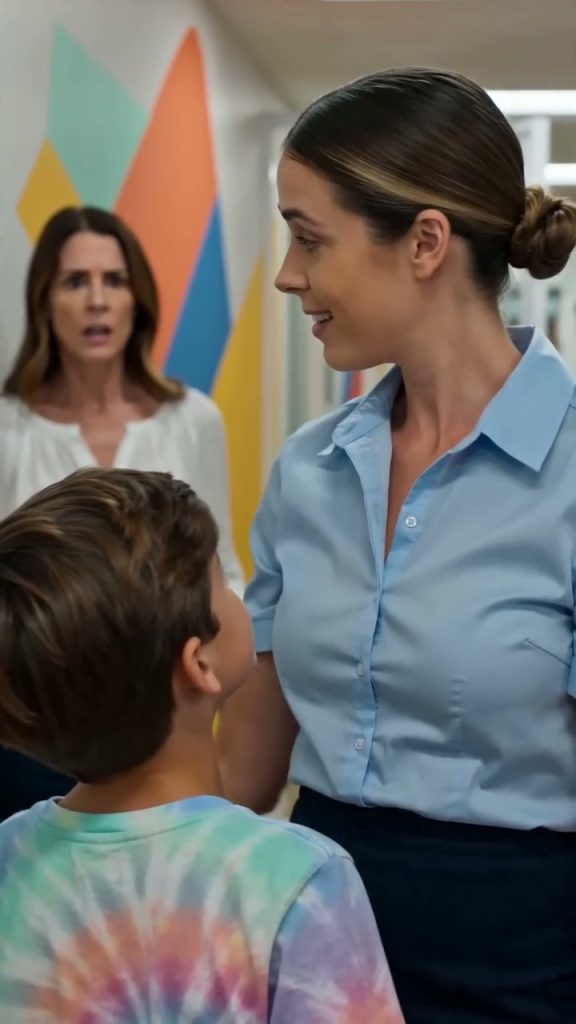
The little boy was being pulled away from the daycare gate, his sneakers dragging across the floor as a teacher gripped his arm with practiced patience. She wore the kind of smile that looked warm from a distance but never quite reached her eyes. Around them, parents moved in and out of the hallway, distracted by their phones, their errands, the ordinary rush of a Tuesday afternoon pickup.
But the boy wasn’t moving. Not willingly.
His fingers scraped along the metal gate as he was pulled backward, his knuckles white with effort. In his other fist, he clutched something small and pink — a tiny hair ribbon, the kind little girls wear on their first day of school. The kind a big brother might pull out of his pocket like it was the most important thing in the world.
Because to him, it was.
“My sister is inside!” he cried out, his voice cracking under the weight of panic no child should have to carry.
The teacher kept smiling. She leaned slightly toward the nearest parent and lowered her voice just enough.
“He’s making a scene.”
A few heads turned. A few parents glanced over with that particular look — the one that says poor thing without really meaning it, before turning back to their own business. Children cry. Children fuss at pickup. It happens every day.
But this boy wasn’t fussing. He was fighting.
He kicked his feet, sobbing so hard his whole body shook. The pink ribbon trembled in his fist. His face was red and wet, his chest heaving with every breath, and still he pointed back toward the closed classroom at the end of the hall.
“She can’t open it!” he screamed. “She’s stuck inside and she can’t open the door!”
The teacher reached for his hand again, gentle but firm, steering him away from the gate. She murmured something reassuring to the parents watching. Just nerves. First-week separation anxiety. He’d calm down once they got outside.
And then a young mother rushed through the front entrance, slightly out of breath, a lunchbox swinging from her hand. She had that look of someone running just a few minutes behind — the look of a parent who had already mentally rehearsed her apology for being late.
She froze the moment she heard his voice.
Not his words, exactly. His voice. The sound underneath the words. The sound of a child who has been screaming for a long time and hasn’t been heard.
“Where is my daughter?” she asked, and something in her tone cut through the noise of the hallway like a blade.
The teacher’s smile stretched just a little too tight.
“She went home,” she said. “Earlier.”
The boy shook his head so violently he could barely stay upright.
“No,” he gasped. “No — listen. Just listen.”
For one long, terrible moment, the entire hallway went still.
And then, from behind the locked classroom door at the end of the hall, came a sound so small and muffled it was almost nothing at all.
Almost.
“Mommy…”
The lunchbox hit the floor with a hollow clatter that echoed off every wall.
No one moved. No one breathed. Every parent in that hallway stood frozen, staring at that door, as the single word their worst nightmares were made of hung in the air between them.
The mother ran.
She covered the length of that hallway in seconds, her hands already reaching, already trembling before she even touched the handle. She grabbed it, twisted it, pulled with everything she had.
Locked.
She pressed her palm flat against the door and leaned close.
“Baby, I’m here,” she whispered, her voice breaking. “Mama’s right here.”
And then the most heartbreaking thing any parent in that hallway had ever seen: a set of tiny fingers appeared in the gap beneath the door. Small, pale fingers, reaching blindly into the light, searching for something familiar in the dark.
The mother dropped to her knees on the cold floor and pressed her own fingers against her daughter’s.
Behind her, the other parents had already gathered. Some were on their phones. Some were calling out to the teacher, demanding answers, their voices rising with urgency and disbelief. A few were already dialing.
And the teacher — the one with the practiced smile, the one who had called him dramatic, the one who had told a mother her child went home — the teacher quietly reached toward the wall.
Toward the fire alarm.
No one noticed until a father near the door stepped in front of her.
“Don’t,” he said. One word. Steady and cold.
The alarm stayed silent. The door was opened moments later by a staff member who arrived with a key, hands shaking. When the little girl stumbled out into the hallway, she went straight into her mother’s arms and didn’t let go.
She had been in there for a long time. Long enough to cry herself out. Long enough that her voice had gone hoarse. Long enough that she had lain down on the floor and pushed her fingers under the door, hoping someone — anyone — would see.
Her brother saw.
He had stood at that gate and screamed until his voice gave out and his legs gave way, and he had never once stopped pointing at that door. He was five years old, and he had known exactly what the adults around him refused to believe.
His sister was inside. She couldn’t get out. And he was not leaving without her.
Some children are too young to understand the world. And some children understand it far better than the grown-ups who are supposed to protect them. That little boy with the pink ribbon in his fist didn’t need a title or a uniform or a name tag on a lanyard to know what the right thing to do was.
He just needed someone to listen.
They almost didn’t. And that is the part that should stay with all of us — long after the door is opened, long after the little girl is home safe, long after the hallway empties out and the lights go off.
Someone almost didn’t listen.
Next time a child is screaming and the adults are walking away, stop. Kneel down. Ask what’s wrong. Because sometimes the smallest voice in the room is the only one telling the truth.