The subway platform was crowded in the way big-city platforms always are — bodies pressed close, eyes fixed on phones, minds somewhere far away from the present moment. Nobody was paying attention to anyone else. That’s just how it goes in places where strangers are forced to share the same small slice of concrete, day after day. You learn to look past people. You learn to stop seeing.
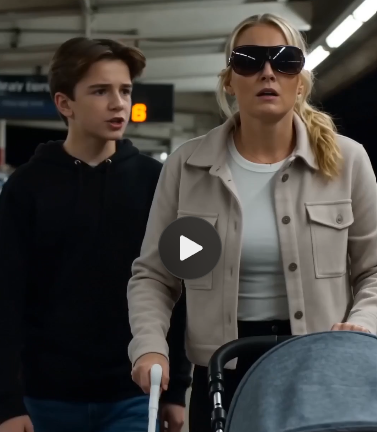
But one little boy hadn’t learned that yet.
He stood near the yellow safety line, small and quiet, wearing a jacket that had seen better days. His sleeves were worn at the elbows, his shoes scuffed beyond recognition. He looked like a child who had grown up fast, the kind of kid who notices things that grown-ups stopped noticing long ago. And on that platform, he noticed her.
A woman was standing too close to the edge — a blind woman, one hand resting on a white cane, the other wrapped tightly around the handle of a baby stroller. She was alone in the most vulnerable way a person can be alone — surrounded by dozens of people who weren’t really there with her. The baby inside the stroller gurgled softly, completely unaware of anything. The mother tilted her head slightly, listening for the train.
The boy watched her.
He watched the way the crowd shifted and jostled, nudging her closer to the edge without meaning to. He watched the way she adjusted her footing, tried to find balance, tried to stay safe. He watched the stroller wheels inch toward the platform edge. And when he realized that nobody else was going to do anything — not the businessman in the expensive suit, not the young couple wrapped up in each other, not the group of teenagers laughing too loudly near the column — he opened his mouth.
“Ma’am, you’re too close!”
His voice cracked on the last word. It wasn’t a commanding voice. It wasn’t the voice of someone who expected to be listened to. It was just a child trying to be heard in a noisy world.
And then the train roared into the station.
What happened next unfolded in seconds, but it felt like something longer — the kind of slow-motion horror that your mind records in perfect detail because it knows you’ll never forget it. The rush of air that preceded the train caught the edge of the stroller. The blind woman startled. Her grip shifted. The stroller lurched.
The transit worker on duty didn’t think. He moved.
His arm stretched over the platform edge, one hand locking around the stroller handle, his shoes sliding against the floor as momentum and gravity fought over that tiny cart and the precious life inside it. He was pulling with everything he had, and it wasn’t enough — not quite — not yet.
Then the little boy grabbed the back of the worker’s jacket and pulled.
It wasn’t strength. It was pure, desperate heart.
And the rest of the platform finally woke up.
Two men caught the worker’s legs. A woman wrapped her arms around the blind mother. For one terrible, breathless second, the stroller tilted toward the tracks — and then the worker pulled harder, the boy held tighter, and the stroller rolled backward just as the train screamed past.
The baby began to cry.
The sound of it — that startled, frightened wail — cut through the crowd like a knife through silence. People who had been frozen finally exhaled. Someone gasped. Someone else pressed a hand to their mouth. The blind woman collapsed to her knees right there on the platform, her cane clattering to the ground, her hands reaching blindly until they found the stroller, until she could feel that her daughter was safe.
“My baby,” she sobbed, and the words cracked open something in everyone who heard them.
The boy stood beside her, shaking so hard his thin little shoulders trembled. He didn’t say anything. He didn’t know what to say. He just stood there because standing there felt like the right thing to do.
The teenager who had been laughing moments before had gone pale with shame. He lowered his head and didn’t lift it.
The transit worker sat down on the platform floor, breathing in ragged pulls, one hand still gripping the stroller handle like he was afraid that if he let go, something would still go wrong. His uniform was disheveled. His face was flushed. He looked like a man who had just run a race that no one had signed him up for.
The blind woman found his sleeve through her tears. She touched it gently, the way you touch something you’re grateful for.
“You saved her,” she whispered.
The worker looked at the boy.
“No,” he said softly, his voice rough at the edges. “He saw what everyone else ignored.”
The boy wiped his eyes with his dirty sleeve. He wasn’t crying dramatically. He was crying the way children cry when something frightens them deeply and they don’t fully understand why their body is reacting that way.
“I just didn’t want her to fall,” he whispered.
And the whole platform went quiet.
Not the distracted, disconnected quiet of people staring at their phones — but the rare, sacred quiet of people who have just been reminded of something they thought they’d lost. Something about human beings. Something about what we owe each other, even among strangers, even on a crowded platform, even on an ordinary Tuesday when nobody is paying attention.
A little boy in a worn jacket had been paying attention.
He had spoken when everyone else had gone silent. He had acted when everyone else had turned away. He had no power, no authority, no special training — only eyes that still chose to see and a heart that still chose to care.
And in the end, that was everything.
The smallest voice on that platform had carried the loudest warning. And it had saved a life.