She had worked the same diner for over thirty years.

Same apron. Same worn-out shoes. Same cracked hands that carried plates through the morning rush and the quiet of slow afternoons. Her name wasn’t on any sign. She wasn’t anyone’s hero. She was just a woman who showed up, day after day, and did her job with the kind of quiet dignity that most people walk right past without noticing.
That was exactly the problem. Most people walked right past her.
But not everyone.
On a cold, rainy evening many years ago, long before the wrinkles had deepened around her eyes, she had stepped out the back door of the restaurant to toss out the trash. The alley behind the building was dark and smelled of wet pavement. She almost didn’t see him.
A boy. Small. Thin. Huddled beside the dumpster with his knees pulled to his chest, trying to make himself invisible. His clothes were soaked through. His eyes, when they finally met hers, were hollow in the way that only hunger and loneliness can make a child’s eyes look. He wasn’t asking for anything. He had already given up on asking.
She didn’t think twice.
She went back inside, wrapped up the bread that was meant to be thrown away, added whatever else she could quietly set aside, and brought it out to him. She didn’t make a scene. She didn’t call anyone. She didn’t take a photo or tell the story at the dinner table that night. She just handed a cold, frightened child something warm to eat and made sure he knew, even without words, that he mattered.
Then life moved on, the way it always does.
She forgot, not because she was heartless, but because that was simply who she was. Helping others was not an event for her. It was just something you did. You saw a person in need, and you helped. There was nothing more to remember.
Decades passed.
The diner changed hands a few times, but she stayed. The neighborhood shifted, the menu evolved, new faces came and went, but she remained. She was the constant. The woman who knew where everything was, who remembered how the regulars took their coffee, who never once made a customer feel invisible.
On an ordinary afternoon, a well-dressed man walked in and sat down at one of her tables.
There was nothing unusual about him at first. He ordered quietly, thanked her when she brought his water, and seemed lost in thought. She assumed he was just another businessman passing through.
But then he looked up at her, and something in his expression stopped her cold.
He was staring at her the way people stare when they’re trying to hold themselves together. His jaw was tight. His eyes were filling with something she couldn’t name at first.
Then he spoke.
“I’ve been looking for you for a long time,” he said softly.
She tilted her head, uncertain.
He told her about the alley. About the rain. About being a child with nothing and no one, sitting in the dark behind this very building, certain that the world had no use for him. He told her how she had come out with bread and sat near him just long enough for him to feel human again. He told her how that single moment had pulled him back from an edge she would never fully understand.
And then he told her what came after.
He had found his footing, slowly and painfully, the way people who survive hard childhoods sometimes do. He had worked, studied, failed, tried again, and eventually built something real. A career. A company. A life that, on the outside, looked nothing like that rainy alley.
But he had never let go of that night.
He had carried it with him through every difficult year as proof that one person’s kindness could reach a child in the dark and actually change the direction of a life. He had come back because he needed her to know that her bread hadn’t just fed him. It had told him he was worth saving.
The restaurant went completely silent.
The other diners, who had been half-listening the way you do in a small space where voices carry, had stopped everything. Forks rested on plates. Conversations trailed off. Nobody moved.
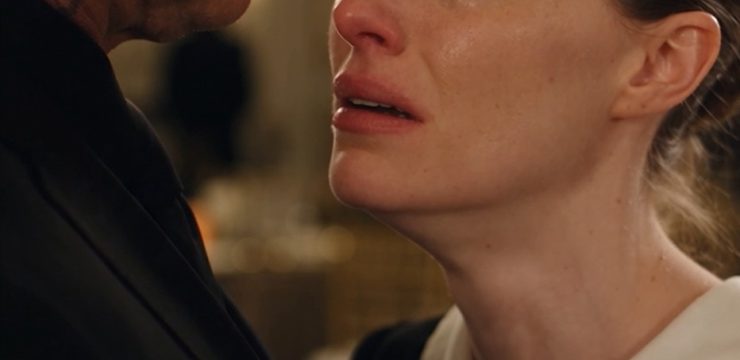
She was trembling by then, one hand over her mouth, tears sliding quietly down her face. She tried to speak. She managed only a whisper.
“I only gave you bread.”
He shook his head, and his voice broke just slightly at the edges.
“No,” he said. “You gave me kindness when the rest of the world gave me nothing. And I have spent years trying to figure out how to give that back to you.”
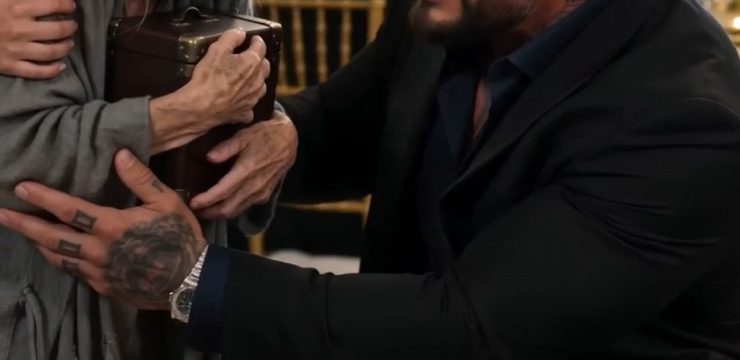
He reached into his coat and pulled out a set of keys.
He took her shaking hands in his and placed them gently in her palm, folding her fingers around them. She looked down, not understanding. He smiled through his tears and told her she would never have to work another day in her life, because the place she had shown up to faithfully for over thirty years was hers now.
She couldn’t stand.
Her legs gave out, and she sank slowly, and he caught her gently as the whole room held its breath. She wept into her hands with the kind of release that only comes when something carried silently for a lifetime is finally, fully seen.
The guests around them didn’t applaud. They didn’t need to. Some wiped their eyes. Some simply sat in the stillness of what they had just witnessed.
Because they understood, in the way that anyone over a certain age understands, that the rarest thing in this world is not money or success or recognition.
It is the moment when a small act of goodness, given freely and without expectation, finds its way home.
She had given a hungry child a piece of bread on a rainy night and thought nothing more of it.
He had built an entire life trying to be worthy of it.
And on that quiet afternoon, in the diner where it all began, the two halves of that story finally met.