The cane slipped from his hand before anyone could stop it.

The sound it made when it struck the marble floor wasn’t loud, not really, but it cut through the lobby like a knife through silk. Everyone heard it. Everyone turned.
The little girl flinched.
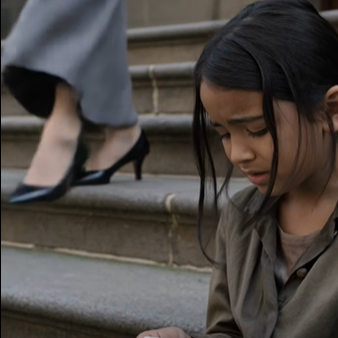
She had been standing there for nearly ten minutes, clutching a manila envelope to her chest, her coat streaked with dirt and her knees still raw from where she had fallen outside on the front steps. She looked like she expected to be yelled at, the way children do when they’ve learned early that the world raises its voice before it opens its arms.
But the old man wasn’t looking at her anymore.
He was looking through the glass wall at the woman in the corner office.
“Margaret.”
His voice was barely above a whisper, but it carried the full weight of a man who had built something enormous and suddenly suspected it had cost him everything.
The executive froze. Her shoulders tightened almost imperceptibly before she slowly turned back toward the lobby. Her face was composed, practiced, the face of a woman who had managed crises for thirty years without flinching.
The little girl’s voice rose above the silence. “Mom said a woman always answered when she called.”
The CEO’s breathing shifted. Something moved across his face, not quite anger and not quite grief, but the specific expression of a man who is beginning to understand that he has been living inside a lie someone else constructed for him.
“What woman?” he asked.
The girl looked at the glass wall. “That one.”
The lobby went completely silent.
Margaret walked out with a calm face, but her hands told a different story. One thumb pressed continuously against her ring, over and over, as though she could hold herself together through sheer physical pressure.
“She’s mistaken,” Margaret said.
The girl shook her head slowly and reached back into the envelope. She pulled out something old, something cracked and wrapped in a thin layer of plastic, preserved the way people preserve things they consider sacred.
A voicemail card.
“My mom kept this until the very end,” the girl said softly.
The CEO took it from her with fingers that were not steady. The security guard near the entrance stepped back without being told. No one moved toward the child now. Something in the room had shifted, and even people who didn’t fully understand what was happening could feel it.
The old man pressed play.
A woman’s voice filled the lobby. Weak. Older than he remembered. Tired in the particular way that years of loneliness make a person tired.
“Dad… it’s me. Please don’t hang up. I know you’re angry, but I had the baby. Her name is Lily.”
He closed his eyes.
His daughter’s voice. Still alive in a recording. Still reaching for him across years he had spent believing she had walked away by choice.
The message continued.
“I came to the building. Margaret said you refused to see me.”
The old man’s eyes opened.
Margaret’s face drained of color.
The little girl stood completely still, tears falling silently onto her dirty coat.
The recording crackled once more before the final words came through.
“She said if I loved my daughter, I should disappear before your name destroyed her.”
He turned toward Margaret then. Not with fury, not with the explosive anger of a man betrayed, but with something quieter and far more devastating.
“You told me she wanted money.”
Margaret’s lips trembled for the first time. “She would have ruined everything.”
He looked at Lily. At her muddy knees. At the hospital bracelet still clasped around her small wrist. At this granddaughter who had found her way across his marble floors because every adult who should have opened a door above her had instead kept it firmly shut.
Lily’s voice was barely audible. “Mom said you had kind eyes before money made people afraid of you.”
That was the moment that broke him.
He sank to his knees right there in the lobby, in front of the suits and the security cameras and every person pretending not to watch. The marble was cold. He didn’t care.
“I called every birthday,” he whispered. “I thought she never answered.”
Lily reached into the envelope one final time and placed a single sheet of paper into his hands.
A printed list.
His calls. His numbers. His attempts, stretching across years, all blocked before they could reach her. All hidden. All stolen from two people who had been made to believe the other had stopped caring.
He looked up at Margaret from his knees. His grief had burned down into something quiet and irreversible.
“You didn’t protect the company,” he said. His voice shook, but the words were clear. “You buried my daughter outside it.”
Lily began crying harder. “I don’t have anywhere to go.”
He reached toward her slowly, carefully, giving her the choice. His hand extended, palm up, not demanding anything.
She stared at it for a long moment, the way children stare at something they want desperately but have been taught not to trust. Hope, when it arrives after a long absence, can look dangerous.
Then she placed her small, dirty fingers inside his.
And the man who had spent decades building an empire finally understood that the only person who truly belonged inside it had arrived at his door on her knees, carrying her mother’s voice in a cracked piece of plastic and the last of her courage in a manila envelope.
Some things cannot be delegated. Some losses cannot be recovered with a phone call or a signature.
But some doors, even the heaviest ones, can still be opened by the smallest hands.