Marie was eight months along when the pain hit her like nothing she had ever felt before. It wasn’t the usual aches and pressure that come with carrying a child close to term. This was something different — sharp, relentless, and frightening. She could barely pull herself out of bed that morning. Her stomach tightened in waves, each one worse than the last, and by the time she reached for her phone to call for help, her hands were already trembling.
Her husband, David, was out of town on a business trip. He couldn’t get back in time. And so, as the ambulance made its way to their home, Marie was not alone in the way most people fear being alone. She had Bruno.
Bruno was their German Shepherd — loyal, attentive, and deeply bonded to Marie throughout her entire pregnancy. From the very beginning, he had been her quiet companion through every difficult night and every moment of uncertainty. He would lie beside her bed each evening without being asked. When the baby moved, Bruno would lift his head and stare at her belly with an expression that seemed almost too knowing for an animal. He wagged his tail slowly, as if he understood that something precious and fragile was growing inside her.
When the paramedics arrived and began moving Marie to the stretcher, Bruno would not stand still. He circled the stretcher anxiously, whimpering in a way that made one of the paramedics pause and say quietly, “That dog really loves her.” No one disagreed.
At the hospital, doctors examined Marie carefully. They ran tests, drew blood, connected her to monitoring equipment, and began working to identify the source of her severe pain. While waiting for results, they prescribed medications to help stabilize her condition and keep her comfortable. At Marie’s gentle request, the hospital staff made an exception — they allowed Bruno to remain beside her in the room for a short while.
The dog settled near her bed without making a sound. He rested his head low, watching her face, and for the first time since the morning chaos began, Marie felt something close to calm. Bruno seemed calmer too. It was as though just being near her was enough for him.
Then the door opened.
A doctor entered carrying a tray with a syringe and medication. He moved with the quiet confidence of someone who had performed this routine a hundred times before.
The moment the doctor stepped into the room, Bruno’s entire body changed.
His ears went rigid. His eyes locked onto the man with an intensity that was impossible to ignore. He rose slowly to his feet, never blinking, never looking away. Marie noticed immediately.
“What’s wrong, Bruno?” she asked softly.
The doctor approached the bed. “We’re going to give you an injection now. You should start feeling much better after this.”
Bruno barked.
Once. Then again. Then louder, with an urgency that filled the room and made everyone stop what they were doing.
Marie tried to soothe him. “Bruno, it’s okay. He’s helping me. Go lie down.”
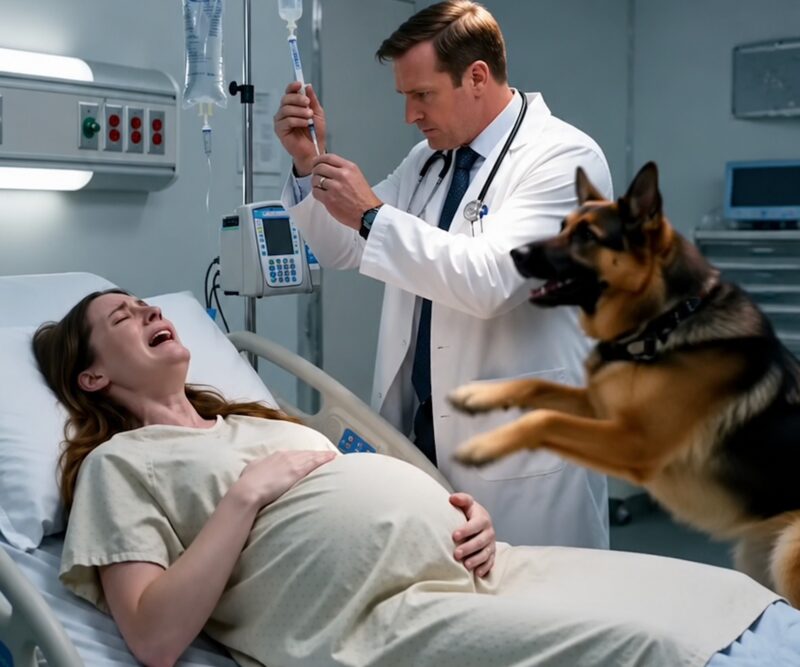
But Bruno did not lie down. He stood his ground between the doctor and the bed, barking with a desperation that made the hair on the back of your neck stand up. The doctor offered a patient smile. “He’s probably just reacting to the syringe. Animals do that sometimes. Nothing to worry about.”
He lifted the syringe and leaned toward Marie’s arm.
What Bruno did next stunned everyone in that room.
In one swift, powerful motion, he leaped up and placed both front paws on the doctor’s shoulders, barking directly into his face. The doctor stumbled backward in shock. The syringe nearly fell from his grip. Nurses rushed in from the hallway. Someone shouted. Someone else moved to pull Bruno away from the room.
The doctor, rattled and visibly frustrated, said firmly, “The dog needs to be restrained. This cannot continue.”
And then the door flew open a second time.
A young nurse rushed in, pale as a sheet, breathing hard, her eyes wide with alarm.
“Stop!” she cried. “Don’t give that injection!”
Every person in the room froze.
She looked at the syringe, then looked at Marie, and her voice shook as she spoke. “We made a mistake. That medication was prepared for a completely different patient. It should never be administered to a pregnant woman. The consequences for both the mother and the baby could have been devastating.”
Silence fell over the room like a heavy curtain.
The doctor slowly lowered his hand. He had gone pale. No one spoke for what felt like a very long time.
Marie sat in her hospital bed feeling a cold, deep shudder move through her entire body. She turned and looked at Bruno. He was standing beside her now — calm, steady, watching her face the way he always did. The frantic energy was gone. He seemed satisfied, as though whatever threat he had sensed had finally passed.
She reached out and pulled him close, burying her face against his neck.
“You saved us,” she whispered. “You saved us again.”
Even the doctor, still visibly shaken, walked over to the dog and placed a hand gently on his head. “If he hadn’t stopped me,” the man said quietly, “today could have gone very, very differently.”
Nobody in that hospital could explain what Bruno had known or how he had known it. There was no scientific answer that fit neatly into the moment. But for Marie, there was no mystery at all.
The ones who love us most — the ones who have watched over us through every quiet night and every frightening morning — sometimes sense the danger that we cannot see. They don’t need words to warn us. They just act. And sometimes, that is enough to save a life.
Bruno was never just a dog to Marie. He was her guardian. And on that day, he proved it in the most extraordinary way imaginable.