Some betrayals are so unthinkable that when you hear them, you have to pause and ask yourself: how does a person reach that point? How do you look at your own father — the man who gave you everything — and see nothing but a dollar sign? This is one of those stories. And before it’s over, it will remind you that no matter how carefully evil is planned, the truth has a way of surfacing.
Viktor had spent the better part of his life building something from nothing. A self-made businessman with calloused hands and an iron work ethic, he constructed a thriving company that provided his family with a life most people only dream about. His children, Michael and Elena, never went without. They attended prestigious universities, wore designer clothes, drove luxury cars, and lived in homes that most working Americans would spend a lifetime trying to afford.
Then Viktor suffered a devastating stroke.
Overnight, the man who had carried his family on his back was confined to a wheelchair, dependent on nurses and around-the-clock medical care. The company he had poured his soul into was sold. The dynamic, commanding father his children had always known was now silent and still — but mentally, Viktor remained completely sharp. His body had failed him. His mind had not.
What he began to notice over the following months broke his heart far more than any medical diagnosis ever could.
His children started visiting more frequently, but their questions had changed. They no longer asked how he was sleeping or whether the physical therapy was helping. Instead, they asked about paperwork. Insurance documents. The will. Beneficiaries. Legal arrangements. Viktor was a man of experience and intuition, and something deep in his chest told him that the people he had sacrificed everything for were now calculating how much his death would be worth.
He was right.
Michael had stumbled across a life insurance policy Viktor had taken out years earlier — a policy worth ten million dollars, with an accidental death clause that would pay the full amount to his children as beneficiaries. For a man drowning in failed investment debts and a woman on the verge of losing her home to overdue loans, that number was intoxicating. What began as a whispered conversation between siblings slowly hardened into something unforgivable.
They convinced themselves it was almost merciful. Their father would never walk again. His quality of life was limited. The money would solve everything. Conscience, when you water it down enough with desperation and greed, has a way of going very quiet.
They chose a scenic stretch of coastal cliffs for what they called a family outing.
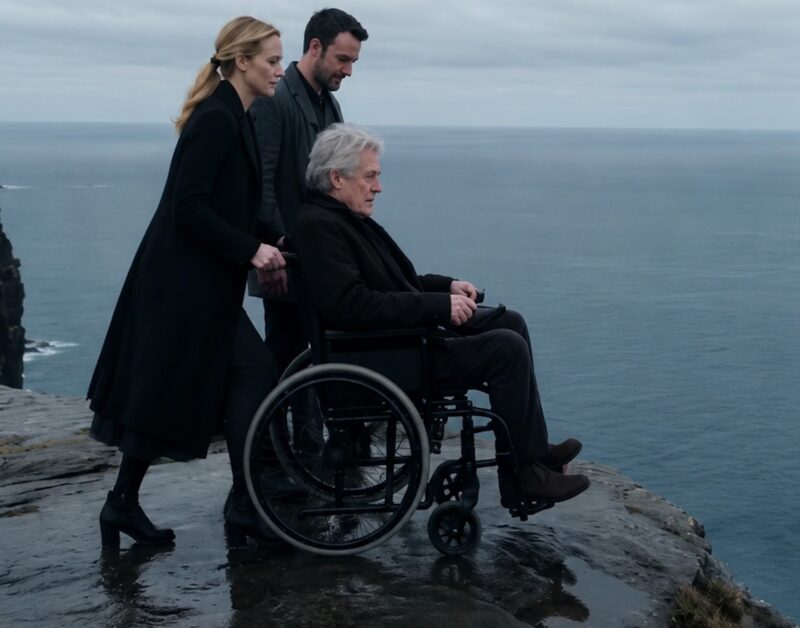
The day was overcast and cold. Heavy clouds pressed down over the ocean, and a sharp wind cut through the air as Michael and Elena wheeled their father to a viewing platform near the cliff’s edge. For a moment, all three of them stood together looking out at the gray water below — a father and his children, a family portrait frozen in time just before it shattered completely.
Viktor sensed something was wrong. He asked quietly what was happening.
No one answered.
Together, Michael and Elena pushed the wheelchair forward. It rolled over the edge. Viktor — helpless, strapped into his chair — disappeared into the drop below.
What the siblings could not have anticipated was that a dense thicket of bushes had grown along a rocky ledge partway down the cliff face. Viktor’s wheelchair became tangled in the brush, dramatically slowing his fall. He was badly injured. But he was alive.
And there was something else they had not anticipated.
Weeks before the trip, Viktor had quietly taken steps to protect himself. Guided by a trusted attorney and old friend, he had rewritten both his will and his insurance policy. The new terms were precise: if there was any suspicion or evidence that his beneficiaries had contributed to his death, every insurance payment would be voided immediately. The full sum would instead be transferred to a charitable organization supporting stroke survivors.
He had also mounted a small, discreet camera to his wheelchair — one that recorded audio and video of everything around him. He told no one.
When rescue teams recovered the damaged wheelchair from the cliff, the camera was still intact. The footage captured everything. The conversation the siblings had near the edge. The moment they pushed him. The deliberate, calculated nature of what they had done.
What had been staged as a tragic accident was now a criminal investigation.
Michael and Elena were arrested while in the middle of filing their insurance claim — as if the universe itself had waited for the most perfectly ironic moment to intervene.
The trial that followed was damning and swift. The camera footage left no room for doubt. Both were convicted. They lost not only any right to the insurance money but also every cent of their inheritance. Viktor’s will ensured that upon his death, his entire estate would be donated to charity — not a single dollar would pass to the children who had tried to take his life.
Viktor survived his injuries and lived to see justice served.
There is something deeply human about this story that goes beyond the crime itself. It’s about what happens when love is replaced by calculation, when a parent becomes nothing more than an obstacle between their children and a payout. Viktor had given Michael and Elena the world. And when he needed them most, they tried to take his.
But he had never stopped being the sharpest person in the room.
Some people spend their lives building wealth, only to discover too late that they forgot to build character in the ones they left it to. Viktor’s story is a reminder — a sobering, gut-wrenching one — that greed doesn’t just destroy the people it targets. It destroys the ones who give in to it.
And sometimes, the cliff you push someone else toward turns out to be the one you fall from yourself.