Some people believe that power gives them the right to say whatever they want, to whoever they want, in whatever language they choose. They assume the person standing in front of them — someone in a uniform, someone holding a mop, someone doing the quiet, invisible work of keeping the world running — simply doesn’t matter enough to deserve basic respect. This is a story about what happens when that kind of arrogance meets something it never saw coming: dignity.
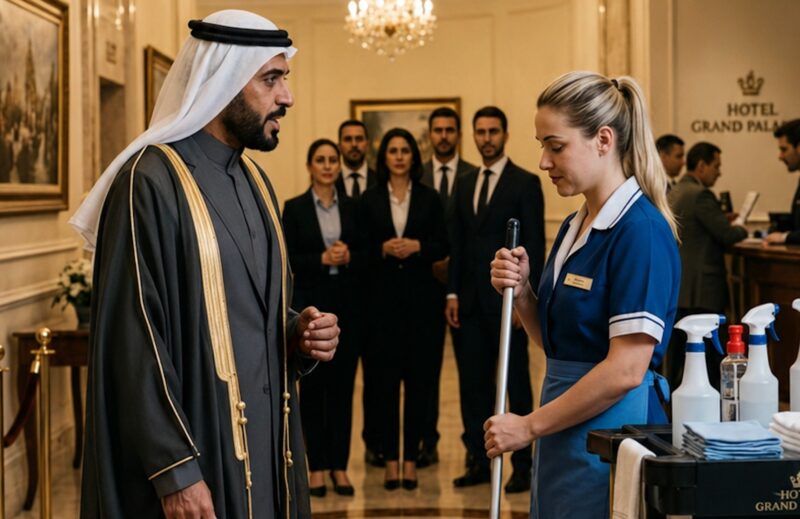
Sheikh Omar was not the kind of man people ignored. When he walked into a room, assistants straightened their posture. When he made a request, staff moved quickly. He had reserved the entire top floor of one of the most prestigious hotels in the city, and from the moment he arrived, every employee understood one thing clearly — do not make mistakes around this man.
He rarely smiled. He spoke to staff with a coldness that made even seasoned hotel veterans nervous. The receptionists triple-checked every detail. The waiters whispered reminders to each other about his preferences. The hotel manager personally walked the floor each morning to make sure nothing — not a single thing — would give Sheikh Omar a reason to complain. In three days, not one person had heard him say a kind word to anyone on staff.
On the morning everything changed, Omar was heading downstairs to meet with foreign business partners. He was already tense, already impatient, flanked by his assistants and the hotel manager as he moved through the corridor toward the elevator.
Emma was there too.
She was young, only a few months into her job at the hotel, but already well-regarded by management. She was dependable, quiet, professional — the kind of employee who gets things done without drawing attention to herself. That morning, she was finishing up the hallway near the elevator, pulling her cleaning cart behind her.
Then it happened. One of the cart’s wheels caught on the edge of the carpet. Emma pulled, the cart lurched, and a bottle of water toppled off the top and hit the marble floor. A few small drops splashed onto Sheikh Omar’s shoes.
“I’m sorry, sir,” Emma said immediately, already moving to wipe the floor. “I’ll take care of it right away.”
She bent down. Omar stopped her.
“Do you even watch what you are doing?” His voice was sharp, cold, and loud enough for everyone in the corridor to hear.
Emma looked up calmly. “It was an accident. I’m sorry.”
But an apology wasn’t what Omar wanted in that moment. The meeting ahead had already put him on edge, and this small inconvenience was the final spark. He began scolding her openly — loudly — in front of her colleagues, in front of the manager, in front of his own assistants.
The manager stepped forward. “Sir, we will certainly take care of this—”
Omar raised one hand. The manager went silent.
And then the sheikh did something he clearly believed was safe: he switched to Arabic.
He was absolutely certain that no one around him understood. So he let go of any remaining restraint. He called Emma a worthless servant. He used words that had no place in any language, in any setting — words designed purely to humiliate. His assistants heard every syllable and understood every word, but not one of them dared to speak. Omar continued, even smiling slightly at the confused expressions on the faces of the hotel staff around him.
Emma stood still. She kept her eyes down. Her hands tightened around the handle of the mop.
The manager, sensing the tension without understanding the words, was about to quietly ask Emma to step away so the situation could end. He opened his mouth.
But Emma moved first.
She set the mop gently against the cart. She straightened up. And she looked Sheikh Omar directly in the eyes.
Then she spoke — in flawless, confident Arabic.
“I thought that in your country, it was not customary to speak to a woman with such words. And I believed you were a man of honor who would never lower himself to this kind of insult. Forgive me if I upset you.”
The corridor went absolutely still.
The smile vanished from Omar’s face.
His assistants stared at the young woman as if the floor had shifted beneath them. Even the hotel manager — who didn’t understand a single word of Arabic — could see from Omar’s expression alone that something entirely unexpected had just occurred.
Several long seconds passed before the sheikh found his voice.
“You… speak Arabic?”
“Yes, sir,” Emma replied, switching back to English without missing a beat. “I lived in Dubai for several years with my family. My father worked as an interpreter. I know the language very well.”
The weight of those words landed fully. Omar now understood exactly what had happened. This young woman — the one he had chosen to belittle in front of a hallway full of people — had heard and understood every single word he said.
He looked around at the faces watching him. Just moments ago, he had believed he was demonstrating his power. Now, he was the one standing in it, surrounded by it — not his power, but his own shame.
Emma quietly picked up a cloth, wiped the last drops of water from the floor, and said softly, “Once again, I apologize for the inconvenience.”
She reached for the cart handle.
“Wait,” Omar said.
She stopped.
He looked at her for a long moment — this young woman who had every reason to be angry, every right to embarrass him the way he had tried to embarrass her, and who had chosen not to.
“You should forgive me,” he said quietly. “I should not have spoken that way. In any language.”
The staff exchanged glances. In three days, not one person had heard Sheikh Omar apologize to anyone for anything.
What stayed with him wasn’t just that a hotel maid spoke Arabic. It was something far more powerful than that. She had been publicly humiliated, and instead of striking back with the same weapons he had used, she had simply held her ground — calm, composed, and utterly dignified.
With one quiet sentence, she hadn’t just defended herself.
She had made a powerful man feel the full weight of his own words.
And that is something no title, no wealth, and no hotel suite can protect you from — the mirror of your own character, held up by someone you thought didn’t matter.