The military cafeteria was alive with the familiar sounds of midday — hundreds of soldiers filling every corner of the massive hall, metal trays clattering against tables, conversations bouncing off concrete walls. For most of the men and women seated in long rows that afternoon, it was simply another routine lunch break. A moment to rest, to eat, to breathe between the demands of military life. Nobody expected anything out of the ordinary. Nobody could have imagined what was about to unfold before their eyes.
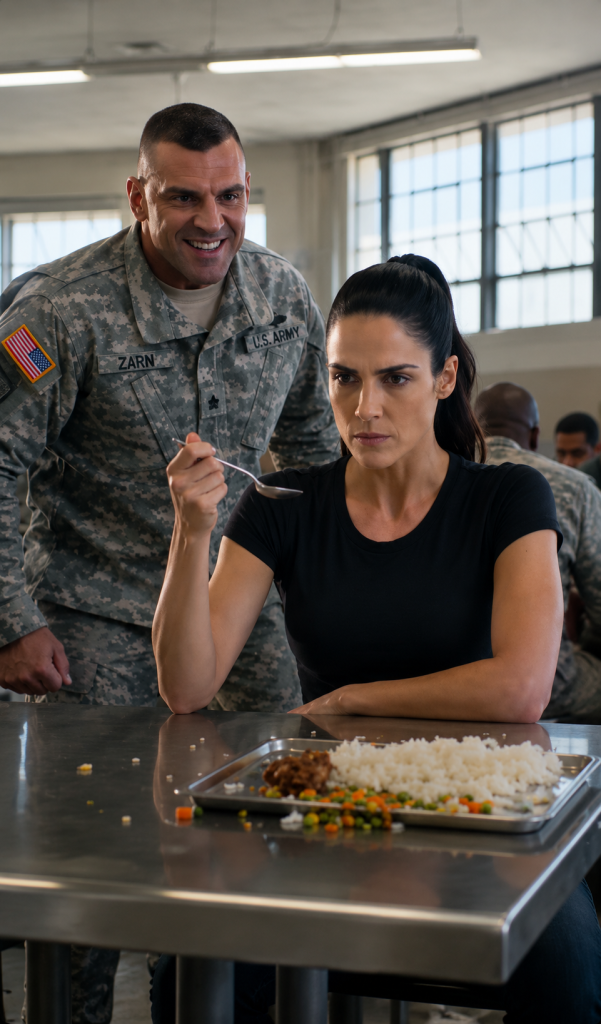
Sergeant Brock Turner sat near the center of the room, impossible to miss. Standing six-foot-five with a build that made walls look narrow, he occupied space the way a storm does — loudly, completely, and without apology. For months, this man had made life miserable for those around him. He stole seats from younger soldiers without a word of explanation. He started fights over nothing. He singled out anyone who seemed too quiet, too nervous, or too inexperienced to push back. And every single time, nobody stopped him. Nobody even tried. Because in that cafeteria, in that base, Brock Turner was the kind of man people simply avoided — and hoped would never notice them.
That afternoon, his eyes landed on a woman sitting alone near the back wall.
She wore a simple military uniform and a dark jacket. She wasn’t talking to anyone. She wasn’t looking around the room. She was just sitting there, quietly eating her lunch, completely unbothered by the noise surrounding her. There was a stillness about her that most people would have recognized as confidence — the kind that doesn’t need an audience. But Brock didn’t see confidence. He saw an easy target.
He grabbed his tray and started walking toward her.
The soldiers nearby noticed immediately. Whispers traveled down the rows. Eyes darted nervously toward the back wall. Everyone in that cafeteria knew what was coming, and not one of them raised their voice loudly enough to stop it. The giant sergeant stopped beside her table. She didn’t look up. That alone seemed to irritate him.
“You sitting here alone?” he asked.
She said nothing.
Brock laughed — the kind of laugh that fills a room — and then, without warning, his arm swept across the table. The lunch tray went airborne. Rice, vegetables, and soup scattered across the floor in every direction. The cafeteria fell completely silent in an instant. Every conversation died. Every head turned.
The woman looked up slowly.
There was no anger on her face. No panic. No tears. Just a calm, steady gaze that somehow unsettled the sergeant far more than any raised voice would have. He leaned forward, smirking, and pointed at the mess on the floor.
“Clean it up,” he said. “Then get out.”
A few soldiers laughed nervously. Others stared at their trays.
The woman stood up without rushing. Still saying nothing. Brock pointed at the scattered food again, louder this time.
“You deaf?”
She looked at him evenly and spoke for the first time. Her voice was quiet — not weak, not shaking. Just quiet and completely certain.
“Walk away.”
The cafeteria froze. Nobody spoke to Brock Turner like that. Nobody ever had. His face darkened with something between rage and humiliation, because hundreds of eyes were watching, and this woman — this quiet woman eating lunch alone — had just told him to walk away.
He threw the first punch.
It was fast. It was violent. It was absolutely confident. And it hit nothing but air.
In the space of a single breath, the woman moved. One clean step. One precise dodge. Brock’s fist cut through empty space, and the sheer momentum of his swing sent him stumbling forward. The cafeteria gasped as one. Before he could recover, a sharp counterstrike connected with his shoulder and sent him staggering sideways. Confused. Disoriented. Because in all his years of intimidating people, nobody had ever moved like that.
He charged again — angrier, harder, more desperate than before. And again, the woman moved. She didn’t chase him. She didn’t yell. She simply responded to every attack with a precision that made the whole thing look almost effortless. A strike to the ribs. A sweep to the leg. A sharp elbow that landed exactly where it needed to. The sounds of impact echoed through the cafeteria — sharp, definitive, impossible to ignore.
And then it was over.
Brock lunged one final time, wild and off-balance. The woman stepped to the side, caught his arm, turned her body, and used every ounce of his own force against him. The crash that followed shook the floor beneath their feet. The giant sergeant lay still on the cafeteria ground — unconscious, silent, no longer laughing.
The room stayed frozen.
The woman calmly adjusted her sleeve. She picked up a napkin and began wiping soup from her uniform, as though she had simply spilled something by accident.
Then a voice thundered from the entrance.
“ATTENTION!”
Every soldier in the room stood immediately. A high-ranking general walked in, flanked by officers. He surveyed the unconscious sergeant on the floor. Then he looked at the woman — and stopped. What happened next left the entire cafeteria struggling to breathe. The general raised his hand in a full, formal salute. A general. Saluting her.
“Good afternoon, Colonel Reyes.”
Colonel Elena Reyes. Legendary close-combat instructor. Special operations veteran. One of the most decorated officers in the history of that branch of service. The woman Brock Turner had marked as an easy target was, in every measurable sense, one of the most formidable people in the building.
The general looked down at the unconscious sergeant and shook his head quietly.
“He attacked you?”
Elena Reyes glanced down briefly, then shrugged with the ease of someone unbothered. “He made the choice.”
The general exhaled slowly. “Some people insist on learning the hard way.”
Then Colonel Reyes looked out across the cafeteria — at the younger recruits, at the frightened faces, at every soldier who had watched in silence and done nothing. And she said the words that none of them would ever forget.
“Rank doesn’t make you strong. Fear doesn’t make you respected.”
She let her gaze fall toward Brock one final time.
“Character does.”
No one spoke. Because no one needed to. The lesson had already been delivered — not with words, but with every single moment that had just unfolded in that cafeteria. Some lessons are taught in classrooms. Some are written in manuals. And some are learned on the floor, in front of everyone, when you mistake quiet for weakness and discover — far too late — just how wrong you were.