Nobody warned them. Nobody saw it coming. And by the time the market manager threatened to call the police, more than thirty phones were already pointed at the wrong person.
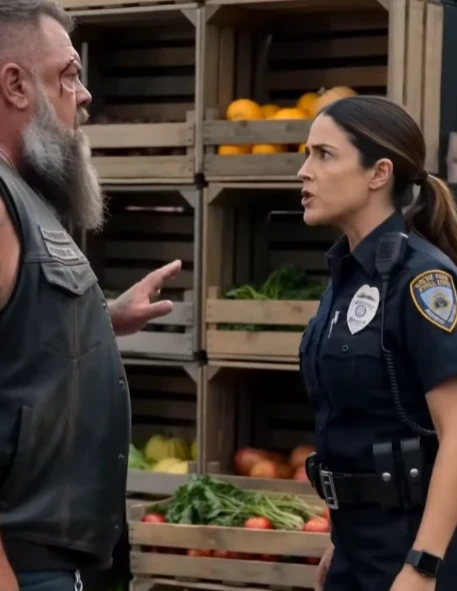
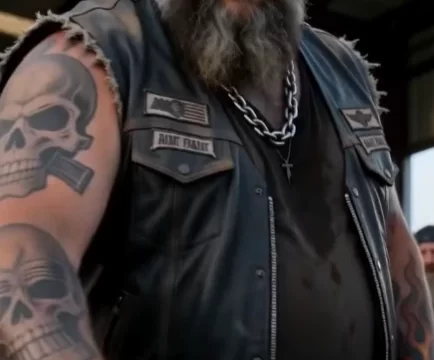
Graham Walker — everyone called him Grizzly — stood in the middle of the Saturday farmers market like a wall of leather and tattoos, his arms loose at his sides, his eyes fixed on something nobody else was watching. He hadn’t raised his voice. He hadn’t touched a single person. But the words he kept repeating — calm, unmoved, and utterly firm — made the crowd angrier than any shout could have.
“Leave it there.”
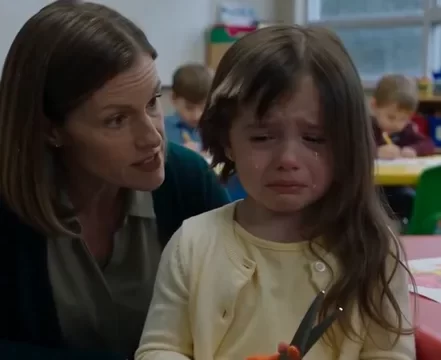
My daughter Sophie had dropped her beloved cloth doll, Rosie, near a stack of wooden produce crates. Rosie wasn’t just a toy. She had been with Sophie since she was three years old — through her first day of kindergarten, two hospital visits, thunderstorms, nightmares, and the year her father left without explaining why. To Sophie, Rosie was family.
And a massive stranger was the only person refusing to let her get Rosie back.
The crowd grew fast. Strangers pulled out their phones. Stories spread in fragments, each one uglier than the last. A biker had grabbed a child. A biker had stolen a little girl’s doll. A biker was threatening anyone who came near it. None of those versions were true — but truth had already become slower than outrage.
Sophie buried her face against my shirt and sobbed. I stepped forward. Grizzly moved one foot across my path without touching me.
“Ma’am. Please. One minute.”
“For what?”
His eyes drifted back toward the doll.
“One minute.”
I stared at him, searching his face for signs of instability, intoxication, something that would explain what was happening. Instead I found something that confused me even more.
Fear.
Not fear of us. Fear for us.
Then I looked where he was looking.
At first, I saw nothing unusual. Rosie lay partly beneath the produce table, her yellow skirt folded over one leg, one cloth arm stretched toward us. The pavement looked ordinary — a paper napkin caught against a crate, a few crushed leaves, and a thin dark gap beneath the lowest wooden box.
Then a narrow shape moved beneath the napkin.
Gone before I could name it.
My anger faltered.
The animal-control officer arrived within minutes. She crouched beside the doll with professional stillness, carefully lifting the edge of Rosie’s yellow dress with a long metal hook.
A small prairie rattlesnake uncoiled beneath it.
The dry, delicate buzz of its rattle was almost too quiet to match the terror it produced.
The crowd surged backward as one. People collided with tables. Someone dropped their phone. Sophie buried her face against my neck and screamed. The handler guided the snake away from the doll and into a secure container with the calm efficiency of someone who had done this before.
Only after the lid locked did Grizzly exhale.
It was the sound of a man who had been holding his breath for the last ten minutes — or perhaps, I would realize later, for the last twelve years.
When Sophie finally stopped trembling, she did something that silenced the entire market.
She walked straight to Grizzly.
She held Rosie out toward him.
“You can hold her if you want.”
Grizzly accepted the doll with both enormous hands, cradling her the way you hold something fragile and irreplaceable. His thumb found the crooked embroidered rose stitched over her heart. And then his face changed entirely.
He turned Rosie over slowly. Near the back of the doll’s neck, beneath strands of repaired yarn hair, three faded stitches appeared in blue thread.
G. W.
His hands began to shake.
“Where did you get this doll?”
I told him what I knew — that my mother had bought her secondhand at an estate charity shop, from boxes donated after a house was cleared out.
Grizzly looked up at Mae, a gray-haired flower vendor who had been watching him with an expression I couldn’t read.
“Graham Walker,” Mae said softly. “You’re Maggie Walker’s father.”
The market seemed to contract around him.
Grizzly had been a diesel mechanic living outside a small rural town when his seven-year-old daughter Maggie was bitten by a rattlesnake in their backyard. She had been reaching for her cloth doll — the one that had blown off her picnic blanket and landed near a woodpile. He had seen movement beneath the wood. He had shouted for her to stop. But he had shouted stop instead of snake — and Maggie, thinking he was keeping her from her doll, ran faster.
He didn’t reach her in time.
Maggie died before sunrise, from a reaction complicated by a heart condition her family never knew she had.
“I gave her a command without giving her a reason,” Grizzly said quietly. “I yelled stop. She thought I was stopping her from getting her doll.”
He looked at Sophie.
“She thought I was being cruel.”
The resemblance between the two mornings settled over the crowd with devastating clarity. A little girl. A cherished cloth doll. Something hidden and deadly beside it. A man whose warning sounded harsh because nobody else could see what he saw.
For twelve years, Grizzly had been living inside the half-second between telling his daughter to stop — and watching her reach anyway.
My mother had told me she’d found Rosie at a charity shop, from donated estate boxes. After Maggie’s death, Grizzly and his wife Rachel had separated — not from lack of love, but because grief had changed its shape inside each of them until they no longer knew how to share the same rooms. Rachel passed away years later, and her belongings — including, apparently, Maggie’s doll — were donated by her sister.
Maggie’s doll had found its way to my mother. My mother had repaired her, loved her, and passed her to Sophie.
“She had two girls,” Sophie said simply, hugging Rosie to her chest. “She took care of Maggie. And then she came to take care of me.”
Grizzly turned away.
“And today,” he said, his voice barely above a whisper, “she brought me back in time to take care of you.”
Several phones lowered.
One man turned his off completely.
The woman who had called Grizzly a coward quietly stepped away.
Grizzly had stood in the center of that market, enduring thirty phones and a hundred accusations, absorbing every insult without explanation — because he understood, more than anyone there, that explanation itself might have caused exactly what he was trying to prevent.
He wasn’t a monster at ten in the morning.
And he wasn’t a hero by afternoon.
He was a scared father with twelve-year-old reflexes — and a little girl’s doll had carried him precisely to the moment he needed most to get right.