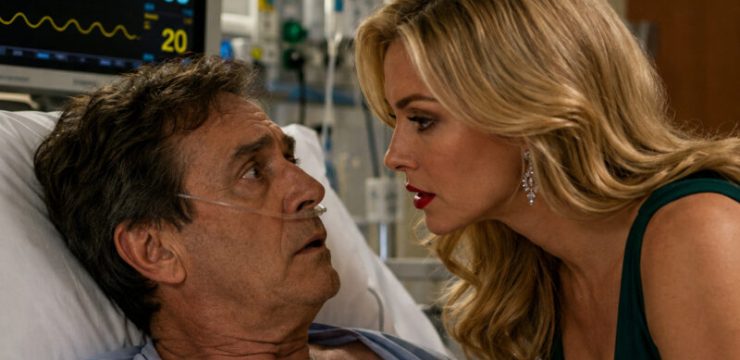
Nobody wanted the job.

Word had spread fast through every nursing agency in the city — Marco Vitale was untouchable. Not in the way he used to be, when his name alone made people lower their voices in crowded restaurants and cross the street to avoid his men. No, this was different. This was the kind of untouchable that meant broken trays, screaming fits, and nurses fleeing his mansion before the week was even halfway done.
Six of them had walked out in two weeks. Six trained, experienced professionals who had dealt with difficult patients their entire careers — and not one of them lasted.
Marco had been a powerful man. The kind of man who controlled dozens of businesses across the city, who never traveled without bodyguards, who had never once in his life been told no and accepted it quietly. His word was law. His presence alone shifted the energy in any room he entered.
Then one night on a dark country road, everything changed.
His car was ambushed. The driver didn’t survive. Marco did — but just barely. One of the bullets had found his spine, and when he finally woke up in a hospital bed weeks later, surrounded by strangers who had been washing him, dressing him, and moving his body while he was unconscious, something inside him broke in a way that no surgery could fix.
He could barely feel his legs.
The doctors spoke carefully about rehabilitation, about the possibility of standing again someday with assistance. Maybe. With time. Perhaps.
For a man who had spent his entire life deciding the fate of others, “maybe” and “perhaps” were unbearable words.
So Marco did what powerful men do when they feel powerless — he fought back against the only thing he could control. He refused help. Threw medication across the room. Screamed at nurses who came too close. But the worst battles happened in the bathroom. Marco would not allow anyone — not a single person — to assist him with bathing. Every nurse who tried received the same terrifying response, and every one of them eventually decided no paycheck was worth it.
Even the private agency, the one the family paid a small fortune to, finally stopped sending people.
That’s when the doctor found Anna.
She was young, quieter than most, and had spent years working in a rehabilitation center with patients who had suffered severe injuries. She understood trauma — not just the physical kind. She had been warned about Marco before she ever set foot in his mansion. She knew exactly who he was and exactly why the others had left.
She had one condition before she accepted.
“If he yells at me,” she told the doctor, “the guards stay out of it. Otherwise, I can’t do my job.”
The first time Anna walked into that bathroom, Marco was already positioned near the large white tub, a towel across his lap, a bodyguard standing at the door like a statue. He looked her over with that familiar cold smirk and asked if she knew how long the last one had lasted.
She said she did.
He told her she could take her first day’s pay and leave right now.
She said nothing.
Instead, she checked the water temperature and laid out clean towels. Marco stiffened immediately, watching her.
“What are you doing?”
“Getting things ready.”
“I’m not bathing.”
“Okay,” she said simply — and turned off the water.
She put the towels away and walked out.
That was it. No argument, no pleading, no lecture about medical necessity. She simply accepted his answer and left.
He didn’t know what to do with that.
She came back the next day. Same thing. And the day after that, Marco decided to test her — told her to run the water. She did. When everything was ready, he told her to leave. She turned off the water again without a word. He said wait. She stopped.
“How am I supposed to get in there?” he demanded.
“You’re not,” she answered calmly. “You told me not to touch you. I’m following your instructions.”
The bodyguard at the door dropped his chin slightly to hide a smile. One sharp look from Marco fixed that immediately.
“You think you’re clever?” Marco growled.
“No,” Anna replied evenly. “You’re an adult man. I’m not going to force you into a bathtub.”
She paused, then stepped closer.
“But if you ask me for help — I’ll help you.”
Something shifted in his face. Just for a second.
“I don’t ask anyone for anything,” he said quietly.
“I noticed,” she replied. And she left.
That evening, the doctor told Anna something none of the previous nurses had ever known. During those weeks in the hospital, unconscious and helpless, strangers had done everything for Marco’s body. When he finally woke up and understood what had happened — understood that he couldn’t even sit up on his own — it was the first time in his life he had felt completely powerless. And that feeling had never left him.
It wasn’t stubbornness. It wasn’t cruelty.
It was shame.
Anna came back the next day with equipment — a transfer board, a grab bar, tools from the rehabilitation center. Marco demanded to know what it was all for.
“I’m not going to wash you today,” she said.
“Then what’s all this for?”
“Today, you’re going to do it yourself.”
He laughed. Told her she was out of her mind. She explained, step by step, how people with mobility limitations could transfer themselves with minimal assistance. He failed the first time. He failed the second time. On the third attempt, his hand slipped from the grab bar. The bodyguard stepped forward — Anna raised her hand.
“That’s not necessary,” she said.
Marco was breathing hard. “Enough. Put it all away.”
Anna didn’t move.
“One more time,” she said.
“I said enough!”
“I heard that Marco Vitale never quits after three tries.”
He looked up at her slowly. She was certain she was about to be fired.
Instead, he reached for the grab bar again.
“Move the chair closer,” he said.
And he did it.
For the first time since the shooting, Marco transferred himself — on his own — from his wheelchair to the seat beside the tub. He sat completely still afterward, staring at his hands like he couldn’t believe what they had just done. Anna quietly set a towel beside him.
“You’ll manage the rest without me.”
She walked toward the door.
“Anna.”
She stopped.
“Stay near the door,” Marco said, his voice rough and low. “In case I need help.”
It was the first time in months he had asked for anything.
In the weeks that followed, Marco remained difficult. He still cursed, still snapped, still demanded things stop when they became too hard. But Anna never did for him what he could attempt himself. Slowly — painfully, honestly slowly — he learned to transfer, to dress his upper body, to use equipment independently.
And something else changed too.
He stopped humiliating the staff. He was still stern, still demanding, still unmistakably Marco Vitale. But the cruelty faded. The man who had terrorized six nurses in two weeks became someone who could simply say stop — without making someone’s hands shake.
Not every wound shows on the outside. And sometimes the most powerful thing you can offer someone isn’t help.
It’s the dignity of letting them try.