The last nail struck the marble floor with a sharp metallic crack.
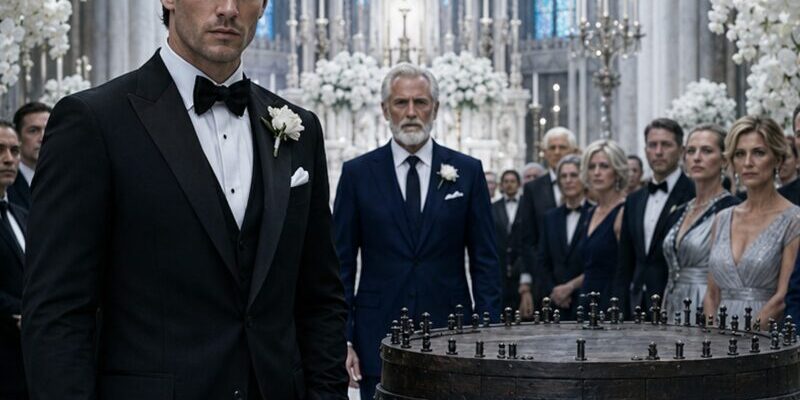
Beside the groom stood an enormous dark wooden barrel. As two men placed their hands beneath its heavy lid, hundreds of wedding guests leaned forward, unaware that the bride inside had been hidden from the world for seven years.
And when the lid finally began to rise, Daniel saw something that made him forget how to breathe.
Seven years earlier, on Emily’s eighteenth birthday, her father Richard had filled their home with relatives.
He raised a glass beneath the chandelier and smiled proudly at his only daughter.
“She has become a true beauty,” he told everyone. “Just like her mother.”
Emily smiled politely, though the comparison always carried an ache. Her mother had died years earlier, and after her death, something inside Richard had changed.
That night, Emily disappeared.
By morning, Richard had an explanation prepared.
His daughter had been sent to an exclusive boarding school abroad, he said. Emily wanted privacy. She disliked crowds and had specifically requested that nobody be given her telephone number.
The family found it strange.
But Richard was wealthy, respected, and convincing.
Nobody imagined the truth was only a few corridors away.
In an isolated room inside the oldest wing of the house stood a massive barrel Richard had commissioned according to his own specifications.
It was taller than a person, constructed from smooth dark wood and reinforced with heavy metal bands. Tiny holes in the lid allowed air inside. A narrow door had been cut into one side.
It could only be opened from outside.
With Richard’s key.
“You cannot do this to me,” Emily whispered when she saw it.
Richard remained frighteningly calm.
After losing his wife, his grief had hardened into obsession. He had convinced himself that protecting his daughter meant preventing every unrelated man from seeing her until marriage.
No neighbor.
No family friend.
No doctor.
Not even a stranger passing on the street.
“Until you have a husband,” he told her, “no other man will look at you.”
Emily begged.
She promised she would stay inside the house. She would avoid parties. She would obey whatever rules he wanted.
Richard opened the narrow door.
Emily stepped backward.
“Dad, please.”
For one second, she searched his face for the father she remembered.
He was no longer there.
Richard locked her inside.
Every morning, an elderly servant named Martha entered the forgotten room carrying food and water.
Richard had ordered her never to speak to Emily.
For several weeks, Martha obeyed.
Then one rainy morning, she heard Emily crying.
“The roses opened yesterday,” Martha whispered through the small opening.
The crying stopped.
“What color?”
“Red.”
That became the beginning.
Martha brought Emily soup, bread, vegetables, fruit and occasionally sweets. More importantly, she brought fragments of life.
She described thunderstorms rolling over the garden. Christmas decorations in town. Children playing outside. New shops opening.
Sometimes she secretly brought old magazines.
Emily would stare for hours at photographs of beaches and crowded streets.
The ocean fascinated her most.
She remembered seeing it once as a child.
Freedom, in her memory, sounded like waves.
Meanwhile, Richard carefully maintained his deception.
He forged messages supposedly sent by Emily. He purchased expensive presents in her name and mailed them to relatives. When people asked for photographs, he occasionally provided carefully staged images showing a young woman from behind.
Years passed.
Emily learned to measure time through Martha’s stories.
Then, shortly before her twenty-fifth birthday, Richard appeared beside the barrel wearing an expression Emily had not seen in years.
Satisfaction.
“I have found you a husband.”
Emily stared through the opening.
His name was Daniel.
He was the son of a prominent construction-company owner—handsome, educated, quiet, from a family Richard considered respectable.
Daniel had never met Emily.
Richard told him that his daughter had been raised according to an unusually strict family tradition. She would remain unseen by her future husband until their wedding ceremony.
Daniel found the arrangement deeply strange.
“Can I at least speak with her?”
Richard refused.
Daniel almost walked away.
But Richard showed him letters supposedly written by Emily.
Daniel did not know they were forged.
He finally agreed, believing Emily herself had chosen the arrangement.
The wedding was held inside a magnificent temple.
White flowers climbed enormous columns. Hundreds of candles burned across polished marble, and towering blue stained-glass windows scattered colored light over the guests.
Daniel waited beside the altar.
Then the barrel arrived.
Conversation stopped.
Four men carried the enormous dark structure toward the front of the temple and positioned it beside the groom.
Daniel stared at Richard.
“What is this?”
Richard smiled.
“Tradition.”
Guests whispered uneasily.
Richard stepped forward in his expensive suit, his white beard immaculate.
“Today my daughter will see her husband for the first time,” he announced. “And he alone will be the first man to see her.”
Daniel felt something cold move through his stomach.
Two men approached the barrel.
They began removing the long nails securing the lid.
One.
Two.
Three.
The temple became completely silent.
The final nail struck the marble.
Daniel stepped closer.
The lid slowly rose.
A smell of enclosed wood and stale air escaped first.
Then Daniel saw a hand gripping the inside edge.
Thin fingers.
Pale skin.
The lid lifted higher.
Emily slowly raised her face toward the light.
Gasps moved through the temple.
She was alive.
But she looked nothing like the radiant bride the guests had expected.
Her skin was unnaturally pale from years without sunlight. Her body was thin, her dark hair falling almost to her waist. She wore a simple white dress, but the fabric hung loosely from her shoulders.
Emily squinted painfully beneath the brightness.
Then she raised one trembling hand over her eyes.
Daniel stared at her.
Not with disgust.
With horror at what had been done to her.
Richard stepped forward proudly.
“My daughter,” he announced.
Emily’s eyes moved toward the voice.
Her entire body stiffened.
Daniel saw it.
Fear.
Not bridal nervousness.
Fear of her own father.
He turned toward Richard.
“How long?”
Richard’s smile faltered.
“What?”
“How long has she been inside that thing?”
The temple went silent again.
Richard straightened.
“You misunderstand our customs.”
Emily suddenly whispered something.
Daniel leaned closer.
“What did you say?”
Her lips trembled.
“Seven years.”
Someone in the first row gasped.
Richard moved toward her.
“Emily.”
She recoiled so violently that her shoulder struck the barrel.
Daniel immediately stepped between them.
“Don’t touch her.”
Richard froze.
The words seemed almost incomprehensible to him.
“This is my daughter.”
“No,” Daniel said quietly. “She is a grown woman.”
Richard’s face darkened.
“You have no idea what sacrifices I made to protect her.”
“Protect me?”
Emily’s voice was weak, but everyone heard it.
She slowly climbed from the barrel.
Her legs buckled the moment her feet touched the marble.
Daniel caught her instinctively.
Emily flinched at first.
Then she realized he was only supporting her.
Martha appeared from behind the guests.
Tears covered the elderly servant’s face.
Richard stared at her.
“You.”
Martha walked forward carrying an old leather bag.
“I should have done this years ago.”
She opened it.
Inside were notebooks.
Dozens of pages documenting dates, meals, Richard’s instructions and the years Emily had spent imprisoned.
Richard’s expression finally changed.
“Give me those.”
Martha stepped backward.
“No.”
Several guests stood.
Richard looked around the temple and seemed to understand, perhaps for the first time, that nobody was looking at him with admiration anymore.
They were looking at Emily.
Then at the barrel.
Then back at him.
“You think you understand?” Richard demanded. “I kept her safe!”
“You stole seven years from her,” Daniel said.
Richard pointed toward Emily.
“She is untouched. I kept my promise.”
Emily slowly straightened.
Something changed in her face.
For years, she had spoken through holes in wood. She had begged through a locked door. She had whispered because shouting changed nothing.
Now hundreds of people were listening.
“I was eighteen,” she said.
Richard stopped.
“I begged you.”
His jaw tightened.
“You were a child.”
“I was your child.”
Emily swallowed.
“And you put me in a cage.”
Richard tried to answer, but voices were already rising among the guests.
Someone had called the authorities.
For once, Richard could not control what happened next.
The ceremony never continued.
When officers arrived, Martha handed them her notebooks and led them to the old wing of the house.
There they found the room.
The narrow bed.
The bucket.
The lamp.
Stacks of magazines.
Seven years of evidence preserved behind a locked door.
Richard was taken away.
Emily watched from the temple steps as he was escorted toward a waiting vehicle.
He looked back at her.
For a moment, she expected another command.
Instead, Richard seemed suddenly old.
“Emily,” he called.
She did not answer.
Daniel remained several feet behind her, deliberately giving her space.
When the vehicle disappeared, Emily looked up.
The sky seemed impossibly large.
She had forgotten that blue could stretch that far.
Her knees trembled.
Martha came beside her.
“I’m sorry.”
Emily turned.
Martha was crying.
“I should have opened that door,” she whispered. “I had the key sometimes. I was afraid of him.”
Emily stared at the woman who had carried pieces of the world to her for seven years.
Then she took Martha’s hand.
“You gave me the world when I couldn’t reach it.”
Martha covered her mouth.
Emily embraced her.
Daniel quietly walked away from the altar.
There would be no wedding that day.
And he refused to let anyone pressure Emily into believing there should be.
Months passed.
Richard eventually faced prosecution supported by Martha’s records, testimony from household staff, and evidence recovered from the old wing.
His carefully maintained reputation collapsed.
But Emily discovered that freedom was more complicated than opening a door.
The first time she entered a supermarket, she froze.
Too many voices.
Too many people.
Too much light.
Daniel happened to be nearby because he had been helping arrange temporary accommodation and legal assistance through his family.
He noticed Emily struggling.
He did not touch her.
Instead, he stood several feet away.
“Do you want to leave?”
Emily nodded.
They walked outside.
That became the foundation of their relationship.
Not romance.
Choice.
Daniel never appeared without asking first.
He never touched her without permission.
He never told her what she should want.
Slowly, Emily began discovering ordinary things.
Coffee in a crowded café.
Rain against her uncovered face.
Walking through a park alone.
Choosing her own clothes.
Opening a door without needing someone else’s key.
One afternoon, Martha gave her a small package.
“I kept something.”
Inside was one of the old magazines she had smuggled into the barrel years earlier.
Emily opened it.
The pages were worn.
Near the center was a photograph of an endless blue ocean.
Emily stared at it.
Martha remembered.
“You used to ask me whether the sea really looked that big.”
Emily smiled.
“I thought photographers were exaggerating.”
Daniel, standing nearby, said nothing.
Several weeks later, he asked Emily a question.
Not about marriage.
Not about their future.
“Would you like to see it?”
Emily knew immediately what he meant.
The ocean.
They traveled with Martha to the coast.
Emily heard the waves before she saw them.
She stopped on the wooden walkway leading toward the beach.
Wind moved through her hair.
Daniel waited.
Martha waited.
Nobody pulled her forward.
Emily removed her shoes.
Then she stepped onto the sand.
Slowly at first.
Then faster.
By the time she reached the water, she was laughing.
The first wave touched her ankles and she gasped, retreating instinctively before stepping forward again.
Martha began crying.
Daniel looked away to give her privacy.
Emily walked farther until the water reached her knees.
Seven years inside a wooden prison had taught her to measure the world in inches.
Now there was no wall ahead of her.
Only horizon.
A year later, Daniel took Emily back to the same beach.
He carried no elaborate ring box.
There were no guests.
No altar.
No barrel.
Just the two of them beneath an evening sky.
“I need you to understand something before I ask,” he said.
Emily watched him.
“If the answer is no, nothing changes. If the answer is not yet, nothing changes. If you never want marriage after what happened, nothing changes.”
Emily’s eyes filled.
Daniel took a breath.
“I want you because you are free to leave.”
Then he asked.
Emily laughed through her tears.
“Yes.”
Their wedding took place six months later.
It was small.
Martha sat in the front row.
There were no traditions Richard had chosen.
No locked doors.
No hidden bride.
Emily walked toward Daniel beneath an open sky with sunlight on her face.
Before the ceremony began, Martha handed her one final envelope.
“I found this among your mother’s belongings years ago,” she said. “Your father told me to destroy it.”
Emily’s hands stopped.
Inside was a letter written by her mother shortly before she died.
Emily unfolded it.
My darling girl,
If there ever comes a day when someone tells you love means making yourself smaller, do not believe them.
Love should never be a locked door.
It should be the person standing beside it, reminding you that you are free to walk through.
Emily stopped reading.
Her vision blurred.
For seven years, Richard had used the memory of her mother to justify imprisoning her.
He had told Emily repeatedly that her mother would have understood.
She hadn’t.
She never would have.
Emily pressed the letter against her heart.
Then she looked toward Daniel.
He was waiting several yards away.
Not reaching for her.
Not calling her.
Simply waiting for Emily to choose the distance between them.
She smiled.
And walked toward him.
Years later, the old barrel was destroyed.
Emily kept only one small piece of its dark wood.
Daniel once asked why.
She showed him what she had carved into it.
A single word.
FREE.
The piece rested beside her mother’s letter in their home overlooking the sea.
And sometimes, early in the morning, Emily would open every window and stand barefoot on the balcony while Daniel made coffee inside and their children chased each other through the rooms.
No locked doors.
No whispered conversations through wooden walls.
No one deciding who was allowed to see whom.
Only sunlight.
Only laughter.
Only the sound of waves reaching the house.
Martha, now gray and slower on her feet, often visited on Sundays. She would sit near the open windows while the children begged her for stories, never fully understanding why their mother sometimes became quiet when Martha described red roses blooming in spring.
Emily never told them everything.
Not yet.
For now, she wanted them to grow up believing something she had needed seven stolen years to learn.
A home was not the place where someone kept you.
It was the place where you were free to leave—and loved enough to want to return.
One evening, after everyone had gone inside, Emily remained on the balcony.
The sunset turned the ocean gold.
Daniel appeared in the doorway.
He did not call her.
He simply held out his hand.
Emily looked at the open doorway behind him, then at the endless horizon before her.
And smiled.
For the first time in her life, both directions meant home.