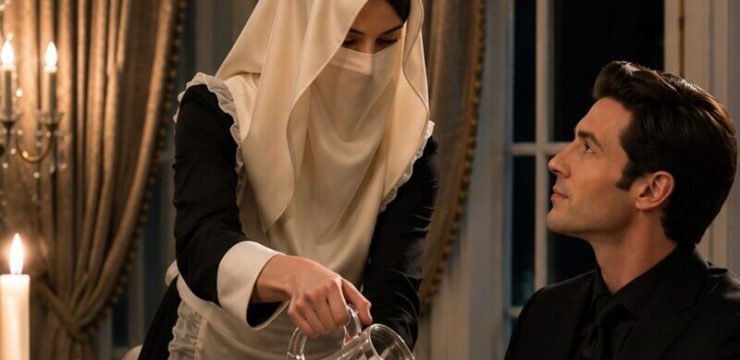
The bride had been missing for only twenty minutes when her sister found her body on the floor. Hours later, at three in the morning, one strange request from the grieving husband would make a morgue nurse wonder whether everyone was mourning the same tragedy—or hiding something beneath the bride’s veil.
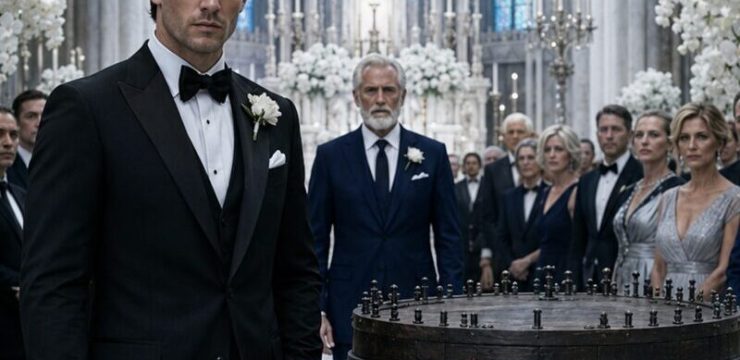
Leila and Adam’s wedding had been planned for months. More than a hundred guests filled an elegant hall outside the city, while expensive cars decorated with white flowers and ribbons waited beneath the lights.
Leila had spent most of the evening in a white wedding gown and a beautiful snow-white hijab. The fabric concealed her hair, neck, and the lower half of her face, leaving only her eyes visible.
At first, nothing seemed wrong.
Guests raised glasses, posed for photographs, and congratulated the newlyweds as music drifted through the crowded room.
Then, roughly two hours into the celebration, Leila disappeared.
Nobody panicked immediately. They assumed she had gone somewhere private to adjust her dress or simply escape the noise for a few minutes.
But twenty minutes passed.
Her younger sister, Emma, began searching.
At the back of the hall, she noticed a door standing slightly open. Beyond it was a small room.
Emma pushed the door wider—and screamed.
The music stopped.
Leila lay motionless beside the wall.
Her bridal bouquet had fallen nearby. White roses were scattered across the floor, several crushed beneath someone’s feet.
She wasn’t breathing.
An ambulance arrived quickly, but there was nothing the medical team could do. What disturbed everyone was how suddenly it had happened.
Leila had been a healthy young woman celebrating her wedding only minutes earlier.
By approximately three in the morning, her body was transported to the municipal morgue.
Anna, the nurse working that night, noticed the family immediately. Women cried quietly in the corridor while several men stood apart. Outside, some of the wedding cars were still there, their white ribbons looking strangely out of place against the darkness.
Adam barely spoke.
But he repeated one request.
“Please don’t uncover her face.”
Anna looked at him.
“The hijab must stay on her,” he continued. “Even during the examination.”
The relatives explained that it was important because of family and religious traditions. They asked the staff to respect their wishes.
Anna said nothing.
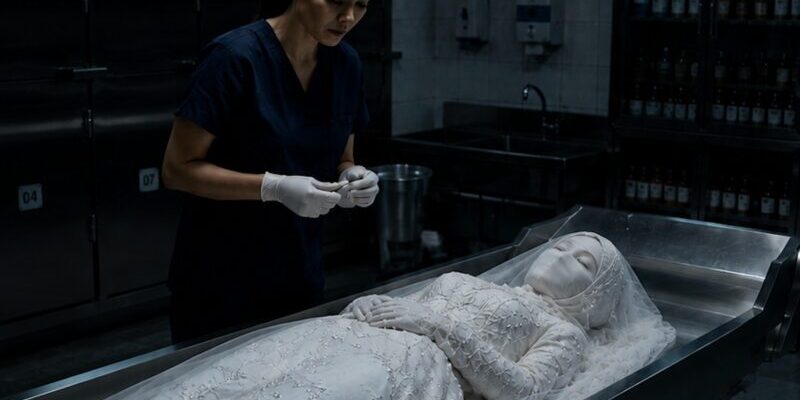
Later, when Leila’s body was transferred into the cold examination room, the wedding dress was still on her. The white hijab remained arranged so carefully that not a single strand of hair could be seen.
Only her closed eyes were visible.
At first glance, there was nothing unusual.
Still, Anna couldn’t shake the feeling that something was wrong.
She remembered hearing about the crushed flowers on the floor.
She remembered Adam’s insistence.
Most of all, she couldn’t stop thinking about how much attention the family had given to the veil when a healthy young bride had somehow died in the middle of her own wedding.
Anna told herself she was exhausted.
But the silence of the morgue made every doubt louder.
She stood beside the metal table and stared at the perfectly arranged white fabric.
Then she reached toward it.
Her fingers hesitated.
Slowly, Anna began removing the veil from Leila’s face.
And the instant she saw what had been hidden underneath, she froze.
A second later, Anna turned and ran from the morgue in terror.
What she had just seen beneath the bride’s hijab was about to change everything they thought they knew about that wedding. 👇
Anna’s shoes struck the corridor tiles so hard that the sound echoed through the empty building.
She reached the nurses’ station, caught the edge of the counter with both hands, and forced herself to breathe.
It wasn’t blood that had frightened her.
It wasn’t an injury.
It was something far more impossible.
The woman on that table was not Leila.
Anna had seen Leila’s photograph attached to the preliminary intake paperwork. She had studied it only minutes earlier: the shape of the bride’s face, the small beauty mark beside her left eyebrow, the delicate curve of her nose.
The woman beneath the hijab had none of those features.
For several seconds Anna simply stood there, hearing the hum of the fluorescent lights above her.
Then she picked up the telephone.
She did not call the family.
She called the physician responsible for the examination and told him to come immediately.
“Don’t let anyone into that room,” he said.
Anna looked toward the closed morgue doors.
“I won’t.”
“And don’t tell the relatives yet.”
She lowered the receiver slowly.
That instruction came too late.
A shadow moved behind the glass panel at the end of the corridor.
Adam was standing there.
Anna couldn’t tell how long he had been watching her.
He stepped through the doorway.
“Is something wrong?”
His voice was quiet, but something had changed in it.
Anna kept one hand against the counter.
“The doctor is coming.”
Adam’s eyes moved past her toward the examination room.
“Why?”
“Routine procedure.”
He stared at her for a beat too long.
Then his gaze dropped to the white fabric visible through the narrow window in the morgue door.
“You uncovered her.”
It wasn’t a question.
Anna felt the skin tighten across her shoulders.
“The examination has to be performed properly.”
Adam took one step closer.
“I asked you not to.”
“And I heard you.”
His jaw tightened.
For the first time that night, grief disappeared from his face.
What replaced it was fear.
The change lasted barely a second, but Anna saw it.
So did the security camera above them.
“Where is Leila?” Anna asked.
Adam stopped moving.
The corridor became completely still.
“I don’t understand.”
Anna’s voice remained low.
“The woman you brought here isn’t your wife.”
His face emptied.
Then he laughed once, softly, as if Anna had made an absurd mistake.
“You’re tired.”
“I know what I saw.”
“You’ve never met Leila.”
“No. But I’ve seen her identification photograph.”
Adam glanced toward the exit.
That was when Anna understood that whatever had happened at the wedding had not ended when the ambulance left.
It was still happening.
The doctor arrived less than ten minutes later with two police officers who had already been involved in documenting the unexplained death.
Adam was asked to wait in another room.
He refused at first.
Then one officer quietly told him that refusal would not change what happened next.
The physician entered the examination room with Anna.
Under the bright clinical lights, the difference was undeniable.
The dead woman appeared close to Leila’s age and build. Her makeup had been carefully applied. Her wedding dress concealed most of her body, and the hijab had hidden nearly every identifying feature.
But she was not Leila.
The physician checked the paperwork twice.
Then he looked at Anna.
“Call the officers back in.”
Within minutes, the morgue changed from a place of mourning into an active investigation.
The body was photographed properly. Fingerprints were taken. Every item of clothing was documented.
And beneath one sleeve, investigators found the first thing that gave the dead woman a name.
A thin hospital identification bracelet had been cut almost completely through, but a small section remained trapped beneath the fabric.
The printed name was still readable.
Nadia Rahman.
Emma was brought into a private room shortly before dawn.
She looked as if she had aged years since the wedding.
When an officer asked whether she knew anyone named Nadia Rahman, Emma’s hands stopped moving.
She had been twisting a tissue between her fingers.
Now she simply stared at it.
“Yes.”
Anna, standing near the doorway, watched Adam turn his head.
Emma looked at him.
“My sister knew her.”
Adam spoke immediately.
“No, she didn’t.”
Emma’s eyes lifted.
“You told me you didn’t know who she was.”
“I don’t.”
“You just answered for Leila.”
The officer leaned forward.
“Emma, who was Nadia?”
Emma swallowed.
“She worked at the clinic where Leila volunteered last year.”
Adam stood.
“I want a lawyer.”
No one tried to stop him from saying it.
One officer simply opened the door and asked him to remain seated until arrangements could be made.
Emma began crying without making a sound.
Then she whispered something Anna almost missed.
“Leila was afraid.”
The room went quiet again.
“Afraid of what?” the officer asked.
Emma looked toward Adam.
“Of getting married.”
Adam’s expression hardened.
“That isn’t true.”
Emma flinched at his voice, but this time she didn’t lower her eyes.
“She loved you,” she said. “That wasn’t the problem.”
“Then what was?”
“She found something.”
Adam went still.
Emma reached into the small handbag she had carried all night and removed her phone.
“Three days ago, she sent me a message. She said if anything strange happened at the wedding, I should check our grandmother’s sewing box.”
Adam stared at her.
“You never told me that.”
“No.”
“Why?”
“Because she told me not to.”
The first gray light of morning had begun filling the high corridor windows when officers returned to the wedding venue.
The ballroom looked nothing like it had hours earlier.
Half-empty glasses remained on linen-covered tables. A fallen chair rested near the dance floor. White flowers had begun to wilt beneath chandeliers that were still burning despite the daylight.
Emma led investigators to the small room where she had found the body.
The crushed roses were still there.
So was something everyone had overlooked.
One section of the wall was covered by a heavy decorative curtain.
Behind it stood a narrow service door.
It opened onto a corridor used by catering staff.
And the corridor led directly to a rear loading area beyond the main parking lot.
The security system had recorded that area.
At 10:47 p.m., twelve minutes before Emma began searching for her sister, a dark car had pulled beside the service entrance.
A woman in a long coat emerged.
Her face was difficult to see.
But when she turned beneath the security light, Emma gripped the edge of the desk.
“Nadia.”
The footage continued.
Nadia entered the building carrying a garment bag.
Nine minutes later, two figures appeared in the service corridor.
One was Nadia.
The other wore a white wedding dress.
Leila.
Nobody spoke.
On the screen, Leila was alive.
Emma covered her mouth.
Adam leaned forward.
For the first time since the discovery at the morgue, something like genuine shock crossed his face.
Leila and Nadia disappeared beyond the camera.
Five minutes later, another figure entered the frame.
A man.
The image was grainy, but his clothes were unmistakable.
Adam’s wedding suit.
Everyone turned toward him.
He shook his head.
“No.”
The officer paused the footage.
“Is that you?”
Adam’s breathing changed.
“I went looking for my wife.”
“Through a service corridor?”
“I saw her leave.”
“You told officers last night you never saw her after the photographs near the dance floor.”
Adam’s mouth opened.
Nothing came out.
The footage resumed.
Adam disappeared through the same door.
Seven minutes passed.
Then Leila returned alone.
She was no longer wearing her wedding dress.
She wore dark trousers, a sweater, and Nadia’s long coat.
She carried something against her chest.
A small wooden box.
Emma made a broken sound.
“Our grandmother’s sewing box.”
Leila looked directly toward the security camera.
Then she did something that made Emma start crying.
She raised one hand to her heart.
It was a gesture the sisters had used since childhood.
Three taps.
Their private signal.
I’m okay.
Leila walked out of frame.
She had left the wedding alive.
But Nadia had not.
The question now was why.
The wooden sewing box was found that afternoon at Emma’s apartment.
Inside were old spools of thread, two photographs of the sisters as children, and an envelope with Emma’s name written across it in Leila’s handwriting.
Emma opened it with trembling fingers.
There was no dramatic confession.
There were copies of financial documents.
Bank transfers.
Loan agreements.
Insurance paperwork.
And several pages showing that Adam had accumulated debts he had concealed from Leila throughout their engagement.
The largest document was a life insurance policy taken out months earlier.
Leila was the insured person.
Adam was the primary beneficiary.
Emma stared at the amount.
Then she looked away.
But another document mattered more.
It was a handwritten statement from Leila.
She had discovered the policy accidentally.
When she confronted Adam, he insisted it was ordinary financial planning.
She had tried to believe him.
Then she found messages between Adam and someone whose name she didn’t recognize discussing money, deadlines, and what would happen “after the wedding.”
The name was Nadia.
Emma’s voice shook as she read.
Leila had contacted Nadia privately.
Nadia admitted that Adam had been paying her.
Not to hurt Leila.
To help him commit fraud.
Adam had used Nadia’s identity in a network of false medical claims and loans, taking advantage of their similar ages and general appearance.
Nadia wanted out.
She had agreed to meet Leila secretly during the wedding because she possessed documents that could prove what Adam had done.
The plan was simple.
Nadia would enter through the service corridor.
Leila would change clothes with her temporarily so she could leave unnoticed, carrying the evidence to Emma’s apartment.
Then Nadia would change back and leave.
But Adam had followed them.
The next part existed only on the security recording and in the evidence investigators later reconstructed.
Inside the small room, there had been an argument.
Nadia had refused to surrender her phone.
Adam had tried to take it.
She backed away.
A table had been knocked sideways.
The bouquet fell.
Nadia stepped onto the scattered roses, lost her footing, and struck the back of her head against the sharp edge of a low stone ledge beneath the window.
The injury proved fatal.
Adam panicked.
And then he made the decision that destroyed whatever remained of his life.
Instead of calling for help, he saw Nadia lying beside Leila’s abandoned wedding dress.
He dressed her in it.
He arranged the hijab carefully over her face.
Then he returned to the celebration and waited for someone else to discover the body.
If everyone believed Leila had died, Adam believed the investigation into his finances might disappear with her.
And if the veil remained in place long enough, he thought the deception might survive until he could leave.
It almost did.
Almost.
Adam sat across from the investigators as the evidence was placed in front of him piece by piece.
The morgue photographs.
The service-corridor footage.
The financial records.
Nadia’s phone.
Leila’s statement.
Finally, the security recording showing him leaving the room after Nadia had already collapsed.
He stopped denying it.
But he still tried to make himself smaller inside the truth.
“It was an accident.”
Emma stared at him across the interview-room glass.
Nobody answered.
Adam rubbed both hands over his face.
“I didn’t mean for her to fall.”
The investigator’s voice remained controlled.
“You didn’t call an ambulance.”
Adam looked down.
“You disguised her body.”
Silence.
“You allowed more than a hundred people to believe your wife was dead.”
Adam’s shoulders sank.
“And you specifically instructed morgue staff not to uncover the face.”
That was the moment his power finally broke.
Not when the officers had arrived.
Not when the footage appeared.
Now.
Because Adam understood that every careful decision he had made to protect himself had become evidence against him.
Emma watched through the glass as he lowered his forehead into his hands.
She expected satisfaction.
None came.
Only exhaustion.
Nadia was still dead.
Leila was still missing.
And justice could not turn a terrible night backward.
Anna stood beside Emma.
For a long time neither woman spoke.
Then Emma whispered, “Where is my sister?”
Anna looked at her.
“I don’t know.”
Emma’s mouth trembled.
“She gave me the evidence. She knew she had to get away.”
“Then maybe that’s what she did.”
“But she doesn’t know Nadia died.”
That thought changed everything.
Police had been searching for Leila since the security footage established that she had left the wedding alive.
Her phone had been found inside the sewing box, deliberately switched off.
She had taken no suitcase.
No passport.
No bank cards investigators could trace.
For almost eighteen hours, there was nothing.
Then Emma remembered something.
Three taps.
I’m okay.
It wasn’t only their childhood signal.
There had been a place connected to it.
When they were little and arguments filled their parents’ house, the sisters sometimes escaped to their grandmother’s cottage beside a lake outside the city.
Their grandmother would open the door without asking questions.
Three taps against the wooden frame.
I’m okay.
I’m here.
Police reached the cottage just before sunset.
Emma insisted on going.
The road narrowed between dark trees until the city disappeared behind them.
Rain had begun falling softly.
When the car stopped, Emma saw no lights inside the house.
Her heart dropped.
Then the front curtain moved.
The door opened.
Leila stood there.
For one impossible second, Emma couldn’t move.
Leila wasn’t wearing white anymore.
Her hair was loose around her shoulders. She wore the same dark sweater seen in the security footage, and her face looked exhausted.
Alive.
Completely, undeniably alive.
Emma ran.
Leila barely had time to step from the doorway before her sister collided with her.
Neither said anything.
Emma’s hands moved over Leila’s shoulders, her face, her hair, as though touch was the only evidence she trusted.
Then she struck Leila once against the chest.
Not hard.
“You let me think you were dead.”
Leila’s face folded.
“I didn’t know.”
Emma hit her again, weaker this time.
“I found her.”
Leila stopped breathing.
“Nadia?”
Emma nodded.
The color disappeared from Leila’s face.
“No.”
She stepped backward.
“No, Nadia was supposed to leave.”
Emma caught her wrists.
“Adam followed you.”
Leila closed her eyes.
The sound that left her was small.
She sank onto the cottage steps.
Emma sat beside her.
Rain tapped softly against the roof.
For several minutes Leila said nothing.
Then the story came out in fragments.
She had left because Nadia had given her enough evidence to expose Adam.
Leila intended to take it to Emma, then contact police from somewhere safe.
When Adam appeared in the corridor, Nadia told Leila to go.
“She said she’d handle him.”
Leila stared into the rain.
“I left her there.”
“You didn’t kill her.”
“I left her.”
“You were afraid.”
“I should have stayed.”
Emma tightened her hand around Leila’s.
“And then maybe we’d be burying two women.”
Leila looked at her sister.
Emma’s eyes were red.
“So don’t make Nadia’s last decision meaningless by blaming yourself for surviving.”
That sentence stayed between them.
Leila bent forward and pressed both hands over her face.
Emma wrapped her arms around her.
This time, when Leila cried, she allowed someone to hold her.
The legal consequences unfolded over months.
Adam eventually admitted to concealing Nadia’s death, interfering with evidence, financial fraud, identity-related offenses, and other charges connected to the scheme investigators uncovered.
The court proceedings were painful.
Leila testified.
So did Emma.
Anna described Adam’s repeated demand that the hijab remain untouched.
Nadia’s family sat together in the courtroom.
Leila found it difficult to look at them.
On the final day, she approached Nadia’s mother outside the courthouse.
The older woman watched her coming.
Leila stopped several feet away.
“I don’t know what I can say to you.”
Nadia’s mother looked tired rather than angry.
“She was helping me.”
Leila’s voice broke.
“I know.”
“I left.”
“I know that too.”
Leila swallowed.
“I’m sorry.”
Nadia’s mother studied her face for a long moment.
Then she stepped forward.
“You survived because my daughter told you to go.”
Leila’s eyes filled.
“Yes.”
“Then live.”
One word.
That was all.
But Leila carried it home.
Adam’s conviction made his downfall permanent, but it did not become the center of Leila’s life.
That mattered.
For months she had defined entire days by what he had done.
Eventually, she began defining them by what she could still choose.
She returned to the clinic where she had once volunteered.
Not immediately.
At first, she couldn’t enter the building without thinking of Nadia.
Then one morning she walked through the doors and stayed.
Emma came with her.
Anna visited several weeks later.
The three women sat in a small courtyard behind the clinic drinking coffee from paper cups.
Nobody talked about the wedding for nearly an hour.
That felt like progress.
Emma complained about work.
Anna told them about a broken coffee machine at the morgue.
Leila laughed.
The sound startled her.
She stopped halfway through it.
Emma looked over.
“What?”
“Nothing.”
“You laughed.”
Leila stared down at her cup.
“I know.”
Emma smiled.
“Do it again sometime.”
Leila rolled her eyes.
And there it was.
Something ordinary.
Something alive.
Nadia’s family later agreed to establish a small emergency fund at the clinic using money recovered during the fraud investigation.
It would help women who needed temporary housing, transportation, legal assistance, or simply somewhere safe to go.
They named it after Nadia.
Leila volunteered to help administer it.
The first time she saw Nadia’s name engraved on the small plaque beside the office door, she had to step outside.
Anna found her there.
“You don’t have to do this.”
Leila wiped beneath one eye.
“Yes, I do.”
“Because you owe her?”
Leila looked through the glass door at the plaque.
For several seconds she said nothing.
Then she shook her head.
“No.”
Anna waited.
“Because she mattered.”
A year passed.
The wedding hall closed for renovations and eventually reopened under another name.
Leila never went back.
She didn’t need to.
The dress had been retained as evidence and later offered to her when the case ended.
She declined it.
The hijab was different.
That she asked to have returned.
Emma didn’t understand why.
Leila kept it folded inside their grandmother’s sewing box.
Not because she wanted to remember Adam.
Because she refused to let one terrible night own something that had once belonged to her.
On the anniversary of Nadia’s death, Leila opened the box.
Emma was sitting beside her on the floor.
“You sure?”
Leila nodded.
She lifted the white fabric carefully.
For a moment neither sister moved.
Then something slipped from between its folds.
A tiny piece of paper landed on the carpet.
Emma frowned.
“What is that?”
Leila picked it up.
The paper had been folded so tightly it was barely larger than a postage stamp.
Her fingers began trembling before she even opened it.
The handwriting belonged to Nadia.
Leila recognized it from the documents she had been given that night.
There were only a few words.
If you’re reading this, you made it out.
Leila covered her mouth.
Emma leaned closer.
There was another line.
Don’t let this be the last thing you ever wear white for.
Neither sister spoke.
Then Emma began crying.
Leila laughed through her own tears.
It was so completely Nadia—practical even while frightened, somehow finding room for hope inside a night built from fear.
The note had probably been tucked into the veil before Nadia entered the wedding hall.
A message intended for Leila to find once she was safe.
Instead, it had traveled through the morgue, the investigation, the evidence room, the trial, and an entire year before finally reaching her.
Leila pressed the paper against her chest.
The woman whose death had nearly become Leila’s false death had left her one final instruction.
Live.
Not merely survive.
Live.
Three months later, the clinic courtyard filled with white flowers.
There was no ballroom.
No hundred guests.
No expensive cars wrapped in ribbons.
There wasn’t even a wedding.
It was the opening of Nadia’s emergency center, funded permanently through recovered assets, donations, and the clinic’s foundation.
Nadia’s mother cut the ribbon.
Anna stood beside Emma.
Leila remained near the back until Nadia’s mother spotted her.
“Come here.”
Leila hesitated.
The older woman held out her hand.
This time Leila took it.
Together they opened the door.
Inside were two small counseling rooms, a legal-services office, a children’s corner with books and toys, and a quiet room where anyone frightened or overwhelmed could simply sit behind a locked door and breathe.
Emma walked slowly through the rooms.
“This would’ve helped her,” she said.
Leila knew she meant Nadia.
“Yes.”
Then Emma looked at her sister.
“And you.”
Leila nodded.
“Yes.”
That evening, after everyone had gone, the sisters returned to their grandmother’s cottage.
Anna came too.
They ate dinner around the old kitchen table while rain whispered against the windows, almost exactly as it had the evening police found Leila there alive.
Nobody noticed the significance until Emma did.
She looked toward the glass.
“It’s raining.”
Leila smiled.
“You’re very observant.”
“No. I mean like that night.”
The room quieted.
Anna glanced toward Leila.
Leila expected the old tightening in her chest.
It didn’t come.
She could remember that night without being pulled back into it.
The memory was still painful.
But it was behind her now.
After dinner, Emma disappeared into the bedroom and returned carrying the sewing box.
“Oh, no,” Leila said.
Emma placed it on the table.
“Oh, yes.”
She opened it.
Inside, beside their grandmother’s thread and Nadia’s note, lay the folded white hijab.
Emma lifted it carefully.
Leila stared at her.
“What are you doing?”
“Giving something back.”
Emma draped the fabric gently over her sister’s shoulders.
Not over her face.
Not hiding anything.
Just white cloth resting softly against Leila’s dark sweater.
Anna understood first.
She smiled.
Leila reached up and touched the fabric.
For so long, white had meant that room.
The crushed roses.
The morgue.
Adam’s lie.
Nadia.
Now Emma adjusted one corner of the veil and stepped back.
“There.”
Leila looked at her reflection in the dark kitchen window.
For the first time, she didn’t see the bride who disappeared.
She saw herself.
Older in ways nobody could measure.
Softer in some places.
Stronger in others.
Alive.
Emma came beside her.
Their reflections touched in the glass.
Three taps sounded against the wooden table.
Leila looked down.
Emma’s fingertips rested there.
Their childhood signal.
I’m okay.
Leila smiled.
She tapped three times in answer.
Outside, the rain was beginning to stop.
Anna turned off the kitchen light, leaving only the warm lamp beside the window.
The three women remained around the old table while the cottage settled quietly around them, Nadia’s note safe inside the sewing box and the white veil no longer covering anyone’s face.
And when Leila finally rested her head against her sister’s shoulder, there was nothing left to hide, nothing left to run from, and nowhere in the world she needed to be except home.