There are moments in life that define a person — not the big ones, not the speeches or the promotions or the handshakes in front of cameras. The defining moments are the small ones. The ones nobody is supposed to see. The ones where a person thinks they’re completely invisible, completely free from consequence, and they choose — in that fraction of a second — exactly who they really are.
This is one of those moments.
He was running late. That was the excuse he would have given, if anyone had asked. The morning traffic was brutal, his patience had worn thin before 8 a.m., and when the black SUV rolled past the flooded gutter near the curb, he didn’t slow down. He didn’t even look. The water hit her like a wave — cold, filthy, humiliating — and she stood there on the sidewalk completely soaked while he barely glanced in the rearview mirror and kept moving.
She didn’t yell. She didn’t chase the car. She stood perfectly still, smoothed her coat with both hands, picked up the folder she’d been carrying, and walked quietly into the building ahead of her.
He thought that was the end of it.
He had no idea it was only the beginning.
The boardroom on the fourteenth floor was already full when he walked in. Senior executives. Board members. Faces he recognized and faces that carried the kind of quiet authority that fills a room without making a sound. He had been called in to assist — a routine matter, he was told. A representative from a major partner company was coming to finalize details on a long-negotiated acquisition deal.
He straightened his jacket, found a spot near the door, and waited.
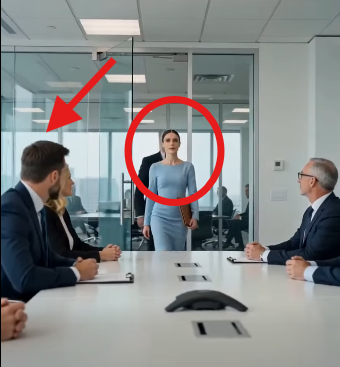
And then she walked in.
The room shifted the moment she entered — not dramatically, not with fanfare, but with the kind of subtle recalibration that happens when someone genuinely powerful steps into a space. She was composed. Dry. Perfectly dressed. The folder under her arm was different from the one the puddle had soaked through that morning, but her face was the same face he’d caught in the rearview mirror for less than a second before he’d looked away.
He couldn’t move.
His body seemed to understand what his mind was still refusing to process. Every executive in the room watched her take her seat at the head of the table — calm, unhurried, completely in control. Then one of them noticed him frozen by the door and frowned.
“Is there a problem?”
He swallowed hard. His mouth opened. Nothing useful came out.
She didn’t look at him right away. She set her folder on the table, adjusted her chair, and let the silence stretch just long enough for everyone to feel it before she spoke.
“That seems to be a pattern,” she said.
The room went still.
The man in the red tie looked between them slowly, the picture assembling itself piece by piece. “You two know each other?”
She folded her hands over the closed folder with the patience of someone who has prepared for exactly this moment.
“We met this morning,” she said. “Very briefly.”
A few people shifted in their seats. One board member lowered his pen. Another leaned back with narrowed eyes. The air in the room had changed completely, and everyone felt it even if they didn’t yet understand why.
“He was in a hurry,” she added.
Those four words hit the room like a verdict.
He felt his face burn. His chest tightened. The comfortable arrogance that had carried him through the morning — through the traffic, through the decision not to slow down, through the momentary irritation of a stranger in his path — evaporated completely.
“Ma’am, I can explain—”
She lifted one finger. Not cruelly. Not dramatically. Simply, finally.
“No,” she said. “What you can do is listen.”
He stopped talking.
She opened the folder and removed the first document. As she explained that her company had been in the final stages of acquiring his company’s transport division, he felt the floor tilt beneath him. She had flown in personally, she said, because she believed the character of a company revealed itself not in conference rooms but in ordinary moments — in the street, in the parking lot, in the way people behaved when they believed no one of consequence was watching.
She placed two photographs on the table. Security footage. City camera stills. His face — unmistakable, undeniable — captured in the exact moment of the exact thing he could not take back.
The executive in the red tie went pale.
The board members exchanged looks that said everything.
He stood there with no script, no exit, no version of this story that ended in his favor.
Finally — because there was nothing else left — he said, “I’m sorry.”
She nodded once. Measured. Without malice.
“I believe you are,” she said.
The silence that followed was the loudest thing he had ever heard.
Then she closed the folder.
“Security will escort you out,” she said. “Not because of what happened on the street this morning.”
She paused, just long enough.
“Because you showed everyone in this room exactly who you are when you think it doesn’t matter.”
He was walked out quietly. No scene. No dramatic confrontation. Just the sound of his own footsteps in a hallway where, an hour ago, he had believed this day would go entirely his way.
The acquisition moved forward.
Under new leadership.
The lesson he learned — the one that cost him everything — is one that most people already know but too few actually live by: how you treat someone when you have nothing to gain is the truest measure of your character. Kindness is not weakness. Decency is not optional. And the stranger you dismiss without a second thought may one day be sitting at the head of the table, holding a folder, and remembering exactly who you chose to be when you thought no one important was watching.
Someone is always watching.
And character — the real kind — doesn’t take days off.