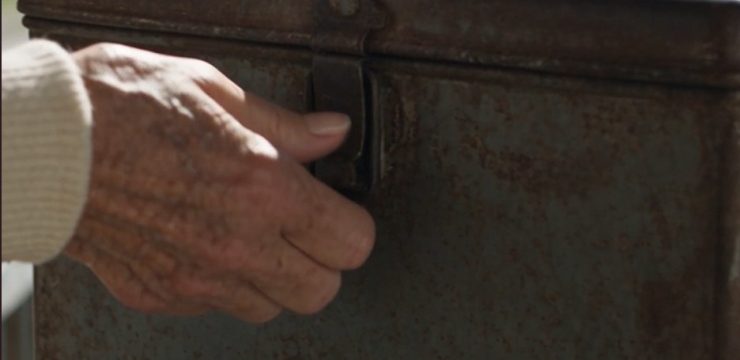
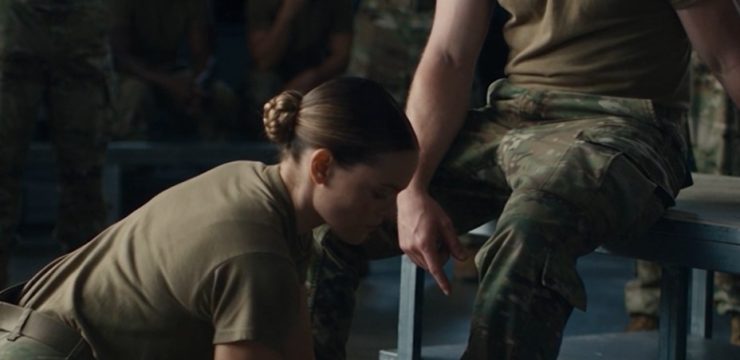
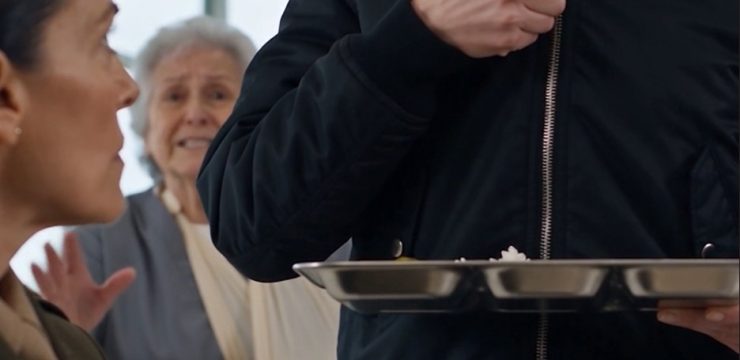
The glass tilted before anyone understood what was happening.
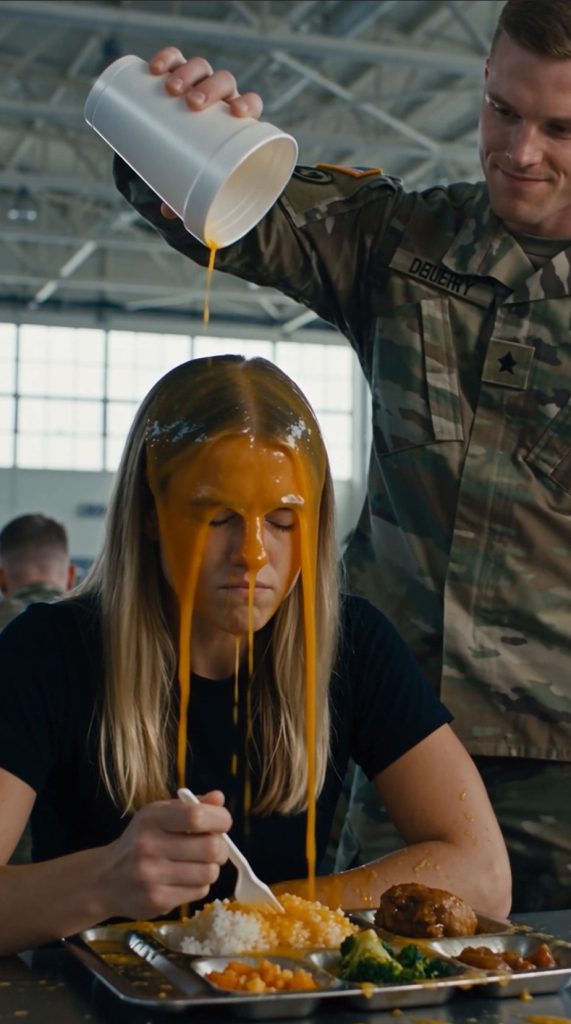
Cold juice poured over the young woman’s hair, ran across her face, and soaked into the black fabric of her uniform. For one long second, the entire dining hall seemed to hold its breath.
And still, she did not move.
For days, whispers had followed the arrival of a new female soldier.
No one seemed to know where she had come from. Some claimed she had been transferred from another unit. Others were convinced she had only recently graduated from the academy.
But there was one detail no one could explain.
Nobody knew her rank.
At lunchtime, several soldiers finally spotted her sitting alone at a table in the far corner of the dining hall.
She ate quietly, almost unnervingly calm beneath the weight of dozens of curious glances. She made no attempt to introduce herself, no effort to join anyone, and showed no sign that she cared about the attention gathering around her.
“Is that her?” one soldier murmured.
“Looks like it.”
Across the room, Captain Mark followed their gaze.
His eyes narrowed.
Mark was accustomed to newcomers finding him first. In his mind, entering his company meant reporting to him, introducing yourself properly, and learning very quickly who controlled the room.
Some of those expectations existed only in Mark’s head.
He had created his own little rules over the years, unwritten traditions designed less around discipline and more around reminding everyone beneath him exactly where they stood.
And he enjoyed enforcing them.
Especially on newcomers.
A faint smile appeared on his face as he reached for a glass of juice.
“Watch,” he said to the soldiers near him. “This is how you welcome someone who doesn’t know her place.”
He crossed the dining hall slowly.
Conversation softened as people noticed where he was going.
The young woman kept eating.
Mark stopped beside her table and waited.
One second.
Two.
Three.
He clearly expected her to notice the captain beside her, spring to her feet, and introduce herself.
She never did.
Mark’s smile tightened.
“You probably haven’t heard,” he said, loud enough for nearby tables to listen. “We have a rule here. You introduce yourself to me first. Then I decide whether you’re allowed to sit down and eat with everyone else.”
The young woman stopped.
Slowly, she placed her fork on the tray.
Then she looked up at him.
There was no fear in her expression. No irritation either.
Just calm.
“I know the regulations by heart,” she said. “There is no such rule.”
The room changed instantly.
Conversations died.
Several soldiers glanced at one another, surprised not by what she had said, but by how calmly she had said it.
People did not usually correct Mark.
His mouth curved into a mocking smile.
“So you’re brave.”
She said nothing.
Mark leaned slightly closer.
“If you know the regulations that well, then you should also know that when a higher-ranking officer appears, a soldier is expected to stand.”
Her eyes stayed on his.
“I know.”
A pause.
“But apparently you don’t know the regulations as well as you think. A soldier is not required to stand while eating.”
Someone at the next table lowered his head quickly, hiding a smile.
Mark noticed.
The amusement vanished from his face.
“I see,” he said quietly. “Not only brave. Smart too.”
The young woman simply reached for her fork again.
That tiny movement did more damage than an insult could have.
She had dismissed him.
In front of everyone.
Mark stared down at the glass in his hand.
His jaw tightened.
Then, without warning, he raised it.
Juice spilled over her head.
It streamed through her hair, across her cheeks, down her neck, staining her uniform as shocked silence gave way to a few nervous chuckles from somewhere behind him.
Mark looked around, satisfied.
“Now,” he said loudly, “you’ll remember your place.”
He waited for anger.
For tears.
For shouting.
Anything that would prove he had broken through that calm expression.
But the young woman merely wiped a drop of juice from beside her eye.
Then she reached slowly into her pocket.
The laughter stopped.
Mark’s smile began to disappear.
She pulled something out, placed it where he could see it, and for the first time since walking across that dining hall, the captain looked genuinely afraid.
Nobody in that room was prepared for what came next. 👇
The leather credential case landed softly beside her tray.
It should have been an insignificant sound, barely louder than the hum of the refrigerators behind the serving line, but in the silence it seemed to strike every wall in the room.
Mark stared at it.
Then he stared at her.
The young woman pushed the open case toward him with two fingers.
Her photograph was on one side. On the other were the insignia and identification Mark had been too arrogant to ask for before deciding what she must be.
Major Elena Ward.
For several seconds, Mark seemed unable to breathe.
One of the soldiers behind him slowly lowered his spoon.
“You said a higher-ranking officer,” Elena said quietly.
Mark’s face drained of color.
She did not raise her voice. Somehow, that made the moment worse.
“Captain,” she continued, “would you like to reconsider the regulation you were explaining to me?”
His lips parted.
Nothing came out.
A chair scraped somewhere near the back of the dining hall.
Mark glanced around as though searching for someone to laugh, someone to break the unbearable weight of the silence and turn what had happened back into a joke.
Nobody did.
Even the soldiers who had chuckled when the juice came down were staring at their trays now.
Mark swallowed.
“Major, I—”
“Don’t.”
The single word stopped him.
Elena picked up a napkin and slowly wiped juice from the edge of her jaw. Her hand was steady, but when she folded the wet napkin and placed it beside her tray, the muscles in her fingers tightened.
“This isn’t about what you did after discovering my rank,” she said. “It’s about what you were willing to do when you thought I had none worth respecting.”
Mark’s eyes flickered.
That sentence seemed to frighten him more than the credential.
He took half a step back.
“It was a misunderstanding.”
Elena looked at the overturned glass.
Then at the dark stain spreading across the front of her uniform.
“A misunderstanding?”
“It was company humor. The men know that.”
No one answered.
Mark turned toward them.
“You know that.”
Still nothing.
A young soldier at the nearest table slowly lifted his eyes.
He was the same one who had hidden a smile earlier.
This time he did not look away.
Mark noticed.
Something hard returned to his expression.
“Private, you have something to say?”
The young man’s shoulders stiffened automatically.
Fear moved across his face before he could hide it.
Elena saw it.
So did everyone else.
And in that instant, the atmosphere in the room changed again.
The issue was no longer juice.
It was that look.
A soldier afraid to speak because his captain had asked him a question.
Elena rose from her chair.
For the first time, Mark had to look slightly upward to meet her eyes.
“I was ordered here three days ago,” she said. “I was instructed not to announce the purpose of my transfer until I had observed this company under normal conditions.”
Mark went completely still.
Several soldiers looked at one another.
Elena continued.
“There have been complaints about command conduct in this unit.”
A pulse jumped in Mark’s temple.
“Complaints from whom?”
“That is not information you are entitled to.”
His composure cracked.
“This is ridiculous. Anyone can complain. Half these kids don’t understand discipline.”
A few faces hardened around the room.
Mark realized too late what he had said.
Elena’s gaze never left him.
“You had one choice when you walked toward this table,” she said. “You could have behaved like an officer.”
She glanced at the juice dripping from the edge of her chair onto the floor.
“You made another choice.”
Mark’s chest rose sharply.
For a moment, pride appeared to fight panic inside him.
Then he reached toward the credential case.
Elena placed her hand over it before he could touch it.
“Don’t.”
His hand stopped in midair.
The doors to the dining hall opened behind him.
Every head turned.
A colonel entered with two senior officers, their boots striking the floor in measured steps. They had been expected for the formal command review later that afternoon.
Clearly, Mark had not expected them now.
The colonel’s eyes moved from Elena’s soaked uniform to the overturned glass, then finally to Mark.
Nobody had to explain the scene.
Not immediately.
The colonel looked at Elena.
“Major Ward?”
She gave a small nod.
“I believe we should move the scheduled review forward, sir.”
Mark’s voice came out too quickly.
“Colonel, this is being taken completely out of context.”
The colonel looked at him for a long moment.
“Then you’ll have an opportunity to provide the context.”
Mark tried to smile.
It failed.
The next hour stripped away everything he had relied upon.
Not his rank.
Not yet.
Something more important.
His certainty that nobody would speak.
The young soldier from the nearby table spoke first.
His name was Daniel.
His voice shook so badly at the beginning that he had to stop twice.
He described the invented rules. The public humiliations. The way punishment seemed to become personal whenever someone questioned Mark. Nothing dramatic came from him at first—only small incidents, each one easy to dismiss by itself.
Then another soldier stood.
Then another.
A sergeant who had spent fifteen years in uniform stared at the floor for almost a full minute before admitting that he had watched Mark cross lines repeatedly and had remained silent because he feared destroying the careers of younger soldiers if he challenged him publicly.
Mark listened as the room he had controlled through embarrassment slowly stopped fearing him.
“No,” he said suddenly. “No, this is coordinated.”
Nobody moved.
“You’re all doing this because she’s here.”
Daniel looked at him.
For the first time, his voice did not shake.
“No, sir.”
Mark’s face tightened.
Daniel swallowed.
“We’re saying it because somebody finally stayed.”
The sentence landed harder than any accusation.
Mark looked around.
There was nowhere left to turn.
By evening, he had been relieved of command pending investigation.
The inquiry that followed lasted weeks.
Witnesses who had once convinced themselves that their experiences were too small to matter finally described them together. Patterns emerged. Statements were compared. Orders were reviewed.
Mark denied most of it.
Then minimized it.
Then insisted that harsh leadership had been mistaken for abuse of authority.
But his own words in the dining hall had been heard by dozens of people, and his treatment of Elena had given the investigators something the frightened soldiers had never had before: a public incident he could not quietly redefine afterward.
When the findings were completed, Mark did not return to command.
Administrative and disciplinary proceedings ended the authority he had used as a weapon for years.
The morning the decision became official, nobody celebrated.
That surprised Elena.
She entered the dining hall expecting relief, maybe even quiet satisfaction.
Instead, she found soldiers eating beneath the pale morning light in an uneasy silence.
Daniel sat near the window.
She carried her coffee over and sat opposite him.
He looked at her cup, then at her uniform.
“No juice today?”
For the first time, Elena laughed.
It was brief and tired, but real.
Daniel smiled, then looked down.
“I thought I’d feel better.”
Elena wrapped both hands around the warm cup.
“About Mark?”
Daniel nodded.
“I wanted him gone for months.”
He rubbed his thumb against a scratch in the tabletop.
“Now he is. And I keep thinking about all the times I watched him do something to somebody else and told myself it wasn’t my problem.”
Elena said nothing for a moment.
Morning light fell across the table between them.
“You were afraid.”
“That doesn’t make it right.”
“No.”
Daniel looked up, surprised by the answer.
Elena leaned back slightly.
“But guilt only becomes useful when it changes what you do next.”
His eyes dropped again.
“What if I’d spoken sooner?”
“Then maybe something would have changed sooner.”
The words hurt. She let them.
Then she added, “And if you hadn’t spoken at all, maybe nothing would have changed.”
Daniel breathed out slowly.
Across the room, the senior sergeant who had testified was helping a new recruit find an empty seat.
No shouting.
No test.
No invented rule.
Just a hand on the back of a chair.
“There’s room here,” he told him.
Daniel watched.
Something in his face softened.
Weeks became months.
The company did not transform overnight.
People who had spent too long measuring every word around their commander still went quiet when senior officers entered rooms. Some soldiers instinctively looked toward the door before complaining about anything. Others apologized for mistakes before anyone had accused them.
Trust returned in pieces.
Elena stayed through the transition.
She learned names.
She listened more than she spoke.
When someone made an error, she corrected it without turning the correction into a performance. When discipline was necessary, she explained why. Slowly, the soldiers began to understand that authority could enter a room without making everyone inside it smaller.
Then, on Elena’s final afternoon with the company, Daniel approached her carrying a thin folder.
“There’s something you should know before you leave.”
She looked at him.
He placed the folder on her desk.
Inside were copies of the original complaints that had triggered her assignment.
Elena frowned.
She already knew their contents.
Then she noticed the dates.
Different handwriting.
Different sections of the company.
Different months.
Daniel stood across from her, his hands clasped behind his back.
“I thought I was the one who started it,” he said. “The first complaint I made was anonymous.”
Elena looked through the pages again.
There were more than she remembered seeing together.
Daniel gave a nervous breath.
“So did everyone else.”
She raised her eyes.
He smiled faintly.
“That’s what they told me this morning. Almost everybody thought they were the only one who had said something.”
Elena stared at the folder.
Suddenly the first day looked different.
The lowered eyes.
The nervous laughter.
The silence after Mark poured the juice.
It had never been the silence of people who accepted what he was doing.
It was the silence of people who believed they were alone.
One by one, without knowing about the others, they had already tried to speak.
Not loudly.
Not perfectly.
But enough.
Elena closed the folder.
Outside her office, voices drifted down the corridor.
Someone laughed.
A door opened.
A soldier called to another to save him a seat for dinner.
Daniel reached for the folder, but Elena kept one hand resting on it.
“You know what this means?”
He shook his head.
“It means nobody saved this company alone.”
His eyes glistened before he looked away.
Elena stood and handed him the folder.
“You saved each other.”
That evening, the dining hall filled slowly.
There was no ceremony.
No speech.
No attempt to turn what had happened into something cleaner than it had been.
Elena took the same seat in the far corner where everything had begun.
A tray appeared across from her.
Daniel sat down.
Then the senior sergeant joined them.
Another soldier pulled over a chair.
Then another.
Within minutes, the table was crowded.
Someone passed Elena a glass.
She looked down.
Orange juice.
The table went silent.
Daniel froze halfway through sitting down.
“Oh, no.”
Elena stared at the glass for another second.
Then she began to laugh.
The sound broke something open in the room.
Daniel laughed too.
The sergeant covered his face with one hand.
Soon the entire table was laughing—not at someone, not because they were afraid not to, but because for once nobody in the room needed to measure the sound.
Elena lifted the glass.
Daniel cautiously raised his own.
“To regulations?” he asked.
She gave him a look.
He grinned.
“To knowing the real ones.”
Glasses touched softly across the table.
Outside, evening light stretched gold across the windows, warming the worn tables and plain walls until the old dining hall looked almost unfamiliar.
Elena looked around at the faces beside her.
No one was standing because they had been ordered to.
No one was silent because they were afraid.
And when the newest soldier in the company appeared uncertainly at the doorway, searching for somewhere to sit, Daniel moved his chair aside and waved him over.
“There’s room here.”
The young soldier hesitated.
Then he smiled and walked toward them.
Elena wrapped both hands around her glass as another chair scraped gently across the floor, making space at the table.
And this time, nobody had to earn the right to belong.
:::