By 10:55 that morning, every belonging my son and his wife had brought into my house was sitting neatly on the front porch.
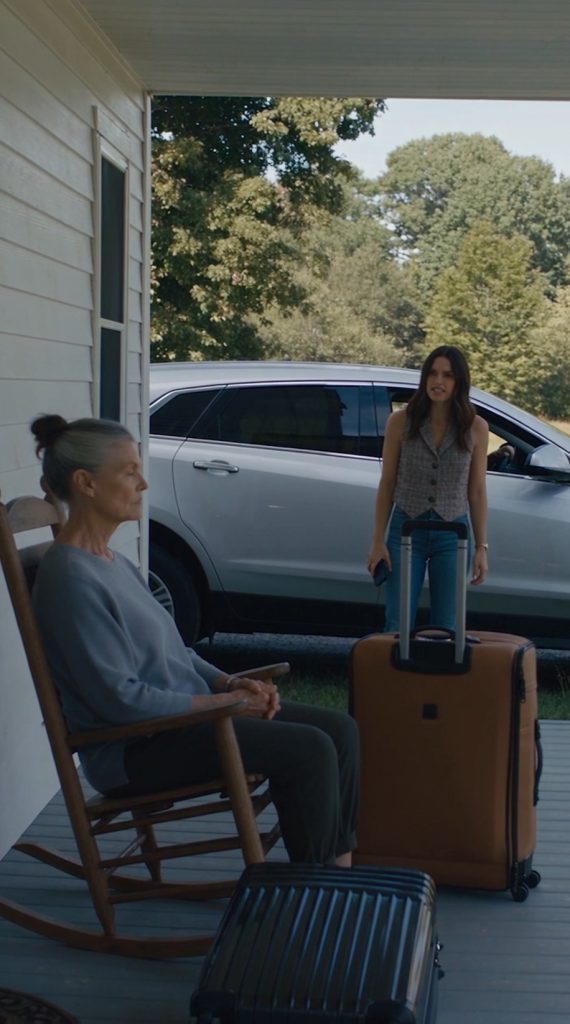
Four suitcases. Three cardboard boxes. My geraniums beside them.
And through the living-room window, I watched my daughter-in-law step out of her SUV and realize something had gone terribly wrong.
Less than two hours earlier, she had been standing in my kitchen with an iced latte in her hand, calmly ordering me out of my own bedroom.
“Move your things,” Sarah said, as casually as if she were asking me to clear a plate from the table. “We’re taking the master bedroom.”
For a moment, I thought I had misunderstood her.
I stood beside the sink, a damp dish towel hanging between my hands, staring at this woman who had been living under my roof for exactly three days.
My name is Kimberly Porter. I’m sixty-four years old, and that four-bedroom house had been mine for twenty years.
My late husband and I bought it together. We chose the furniture together. We argued over paint colors, planted flowers in the yard, and spent years filling those rooms with the ordinary little memories that become priceless after someone is gone.
It was not a rental.
It was not a temporary family property.
It was my home.
A month earlier, my son David had called because the rent on his apartment was increasing. I told him he and Sarah could stay with me temporarily while they saved money and searched for somewhere else.
Three days later, Sarah was claiming my bedroom.
“Excuse me?” I finally said.
David appeared in the kitchen just then.
He wouldn’t meet my eyes.
Instead, he stared at the floor.
“Mom, Sarah needs the space,” he said quietly. “The guest room doesn’t have a walk-in closet for all her clothes. And she works from home now.”
I waited for him to laugh.
To tell me this was ridiculous.
Instead, he added, “Just show some respect and let us have the master.”
Something inside me went very still.
Respect.
In the house I owned.
David had always been easy to sway. Even as a boy, he hated conflict so much that he would usually bend toward whoever pushed hardest.
That morning, Sarah was pushing.
“Your room is the guest room,” I said, folding the dish towel carefully. “That was the arrangement.”
Sarah rolled her eyes.
She set her plastic cup on my granite counter with a sharp clink.
“I’ve already decided,” she said. “The movers are bringing the rest of our bedroom furniture this morning. Make sure your room is empty by eleven.”
Then she walked away.
David followed her.
Minutes later, their silver SUV disappeared down the driveway.
I stood alone in the kitchen.
No shouting.
No tears.
I made tea.
Then I sat at the table, listening to the soft hum of the refrigerator while the meaning of what had just happened settled over me.
At 9:15, I went upstairs.
I passed my bedroom without touching a thing.
My oak dresser remained exactly where it belonged. My bed was untouched. In the corner sat my husband’s old reading chair, still angled toward the window the way he had liked it.
I rested my hand on the doorframe.
Then I turned toward the guest room.
Sarah’s skincare bottles covered the dresser. David’s shoes lined the wall. Their suitcases lay open across the floor as though three days had already made them permanent residents.
I stared at everything for a long moment.
Then I picked up the largest suitcase.
I packed carefully.
Sarah’s silk blouses were folded. David’s socks were paired. Toiletries went into a waterproof bag. Nothing was broken. Nothing was thrown away.
I simply removed every possession they had brought into my home.
By 10:30, the room was empty.
One by one, I carried four suitcases and three boxes downstairs and arranged them neatly on the porch.
Then I locked the front door.
At 10:55, the silver SUV turned into the driveway.
Sarah climbed out laughing into her phone.
She took three steps.
Then she saw the luggage.
Her smile vanished.
David stepped out behind her and followed her stare toward the porch.
Inside, I remained perfectly still in my favorite chair by the window.
Sarah slowly lowered the phone from her ear and looked toward the locked front door.
And then she started walking toward me.
Nobody in that house was prepared for what came next. 👇
Her knuckles struck the front door hard enough to rattle the glass.
“Kimberly!”
I stayed seated.
She knocked again, louder this time, then tried the handle as though she still couldn’t quite believe I had locked her out.
David remained near the SUV. His face had gone pale.
“Mom,” he called through the door. “Can we just talk?”
I stood slowly and walked into the hallway.
Before I could reach the door, the low growl of a truck rolled into the driveway behind their SUV.
The movers.
Sarah glanced over her shoulder, and for the first time that morning, I saw something other than anger cross her face.
Fear.
A man in a navy work shirt climbed down from the cab carrying a clipboard.
“Sarah Porter?”
She hurried toward him.
“Yes. You’re late.”
He glanced at his paperwork. “We have an eleven o’clock bedroom removal and installation.”
David’s head lifted.
“Removal?”
The word hung in the air.
Sarah froze.
The mover looked from her to the house. “Existing master-bedroom furniture is to be removed before the client furniture goes in. That’s what the order says.”
For several seconds, nobody moved.
Then David turned toward his wife.
“You told me they were bringing our furniture.”
“They are.”
“You told them to remove Mom’s?”
Sarah’s jaw tightened. “Obviously something had to come out.”
My fingers were still resting on the deadbolt.
I unlocked the door but did not open it more than a few inches.
“Sir,” I said to the mover, “I own this house. I did not authorize anyone to remove anything.”
He immediately stepped back.
Sarah spun toward me. “Don’t do this.”
“I’m not doing anything.”
The mover lowered his clipboard. “Ma’am, if the homeowner hasn’t approved the removal, we can’t touch the property.”
“She approved it,” Sarah snapped.
“No,” I said.
David looked at the clipboard.
“Who signed the authorization?”
The mover hesitated, then turned it toward him.
Sarah’s signature was at the bottom.
Beside it, under authorization, she had identified herself as a resident with permission to alter the room.
David stared at the page.
A muscle moved once in his cheek.
“You said Mom agreed.”
Sarah’s eyes flicked toward him.
“I said I would handle it.”
“That isn’t what I asked.”
Her shoulders rose with a sharp breath.
“Oh, please. We’re married, David. We needed a decent room. Your mother has this entire house to herself.”
I opened the door fully.
The morning air carried the warm smell of cut grass and exhaust. My geraniums trembled slightly in the breeze beside their luggage.
“This house being mine is not a problem that needs solving,” I said.
Sarah laughed once, but there was no humor in it.
“You act like we’re strangers.”
“No,” I said. “Strangers would never have felt entitled enough to do this.”
David flinched.
Sarah saw it.
And then she made the mistake that ended everything.
“Why are you acting surprised?” she demanded, turning on him. “There’s no apartment to go back to anyway.”
David stared at her.
“What?”
She stopped.
Too late.
Even the mover seemed to sense that the air had changed. He took two quiet steps toward his truck.
David’s voice dropped.
“What do you mean, there’s no apartment?”
Sarah folded her arms.
“I gave notice.”
His face emptied.
“When?”
“Two weeks ago.”
Two weeks.
A full week before they moved into my house.
David looked at me, then back at her.
“You told me we were staying here while we looked for another place.”
“I knew you’d drag your feet.”
“So you ended our lease without telling me?”
“I made a decision.”
The same words.
The same tone she had used in my kitchen.
I’ve already decided.
David seemed to hear it too.
His gaze dropped to the suitcases on the porch, then lifted slowly to the bedroom window above us.
“You never planned for this to be temporary.”
Sarah said nothing.
He stepped closer to her.
“You planned to move us into Mom’s house.”
“It will be yours someday anyway.”
The silence that followed was so complete I could hear leaves scraping softly across the driveway.
David’s face changed.
Not dramatically.
That was what made it hurt to watch.
His mouth parted slightly. His shoulders lowered. Something in him simply stopped defending her.
“My mother is standing right there,” he said.
Sarah rolled her eyes.
“I know that.”
“No,” David whispered. “I don’t think you do.”
She reached for his arm.
He moved away.
It was only half a step.
But Sarah noticed.
So did I.
“David.”
He looked at her hand hanging between them.
Then he looked at me.
His eyes were wet.
“Mom, I’m sorry.”
I didn’t answer.
He swallowed.
“I stood in your kitchen and told you to show respect while my wife was trying to take your bedroom.”
Sarah made an impatient sound.
“Don’t turn this into some dramatic betrayal.”
David turned on her so suddenly she stopped speaking.
“You canceled our lease.”
His voice cracked.
“You lied to me. You lied to her. You hired people to carry my father’s furniture out of the room he shared with my mother.”
Sarah’s face hardened.
“I was trying to build a life for us.”
“By taking hers?”
She had no answer for that.
The mover quietly held the clipboard toward Sarah.
“We’ll need to know where you want your furniture delivered instead.”
She stared at him.
Then at the luggage.
Then at David.
For the first time since I had met her, nobody was rushing to fix the consequences of her choices.
Her power disappeared in the silence.
“Fine,” she said. “David, get your things.”
He didn’t move.
“David.”
“I’m not going with you.”
Her face went still.
Neither of us had expected those words.
Maybe David hadn’t either.
He rubbed both hands over his face and took a shaky breath.
“I’m not staying here, Mom,” he said quickly. “I know I don’t deserve that. I’ll get a hotel.”
Then he looked at Sarah.
“But I’m not pretending this didn’t happen.”
She stared at him for several seconds before snatching her phone from her purse.
“Unbelievable.”
She gave the movers the address of a storage facility.
Within twenty minutes, the truck was gone.
Sarah followed it in the SUV.
She never looked back.
David’s suitcase remained on my porch.
He picked it up himself.
At the bottom step, he stopped.
“I don’t know how to fix what I said to you.”
“You don’t,” I answered.
His eyes closed briefly.
I softened my voice, but not the truth.
“You live differently after saying it.”
He nodded.
Then my son carried his suitcase to the curb and called a taxi.
I watched him leave without inviting him back inside.
That was one of the hardest things I had ever done.
Three evenings later, the doorbell rang.
David stood beneath the porch light wearing the same jacket he had left in. There were shadows beneath his eyes.
He didn’t have a suitcase.
He didn’t ask to come home.
“I filed for a legal separation today,” he said.
I opened the screen door.
He remained outside until I stepped aside.
We sat at the kitchen table where Sarah had placed her iced latte that morning.
David kept both hands wrapped around a mug of coffee he barely touched.
“She still thinks the problem is that I embarrassed her by not leaving with her,” he said.
I watched steam curl between us.
“Not what she did?”
He shook his head.
“No.”
His thumb moved slowly over the rim of the mug.
“I kept telling myself I was keeping the peace. With her. With everyone.”
He looked toward the floor.
“But peace isn’t what I was keeping.”
I waited.
“I was keeping myself comfortable.”
That was the first apology I believed.
Months passed.
David rented a small one-bedroom apartment across town. He went to counseling. He stopped asking me to tell him he was forgiven.
Instead, he showed up.
He fixed the loose hinge on the garden gate. He brought groceries when I had the flu. When he came for dinner, he asked before taking anything home.
Small things.
Ordinary things.
The kind trust is actually made of.
Sarah signed the divorce papers after months of insisting David would change his mind.
He didn’t.
Her possessions remained hers. My house remained mine. And David learned that losing a marriage did not mean he was entitled to reclaim his childhood bedroom.
One Sunday afternoon, nearly a year after that morning, he helped me clean upstairs.
When we reached the master bedroom, he paused at his father’s reading chair.
“I haven’t sat in that thing since Dad died.”
“You always complained it swallowed you whole.”
A faint smile crossed his face.
“It did.”
He bent to lift one side so I could vacuum beneath it.
Something crackled inside the fabric.
David frowned.
He reached beneath the loose lining and pulled out a yellowed envelope.
My breath caught.
I knew the handwriting before he turned it over.
David did too.
His father’s handwriting.
Across the front were two words.
For David.
He looked at me.
I shook my head.
“I’ve never seen it.”
His hands began to tremble.
Inside was a single folded page.
My husband had written it years earlier, apparently after one of those long father-and-son talks I had forgotten about.
David read silently at first.
Then his face crumpled.
He handed me the page.
Near the bottom, my husband had written:
Being kind does not mean disappearing. Never call surrender peace. And never let anyone you love believe they must give up their dignity to keep yours.
I covered my mouth.
There was one final line.
Your mother made this house a home because everyone inside it knew they were safe with her. Make sure she always feels safe too.
David sat down in the chair.
For a long time, neither of us spoke.
Then he bent forward, pressed the heels of his hands against his eyes, and cried with the quiet helplessness of a boy who had found his father’s voice exactly when he had finally learned how to hear it.
I sat beside him on the edge of the bed.
He lowered his hands.
“I failed him.”
“No.”
My voice came out softer than I expected.
“You failed me that morning.”
He looked at me.
“And then you stopped.”
His chin trembled.
I reached for his hand.
“That matters too.”
He held on.
Not tightly.
Just enough.
By spring, the geraniums on the porch were blooming again.
David came for Sunday dinner carrying a loaf of bread from the bakery his father used to love. He washed the dishes afterward while I dried them, and sunlight poured across the kitchen counter where an iced latte had once marked the beginning of the worst morning between us.
Before he left, I placed something in his palm.
A spare key.
He stared at it.
“Mom…”
“This doesn’t mean you live here.”
A surprised laugh escaped him through suddenly wet eyes.
“I know.”
“It doesn’t mean this house is yours.”
“I know that too.”
I closed his fingers around the key.
“It means you’re my son. And you’re welcome.”
He looked down at our joined hands.
Then he leaned forward and wrapped his arms around me.
There was no speech.
No perfect sentence that erased what had happened.
There didn’t need to be.
Over his shoulder, I could see my husband’s old reading chair upstairs through the open bedroom door, warmed by the last gold light of the afternoon.
The letter was tucked safely in David’s jacket pocket.
The geraniums moved gently outside the window.
And as my son stood in my kitchen holding a key he finally understood was an invitation rather than a right, the house no longer felt like something I had to protect from the people I loved.
It simply felt like home.