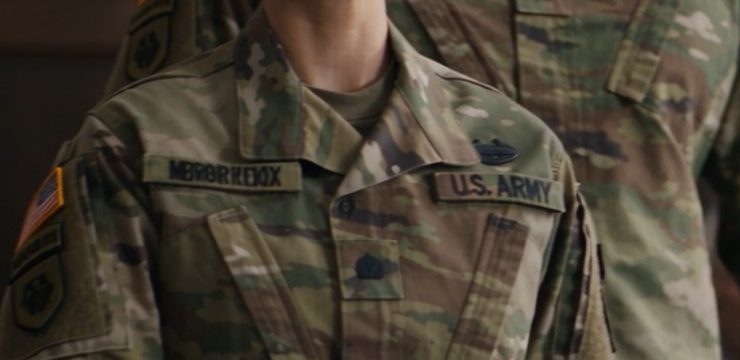
His hand closed around the front of her uniform before anyone had time to react.
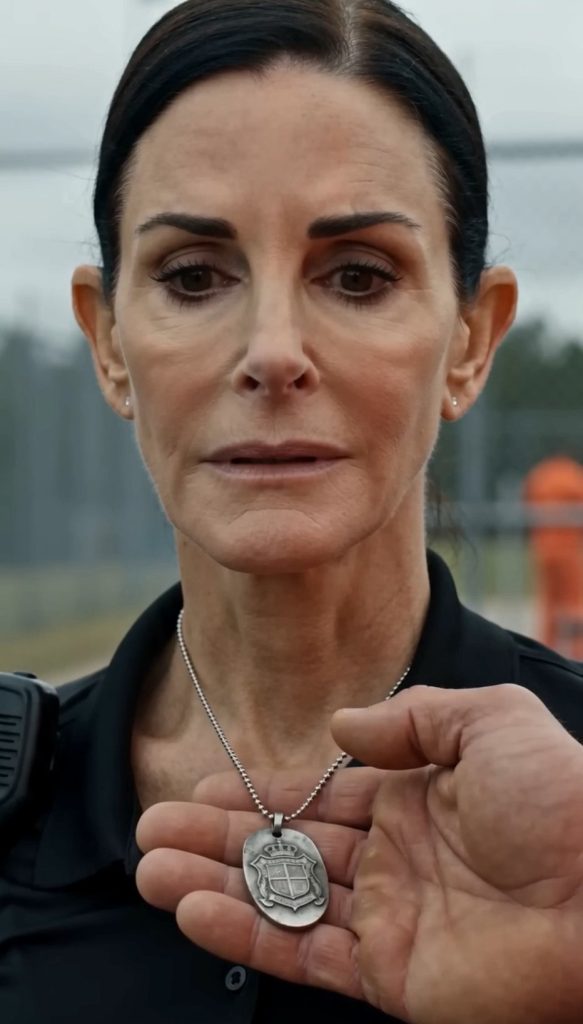
The prison yard went silent as the most feared inmate in the facility stared at the medallion hanging from the new guard’s neck. Whatever he saw in that small piece of metal had erased every trace of calm from his face.
Hours earlier, the tension had been easier to understand.
A new female guard had entered the prison, and the reaction was immediate. Men in orange uniforms traded looks across the yard. Some smirked. Others watched her with open irritation.
“Just what we needed,” one inmate called out. “A woman telling us what to do.”
Laughter spread behind him.
She gave them nothing.
She crossed the yard at the same steady pace, shoulders straight, eyes forward. She didn’t rush. She didn’t look down. If the comments reached her, there was no sign of it beyond the slight tightening of her jaw.
Later that day, the inmates were brought outside for exercise.
Some stretched lazily against the bars. Others sat on the concrete, talking beneath the watch of guards stationed above them.
And, as always, one man seemed to bend the entire atmosphere around himself.
He sat alone on a bench near the center of the yard, leaning slightly forward, forearms resting against his thighs. He was known as the most dangerous inmate in the prison, a man even experienced guards approached carefully.
Several inmates loyal to him stood nearby.
They spoke in low voices, occasionally glancing toward the new guard with amused expressions.
He wasn’t laughing.
He was watching her.
At first, his expression revealed nothing. Then sunlight caught something at her throat.
A thin chain.
A small medallion rested against her uniform—old, darkened with age, its unusual shape marked by a pattern so faded it was almost invisible.
His entire body went still.
Then his face changed.
The cold control disappeared from his eyes, replaced by something sharper. Anger, yes—but beneath it was something harder to name.
Recognition.
He stood so suddenly that the men beside him stopped talking.
One step.
Then another.
From the second level, the guards noticed immediately. Hands moved toward weapons. Bodies shifted into position.
The woman saw him coming.
She stayed where she was.
He stopped inches away.
Then his fist closed around her collar.
“Where did you get this medallion?”
His voice cracked across the yard.
Every conversation died.
Inmates turned toward them. One man who had been leaning against a wall straightened. Another instinctively backed away.
The guard didn’t.
Her breathing remained measured as she looked directly into his eyes.
“Let go.”
“I asked where you got it.”
His fingers tightened around the fabric.
“I recognize it.”
“That’s none of your business,” she said. “Go back to your place.”
For a moment, neither moved.
Then he leaned closer until barely any space remained between them.
“My mother had one like this.”
The anger in his voice faded just enough for something else to slip through.
A tremor.
His eyes dropped to the medallion again.
“Where did you get it?”
“One more move and I call the guards.”
Her voice remained steady, but her hand had gone still at her side.
He stared at her as if the prison yard had disappeared around them.
“I’ve got nothing left to lose,” he said.
Then, quieter:
“Talk.”
She said nothing.
That silence seemed to push him past whatever restraint he had left.
His hand released her collar and shot toward the chain.
Several guards above moved at once.
“Back away!”
Too late.
He yanked the medallion forward.
The chain pulled tight against her neck as his thumb found the tiny clasp along its edge.
Her expression changed for the first time.
Not fear.
Something closer to dread.
He saw it.
And that only made him more determined.
With one sharp movement, he forced the old medallion open.
The metal clicked.
Everyone nearby seemed to stop breathing.
His eyes dropped to whatever had been hidden inside all these years.
Then his face went completely pale.
The woman stared at him, motionless.
And around them, an entire prison waited for him to say what he had just discovered.
Nobody in that yard was prepared for what came next. 👇
His thumb trembled against the open metal.
Inside the medallion was a photograph no larger than a postage stamp. A young woman stood beneath a hospital awning, one arm around a dark-haired little boy and the other cradling a newborn wrapped in white.
The inmate stared at the boy.
Then at the woman.
“That’s my mother.”
The guard’s eyes flickered. For the first time since she entered the prison, the steadiness in her face broke.
“I know.”
A murmur moved through the yard.
He looked at her again, forcing himself to see what he had missed. The shape of her eyes. The small scar near her eyebrow. The way her mouth tightened when she was afraid.
“Who are you?”
Before she could answer, a voice thundered from the upper walkway.
“Separate them. Now.”
The warden was already coming down the metal stairs.
The guard’s face changed again.
Not relief.
Alarm.
She reached for the medallion, but the inmate closed his fist around it.
The warden crossed the yard with two officers behind him, his expression controlled except for the pulse beating hard in his temple.
“Give me that.”
The inmate slowly turned.
The guard stepped between them.
“No.”
The word was soft, but it stopped him.
The warden stared at her. “Officer, that is an order.”
Her fingers hovered near the body camera clipped to her chest.
“You knew why I came here.”
His eyes narrowed.
The warden lowered his voice. “Think very carefully about what you say next.”
The guard pressed the button on her body camera.
A tiny red light came on.
“I have been thinking about it for nineteen years.”
The warden moved toward her.
The inmate stepped in front of the guard, not touching him, simply placing his body between them.
Every officer above tensed.
“Don’t,” the guard whispered.
He kept his hands visible.
She pulled a folded photograph from inside her uniform pocket.
It was the same hospital picture, only larger.
On the back, written in faded blue ink, were three words, a date, and a case number.
The inmate recognized his mother’s handwriting before anything else.
“She left this with the family who raised me,” the guard said. “Along with the medallion. She told them that if anything happened to her, I was never to come looking until I could prove what happened.”
The warden’s face hardened.
“You were a baby,” the inmate said.
She nodded.
“You’re my—”
“Yes.”
His hand opened.
The medallion lay in his palm between them.
For years, rage had been the only thing people saw when they looked at him. Now it drained out of his face, leaving behind a man who looked suddenly younger and far more wounded.
“My sister.”
The warden lunged for the photograph.
The guard jerked back.
And that mistake ended him.
Her body camera caught it. So did the yard surveillance system.
The warden froze with his hand still extended.
The guard looked at him.
“You recognized the case number before you were close enough to read it.”
Silence spread across the concrete.
“That case belonged to my mother’s death investigation,” she continued. “You were the detective who signed the evidence log. You testified that my brother’s fingerprints proved he killed her.”
The warden’s jaw tightened.
“He did kill her.”
“No.”
She removed a small flash drive sealed in a clear evidence bag.
“I found the original intake photographs. The apartment door had been forced from the outside. There was blood on the broken latch. And the fingerprint report you signed was altered after the lab submitted it.”
The inmate stopped breathing.
“That proves nothing,” the warden said.
“It proves enough that Internal Affairs is outside the gate.”
Sirens sounded beyond the walls.
The warden turned toward the administration building.
The two officers behind him stepped away.
For years, authority had followed him wherever he walked.
Now nobody moved to protect him.
He looked at the inmate with naked hatred.
“You think this makes you innocent?”
The inmate’s hands curled into fists.
The guard caught his wrist.
“Don’t.”
He looked down at her fingers.
His sister’s fingers.
Slowly, he opened his hands.
“I’m not giving him one more thing to use against me.”
The gate at the far end of the yard opened.
Investigators entered with state officers behind them.
The warden called the scene an assault. He called the guard unstable. He called the inmate violent and manipulative.
Then one investigator held up a file.
The original evidence file.
The warden stopped talking.
His signature was on the altered pages. His access code had been used to remove photographs from storage. And minutes earlier, after seeing the medallion, he had ordered old case material destroyed over the prison radio.
He had done the final damage himself.
They handcuffed him in the same yard where men had spent years lowering their eyes when he passed.
No one cheered.
The inmates simply watched.
The officers watched too.
The guard stood beside her brother while the warden was led through the gate.
Only after the steel door shut did the inmate exhale.
The sound was almost a sob.
He sat on the nearest bench.
His sister sat beside him.
For a long time, neither spoke.
“You knew who I was when you came in here,” he finally said.
“Yes.”
“Why didn’t you tell me?”
“Because I didn’t know what you’d become.”
He flinched.
She didn’t soften the words.
“I had files full of fights, solitary reports, men afraid of you. I needed to see you before I trusted the boy in that photograph.”
He stared at the ground.
“And?”
She looked at his open hand, where the medallion still rested.
“I saw you stop.”
He turned toward her.
“When he tried to provoke you, you stopped. When I touched your wrist, you stopped. That mattered.”
His eyes filled before he looked away.
Months later, the court vacated the murder conviction.
The recovered photographs, laboratory records, altered reports, and the warden’s recorded attempts to destroy evidence collapsed the case that had put him away.
The warden was convicted of evidence tampering, obstruction, and crimes tied to the killing he had spent years hiding.
When the judge ordered the inmate’s release, the man everyone had called the most dangerous prisoner did not smile.
He stood absolutely still.
Then he asked, “Can my sister come in?”
She was already crying when she reached him.
He hesitated before opening his arms.
So did she.
Then the years between them disappeared into one awkward, crushing embrace.
Outside the courthouse, the world felt almost insulting in its normality.
Cars moved through traffic. Wind pushed dry leaves along the sidewalk.
He stood beneath an open sky with no fence above it.
His sister handed him the medallion.
He shook his head. “It’s yours.”
“It was never only mine.”
She pressed the tiny clasp.
A second compartment opened.
Hidden beneath the photograph was a paper-thin strip of yellowed fabric embroidered with two initials.
His mother’s letter, preserved by his sister’s adoptive family, explained the rest.
Before sending her baby daughter away for safety, she had sewn two small cloth bands, one for each child, and hidden both inside the medallion. She believed her son would recognize it one day.
The medallion had never been only a keepsake.
It had been a promise.
His sister handed him the letter.
He read the final lines twice.
All those years, he had believed his mother’s last act was leaving him behind.
Instead, she had spent it trying to make sure his sister could find her way back to him.
That evening, they went to her grave together.
His sister cleared dead leaves from the stone. He crouched beside her and traced their mother’s name with two fingers.
Then he placed the medallion between them.
“No,” his sister said quietly.
She picked it up and closed his hand around it.
“She already gave it back to us.”
His shoulders began to shake.
This time, he did not turn away.
His sister sat beside him on the cold grass and leaned against his arm.
The sky darkened slowly above them, blue fading into gold at the horizon.
For the first time in years, nobody was watching him through bars.
Nobody was giving orders.
Nobody was afraid.
When they finally stood to leave, he fastened the medallion around his sister’s neck again.
She smiled through swollen eyes.
“Still yours?” he asked.
She reached for his hand.
“Ours.”
And together they walked toward the waiting lights of home, carrying nothing between them now except the small, warm weight of a promise that had finally found its way back.