The room went completely still the moment they heard his voice.
Not because it was loud or demanding. Not because it startled anyone or cut through an argument. It went still because of what that voice sounded like — small, trembling, and worn down in a way that no child’s voice should ever be. It carried something that didn’t belong in childhood. It carried shame.
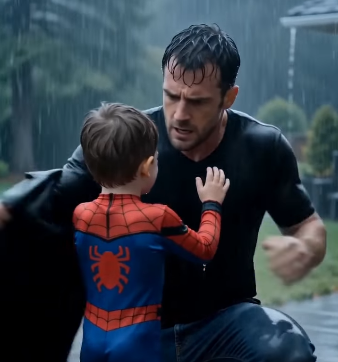
The man standing in the doorway hadn’t moved. He still wore his leather jacket, soaked straight through from the storm outside. His eyes hadn’t left the woman in that bed. Not once. Because he was trying to understand how a person he had built an entire life around could become someone he no longer recognized.
He had loved her completely. The kind of love that doesn’t ask for applause — the quiet, daily kind. He worked long hours and came home exhausted. He rode through bad weather without complaint. He skipped meals, cut sleep short, and gave everything he had to keep their family stable and warm. Every night when their little boy came running to the front door calling for him, he told himself it was all worth it. That was the proof. That moment right there — his son’s face lighting up — was the whole reason.
But something had been shifting for months. Something he noticed but couldn’t quite name.
His son had become quieter. More cautious around the house. More eager to stay out of the way, to avoid making anyone uncomfortable, to shrink himself down just enough not to cause trouble. He apologized constantly — for spilling a drink, for asking a question at the wrong moment, for simply being present in a room. A child that young shouldn’t know how to make himself invisible. A child that young shouldn’t feel like he needs to.
And then tonight, coming home through the rain, he had seen something that stopped him cold.
His son — his little boy in a Halloween costume — was locked outside. Standing at the glass door. Knocking. Crying. While the lights inside glowed warm and no one came.
That image would not leave him.
The woman in bed finally spoke. Her voice was careful, almost casual, like she was explaining away something minor.
“It was only for a minute.”
He took one step forward.
Just one.
But the two people in that bed flinched like he had crossed a much greater distance.
“A minute?” he said quietly. “He was freezing out there.”
The other man in the room tried to say something. Stopped. Thought better of it. Because he must have understood — even in that moment — that what was happening in this room had gone far beyond the obvious betrayal. Yes, the betrayal was real and ugly and would leave its own damage. But it was not the worst thing present. It was not even close.
The worst thing in that room was this: while she had been upstairs, her child had been standing in the rain outside learning what it feels like to be forgotten. Learning what it means when the people who are supposed to protect you simply don’t show up. He didn’t have the words for it yet. He was too young to understand the concept. But his body knew. His heart knew. And children carry those lessons long after they forget where they learned them.
Then the little boy appeared in the doorway.
Still wrapped in his father’s leather jacket, which swallowed him whole. His Halloween costume was soaked. His dark curls were plastered flat against his forehead. His cheeks were splotchy and red from crying too hard for too long. He looked at his father first — searching, the way children do when they’re trying to figure out if they’re safe. Then slowly, his eyes moved to his mother.
And in a voice so quiet it barely filled the room, he said seven words.
“I said I was sorry.”
Everything that had been holding together simply gave way.
Because those words told a story no parent should ever have to hear. Children only apologize like that when they have already decided that love is something they have to earn. When they believe that warmth and safety can be pulled away if they step out of line. When they have learned — from experience, not imagination — that being good enough is the price of being loved.
This little boy had been locked out in the rain and had concluded that somehow, it was his fault.
The father dropped to his knees in the doorway.
Not from weakness. From purpose. He needed to be at eye level with his son. He needed that child to look directly into his face when he heard what came next.
“You did nothing wrong,” he said.
The boy broke down completely.
Because sometimes the most overwhelming thing a hurt child can receive is the simple truth after spending so long absorbing the blame. To suddenly be told — clearly, directly, without condition — that none of it was his fault. That he didn’t deserve any of it. That he was never the problem.
The mother in that bed no longer looked defensive. She looked pale and exposed, like someone seeing themselves clearly for the first time in a long while — and not recognizing the person looking back.
The broken glass downstairs suddenly felt like the least important thing in the house.
What mattered was the man on his knees and the little boy finally being told the truth.
That glass had shattered when a father came through a locked door.
But what broke open in that upstairs room was something far more important — the silence that had been protecting a lie while a child quietly learned to disappear.
Some moments in a family cannot be undone. But some moments — like a father dropping to his knees to look his son in the eye — become the ones a child carries forward instead.