I Was Seven Years Old When I Heard The Footsteps Behind Me Speed Up Every Time I Walked Faster.
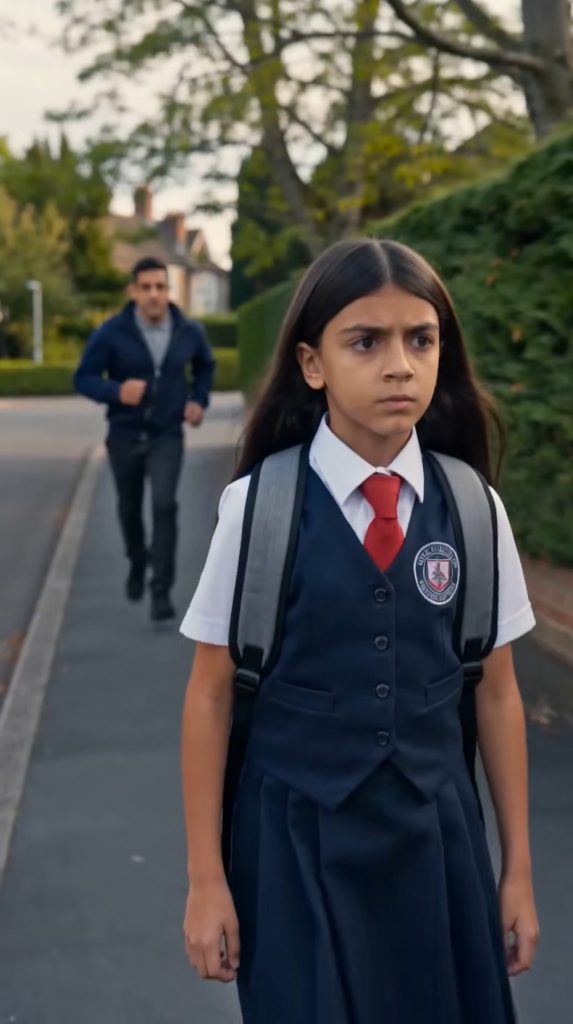
“Never Lead A Stranger Home,” My Mother’s Warning Suddenly Echoed In My Head—And My Front Door Was Only One Block Away. I Crossed The Street. The Tall Man In The Dark Jacket Crossed Too. He Was Getting Closer, And Every Part Of Me Wanted To Run Straight Home. Instead, I Stopped. I Had Just Seen Something Ahead That Changed My Mind Completely. I Turned Around And Looked Him Straight In The Face. He Slowed Down. Then I Made One Small Move Toward What I’d Noticed—and The Look On His Face Changed Instantly. Why Did He Suddenly Hesitate? What Had I Seen? And Why Would A Police Officer Later Tell My Mother That Those Next Few Seconds May Have Saved My Life?
The bakery door was open.
Warm yellow light spilled across the sidewalk, and behind the glass counter stood the woman Sofia had seen almost every afternoon on her walk home.
Sofia didn’t run toward her house.
She ran toward the bakery.
The stranger moved faster.
For half a second, Sofia heard his shoes scrape hard against the pavement behind her.
Then she heard his voice.
“Hey.”
She didn’t turn.
“Little girl, wait.”
Sofia’s heart hammered so violently that the straps of her backpack seemed to jump against her shoulders.
The bakery was only a few steps away now.
The woman behind the counter looked up.
Sofia reached the door, shoved it open with both hands, and stumbled inside.
A small brass bell above the frame rang sharply.
The woman froze when she saw Sofia’s face.
Sofia didn’t cry.
Not yet.
She pointed through the window.
“That man is following me.”
Everything changed in the woman’s expression.
She immediately came around the counter and pulled Sofia behind her.
“Stay here.”
Outside, the man had stopped.
For several seconds, he simply stood on the sidewalk staring through the bakery window.
Then he smiled.
It wasn’t a friendly smile.
It was the kind people used when they were pretending nothing was wrong.
He lifted one hand as if the whole thing had been a misunderstanding.
The bakery woman didn’t wave back.
Instead, she reached beneath the counter and picked up her phone.
The man saw it.
His smile disappeared.
He turned and began walking away.
“He’s leaving,” Sofia whispered.
The woman’s eyes stayed fixed on him.
“No,” she said quietly. “We’re not letting him disappear.”
She called the police.
Then she locked the bakery door.
Only after the deadbolt clicked into place did Sofia realize how badly her hands were shaking.
The woman crouched beside her.
“What’s your name?”
“Sofia.”
“I’m Elena.”
Sofia already knew that, though she had never spoken to her before. She had seen the name printed on a little badge pinned to Elena’s apron nearly every day.
Elena lowered her voice.
“Is your mother home?”
Sofia nodded.
“Do you know her number?”
Another nod.
Elena handed her the phone.
Sofia pressed the numbers slowly because her fingers kept slipping.
Her mother answered on the second ring.
“Hello?”
Sofia tried to speak.
Nothing came out.
“Sofia?”
Her mother knew.
Somehow, from the silence alone, she knew.
“Sofia, where are you?”
“At the bakery.”
A pause.
“What happened?”
“There’s a man.”
The sound on the other end changed completely.
“What man?”
“He followed me.”
Her mother inhaled so sharply Sofia heard it through the phone.
“I’m coming.”
“No.”
The word came from Elena.
She gently took the phone.
“Please stay inside your house,” she told Sofia’s mother. “The police are coming. We don’t know where the man went.”
Sofia stared at Elena.
Until that moment, she hadn’t understood that the stranger might still be nearby.
The thought made her look toward the window.
The sidewalk was empty.
That frightened her more.
Within minutes, blue lights reflected against the bakery glass.
Two police officers entered.
Sofia’s mother arrived almost at the same time, despite Elena’s warning.
The moment she saw Sofia, she dropped to her knees.
Sofia ran into her arms.
Neither of them spoke.
Her mother held the back of her head with one hand and pressed her cheek against Sofia’s hair.
Only then did Sofia begin to cry.
Not loudly.
Her whole body simply folded against her mother as if she had been holding herself together until she reached somewhere safe enough to fall apart.
One officer waited.
He didn’t interrupt.
When Sofia finally lifted her head, he crouched several feet away.
“My name is Officer Daniel Ruiz,” he said. “I’m going to ask you some questions, okay?”
Sofia nodded.
He asked what the man looked like.
Tall.
Dark jacket.
Cap.
Which direction had he gone?
Toward the old house with the green fence.
Officer Ruiz looked at his partner.
Something passed between them.
“Are you sure?”
Sofia nodded again.
The officers left immediately.
Her mother noticed.
“What is it?”
Officer Ruiz paused at the door.
“We’ve had two reports this week about a man approaching children a few streets from here.”
The bakery became completely silent.
Sofia’s mother tightened her arms around her daughter.
“Approaching them how?”
“He asks for directions. Sometimes he says he knows their parents.”
Sofia buried her face against her mother again.
Officer Ruiz’s jaw tightened.
“No one has been hurt,” he added. “But we’ve been trying to identify him.”
Outside, another police car arrived.
Then another.
Twenty minutes passed.
To Sofia, it felt much longer.
Every time tires moved along the street, she looked toward the window.
Then Officer Ruiz’s radio crackled.
His expression changed.
He listened without speaking.
“Copy.”
He stepped outside.
Sofia’s mother stood.
“What happened?”
Nobody answered immediately.
A few minutes later, another officer entered carrying a dark baseball cap inside a clear evidence bag.
Sofia stopped breathing.
“That’s his.”
Her mother looked at her.
“You’re sure?”
Sofia pointed.
“That’s his cap.”
The officer placed the bag carefully on the counter.
“We found him three blocks away.”
Elena exhaled.
Sofia’s mother covered her mouth.
But Officer Ruiz was not smiling.
“There’s something else.”
He looked toward Sofia, then back at her mother.
“Can we speak privately?”
Sofia’s mother shook her head.
“If it concerns my daughter, I want to hear it.”
Officer Ruiz hesitated.
Then he placed another clear bag on the counter.
Inside was a folded piece of paper.
On it were several handwritten street names.
And beside some of those streets were times.
School dismissal times.
Sofia’s mother stared at the paper.
Her face lost its color.
Officer Ruiz spoke quietly.
“We found this in his jacket.”
Nobody moved.
Sofia looked at the handwriting without understanding why the adults seemed suddenly unable to breathe.
Then Elena whispered, “Oh, God.”
There were four schools listed.
Sofia’s was one of them.
The police searched the man’s car.
What they found turned suspicion into evidence.
Photographs of several neighborhood streets.
Notes describing routes children commonly used after school.
A pair of license plates that did not belong to the vehicle.
And, tucked beneath the passenger seat, a small notebook containing descriptions of children.
Sofia was described on the final page.
Red backpack.
Usually alone.
3:20.
For several seconds after Officer Ruiz read those words to Sofia’s mother, she did nothing.
Then she slowly sat down.
Her hands rested flat on the bakery table.
Sofia watched one tear fall from her mother’s face and land beside her thumb.
“He had been watching her?”
Officer Ruiz nodded once.
“We believe so.”
“How long?”
“We don’t know yet.”
Her mother looked toward Sofia.
That look stayed with Sofia for years.
It wasn’t only fear.
It was the unbearable realization that danger had been standing quietly inside ordinary afternoons, hiding among things they trusted—the bakery, the green fence, the tree on the corner, the familiar walk home.
The man was arrested.
When officers confronted him with the notebook, photographs, false plates, and witness statements, his calm story began collapsing.
He first claimed he had only been walking.
Then that he had been looking for an address.
Then that Sofia had misunderstood him.
But the evidence didn’t misunderstand anything.
Neither did the security camera above Elena’s bakery door.
It had recorded Sofia crossing the street.
It had recorded the man crossing behind her.
It had recorded Sofia stopping.
And it had recorded him accelerating the moment she ran toward the bakery.
That footage became one of the strongest pieces of evidence in the investigation.
More families came forward.
One father recognized the man from an encounter outside another elementary school.
A mother remembered seeing his car parked near a playground.
Another child described the same dark jacket and low cap.
The man’s carefully constructed version of events broke apart piece by piece until there was nowhere left for him to hide.
Months later, he accepted a lengthy prison sentence after prosecutors presented the evidence gathered from his car, his notes, the surveillance footage, and the accounts of multiple families.
For Sofia’s mother, the courtroom did not feel victorious.
She sat with both hands clasped tightly together while the sentence was read.
When it was over, she closed her eyes.
Just once.
Then she stood and walked outside.
Sofia had not been required to sit through the hearing.
Her mother had made sure of that.
But there was one question Sofia kept asking afterward.
“Did I do the right thing?”
Every time, her mother answered the same way.
“You came home.”
For weeks, Sofia refused to walk anywhere alone.
A car slowing beside the sidewalk made her grip her mother’s hand.
Footsteps behind her in a grocery store made her glance over her shoulder.
Her backpack stayed untouched beside the front door because she no longer wanted to carry the red one.
Her mother never forced her.
Instead, they began walking the route together.
Past the tree.
Past the green fence.
Past the bakery.
Slowly.
Some afternoons they talked.
Others they didn’t.
Elena began stepping outside whenever she saw them.
At first she simply waved.
Then one afternoon she appeared carrying a small paper bag.
“For the bravest customer I ever had.”
Inside was a warm chocolate pastry.
Sofia smiled for the first time on that street since the arrest.
“I wasn’t brave,” she said.
Elena tilted her head.
“You were scared?”
Sofia nodded.
“Then you were brave.”
Sofia thought about that.
Years later, she would still remember the answer.
But the final surprise came several weeks after the case ended.
Officer Ruiz visited their home carrying an envelope.
Sofia recognized him immediately.
Her mother invited him inside.
He sat at the kitchen table and placed the envelope between them.
“There’s something I think Sofia should know.”
Her mother stiffened.
Officer Ruiz noticed.
“It’s good.”
He opened the envelope.
Inside was a letter from Elena.
Sofia looked confused.
“She could have just given it to me.”
“She wanted your mother to decide when you were ready.”
Sofia unfolded the paper.
Elena had written about the day Sofia entered the bakery.
But near the bottom was something Sofia had never known.
Months before the stranger appeared, Sofia’s mother had stopped inside that same bakery.
She had introduced herself to Elena.
“My daughter walks past here every afternoon,” she had said. “She knows she can come inside if she ever feels unsafe. I hope that’s okay.”
Elena had promised it was.
Sofia slowly looked up from the letter.
Her mother’s eyes were already wet.
“You talked to her?”
Her mother nodded.
“Before any of this?”
“Yes.”
“Why didn’t you tell me?”
A small, trembling smile appeared on her mother’s face.
“Because I didn’t want you walking through the world terrified. I just wanted there to be safe doors along your way home.”
Sofia stared at her.
Suddenly, something inside that terrible afternoon changed.
The bakery had not simply happened to be there.
Elena had not merely been a stranger who chose to help.
Long before danger arrived, two adults had quietly built a bridge of safety around a child who never knew she might someday need it.
Sofia walked around the table.
Her mother opened her arms.
This time Sofia wasn’t seven years old and running from footsteps.
She walked into those arms slowly.
Officer Ruiz looked away, giving them the privacy of the moment.
That evening, Sofia asked to walk to the bakery.
Her mother reached automatically for her coat.
Sofia paused at the door.
“Can I walk beside you instead of holding your hand?”
Her mother’s fingers stopped on the zipper.
Then she smiled.
“Of course.”
They stepped outside together.
The street looked ordinary.
A bicycle leaned against a fence.
Someone was watering flowers.
The enormous tree at the corner moved gently in the evening breeze.
When they passed the green fence, Sofia looked ahead.
The bakery windows were glowing.
Elena saw them coming and opened the door before they reached it.
The little brass bell rang above Sofia’s head.
This time, she did not enter because she was afraid.
She entered because she knew exactly who was waiting inside.
Her mother remained beside her.
Elena placed two warm pastries on the counter.
And beneath the soft yellow light, on the same street that had once seemed filled with danger, Sofia finally understood what her mother had tried to teach her all along.
Home was not only the house at the end of the block.
Sometimes home was every safe door someone had quietly left open for you along the way.