The laughter came first.
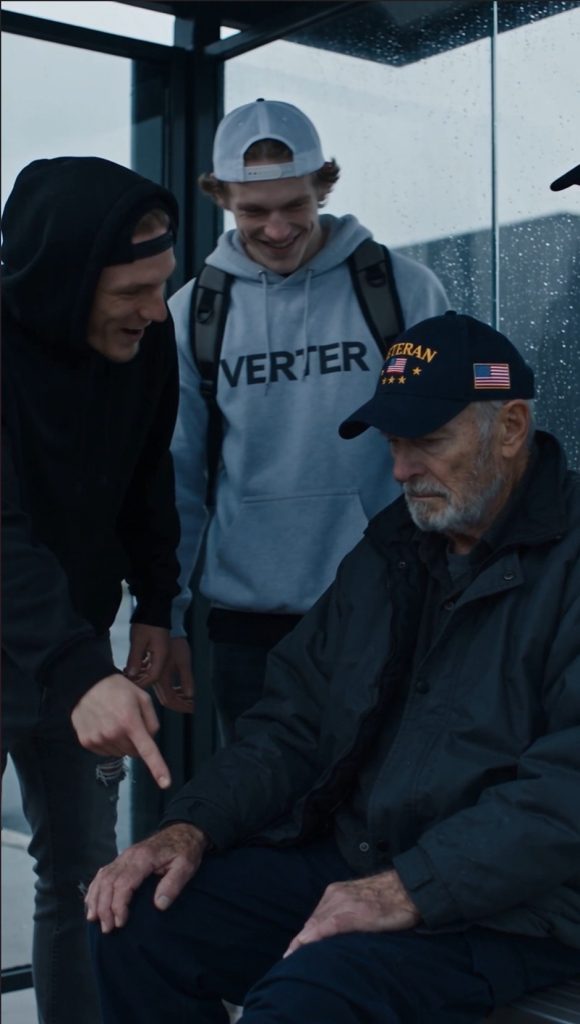
Sharp, careless, and loud enough to make strangers glance over before quickly looking away. At the center of it sat an old man with one prosthetic leg, his hands resting silently in his lap as three young men turned his disability into entertainment.
What none of them understood was that they had chosen the wrong man to humiliate.
The rain had stopped only minutes earlier, leaving the street dark and shining beneath a pale blue sky. Cold wind moved through the bus shelter while people hurried past with their collars raised, focused only on getting home.
Walter had been waiting there for almost twenty minutes.
He was used to strangers noticing his leg.
Some stared a second too long. Others looked away the moment he caught them. A few gave him that soft, uncomfortable expression he had learned to recognize years ago—the look people wore when they wanted him to know they felt sorry for him.
None of it bothered him as much as people imagined.
Losing his leg had never been the deepest wound.
The battlefield had taken friends from him. It had taken his youth, much of his health, and the quiet future he once assumed would simply be waiting when he came home.
It hadn’t been.
Walter had returned from military service as a different man, carrying memories nobody around him could see. Years passed, but some nights still dragged him awake before dawn, his heart pounding as if the war had followed him all the way into his bedroom.
For much of his life afterward, he had been alone.
Then three young men stopped near the shelter.
They were barely twenty. Backward baseball caps. Loud voices. The easy confidence of people who had never been forced to think seriously about how quickly a life could change.
Jake noticed the prosthetic first.
He nudged Mason and pointed.
“Hey, Grandpa. What’s that supposed to be?”
Mason looked down and laughed.
“It looks like a robot leg.”
Tyler stepped closer, studying Walter as though he were some strange object instead of a person.
“Doesn’t your leg get cold, old man?”
Their laughter grew louder.
Jake grinned at his friends. “Careful. His battery might die. Then he won’t even be able to walk home.”
All three burst out laughing again.
Walter didn’t answer.
Around them, people noticed.
One woman slowed for half a second before continuing. A man standing farther down the sidewalk turned his head, saw what was happening, then suddenly became very interested in his phone.
Nobody said anything.
Walter’s hands remained in his lap.
Only his fingers changed.
Slowly, almost invisibly, they curled into fists.
The young men had no idea what those hands had once done.
They didn’t know Walter had pulled wounded soldiers through chaos while danger closed in from every direction. They didn’t know he had lost his leg while trying to protect the men serving beside him.
They didn’t know how many names he still remembered.
Or how many voices returned in his dreams.
To them, he was simply an old man who looked too tired to fight back.
“Come on, Grandpa,” Mason said, smiling wider. “Show us how fast that thing can go.”
Tyler slapped Jake on the shoulder.
“Maybe he’s got a turbo button.”
More laughter.
Walter stared at the wet pavement.
For a moment, something moved behind his eyes—not anger exactly, but the weight of years he had spent learning when to speak and when silence said more.
He had sacrificed pieces of his life so young men like these could grow up in peace.
Now they stood in front of him laughing at the price he had paid.
Walter took a slow breath.
Then he lifted his head.
The laughter began to weaken.
For the first time, he looked directly at all three of them.
There was no rage in his face.
No fear.
Only a calmness so complete that Jake’s grin faded slightly. Mason stopped laughing first. Tyler’s hand slipped from his friend’s shoulder.
Something about the old man’s expression had changed the air.
Walter shifted forward in his seat.
The boys went quiet.
And only then did they realize that someone was approaching from behind them.
None of them were prepared for what happened next. 👇
A shoe scraped against the wet pavement behind them.
“Walter?”
The voice was older and rough around the edges, and it stopped Walter more completely than the boys’ laughter ever had.
The man who had been standing farther down the sidewalk was coming toward them now. He had put his phone away. Rain darkened the shoulders of his coat, and one hand trembled around a wooden cane.
Walter stared at him.
Then the stranger’s face changed.
His eyes dropped to Walter’s prosthetic leg, then rose again, shining.
“My God,” he whispered. “It really is you.”
Jake gave a nervous laugh. “You know him?”
The man ignored him. He pulled back his sleeve, revealing a pale, jagged scar running from his wrist almost to his elbow.
Walter’s breath caught.
“Daniel?”
The name almost vanished beneath the hiss of tires on the wet street.
Daniel nodded.
Walter’s fists opened.
Jake looked between them, irritated now that the joke no longer belonged to him.
“What is this?”
Daniel turned.
“You were asking about his leg.”
Jake shrugged. “We were messing around.”
“No.” Daniel’s eyes stayed on him. “You were enjoying hurting someone you thought couldn’t do anything about it.”
Jake’s jaw tightened.
Daniel pointed toward Walter, his hand shaking.
“That man carried me through gunfire.”
The street seemed to go silent.
“I was bleeding so badly I couldn’t feel my hands,” Daniel continued. “I told him to leave me. I begged him to leave me because I knew what would happen if he stayed.”
Walter lowered his eyes.
“He stayed anyway.”
Jake’s expression shifted, but pride moved faster than shame.
“So what? That doesn’t mean we did anything.”
Walter looked up.
“Enough.”
One quiet word.
Jake stepped toward him. “You gonna lecture me now?”
Mason caught Jake’s arm. “Man, just leave it.”
Jake tore free.
Daniel moved between Jake and Walter.
“You don’t have to kill someone to show what kind of man you are.”
Jake shoved him.
Daniel’s cane skidded across the pavement. His body twisted, and for one terrible second he was falling.
Walter moved first.
He caught Daniel by the coat and shoulder. Pain flashed across Walter’s face as his prosthetic foot slipped on the wet concrete, but he held on.
A woman near the shelter screamed.
Tyler stepped backward, staring at Jake as if he had only just seen him clearly.
Then a voice cut through the street.
“Don’t move.”
A police officer was crossing from the opposite curb.
Jake went pale.
The officer reached them. “I got a call about three young men harassing an elderly man. Then I saw the shove.”
Jake pointed at Walter. “He came at me.”
“No,” Tyler said.
Everyone turned.
Tyler’s face had gone white.
“He didn’t.”
Jake glared at him. “Shut up.”
Mason looked at the pavement.
Then he spoke.
“Jake shoved the other guy. Walter didn’t touch him.”
The woman who had screamed lifted her phone.
“I recorded it.”
Jake’s face emptied.
For the first time, there was nobody left for him to perform for.
The officer told him to turn around.
Jake resisted for half a second.
Then the handcuffs closed.
Metal against metal.
Mason covered his mouth with one hand. Tyler stared at Walter, unable to hold his gaze.
Jake kept talking as he was led away.
He blamed Daniel.
He blamed the woman with the phone.
He blamed Mason and Tyler.
He blamed everyone except himself.
Walter watched until the patrol car door shut.
Then he looked at Daniel.
“You were the man with the phone.”
Daniel gave a tired smile.
“I wasn’t ignoring you.”
Walter said nothing.
“I recognized you when you raised your head. I called the police because I didn’t know what those boys were going to do.”
His voice softened.
“And because my hands were shaking too badly to trust them.”
Walter looked at the scar on Daniel’s arm.
“Why are you here?”
Daniel reached inside his coat.
Walter stiffened, an old instinct moving through him before thought could stop it.
Daniel noticed.
Slowly, he withdrew a worn leather wallet.
Inside was a photograph.
A younger Daniel stood beside a woman in a summer dress. Two children leaned against his legs. Behind them was a small house with a crooked porch.
Daniel turned the photograph over.
The handwriting was faded.
All of this happened because you came back for me.
Walter read it twice.
“I wrote that thirty-four years ago,” Daniel said. “I carried it because I kept thinking one day I’d find you.”
Walter’s thumb touched the edge.
“You looked for me?”
“For years.”
Walter turned away.
Water dripped from the shelter roof.
“I thought everybody moved on,” he said.
“We did.”
Walter flinched.
Daniel stepped closer.
“But moving on wasn’t forgetting.”
He tapped the photograph.
“My daughter became a teacher. My son became a paramedic. I have four grandchildren. Every birthday, every graduation, every Christmas morning—I knew there was one man who should have been standing somewhere in the picture.”
Walter pressed his lips together.
His hands began to tremble.
Daniel reached for him.
Walter hesitated.
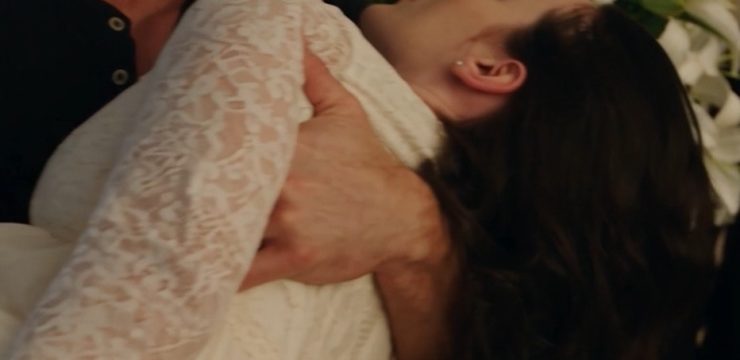
Then the two old men embraced beside the bus stop.
Daniel’s cane fell again.
Walter laughed once through a breath that sounded dangerously close to a sob.
Neither man bent to pick it up.
Mason and Tyler stood several feet away.
When Daniel stepped back, Mason cleared his throat.
“Sir?”
Walter looked at him.
“I’m sorry.”
Tyler nodded, eyes red.
“So am I.”
Walter studied them.
“You’re sorry because he showed up.”
Neither answered.
“That’s not the same as being sorry because you understood what you were doing.”
Mason’s eyes dropped.
“Maybe someday it will be,” Walter said.
The bus arrived with a sigh of brakes.
Walter didn’t get on.
Three weeks later, Mason and Tyler came to the veterans’ center where Daniel had convinced Walter to attend a reunion lunch.
They carried no cameras.
Mason stacked chairs. Tyler served coffee and listened more than he spoke.
Near the end of the afternoon, Mason placed two folded letters beside Walter’s cup.
“No excuses,” he said. “Just what we should’ve said that day.”
Walter took the letters home.
He did not read them until midnight.
Months passed.
Jake pleaded guilty to assault after the video and witness statements left no version of the story he could hide behind. He received probation, restitution, and court-ordered community service.
Mason and Tyler gave truthful statements even after Jake stopped speaking to them.
The friendship that had once made them feel powerful ended quietly.
Another kind began in its place.
On Saturdays, Mason and Tyler kept showing up at the veterans’ center.
Not because Walter asked.
Because eventually, they stopped needing to be asked.
One spring afternoon, Walter sat on Daniel’s porch beneath a clear sky.
Children ran through the yard.
Daniel’s grandchildren.
A little boy missing both front teeth raced up the steps and stopped in front of Walter’s prosthetic leg.
Walter braced himself out of habit.
The child stared at it.
“Does it hurt?”
“Sometimes.”
The boy thought about that.
Then he put one small hand on Walter’s knee.
“I’m glad you’re here anyway.”
Walter looked across the yard.
Daniel was watching him.
So were Mason and Tyler, carrying chairs from the garage for the family barbecue.
Nobody said anything.
Walter reached into his shirt pocket and unfolded Daniel’s photograph.
For most of his life, he had believed the war had divided everything into what he had lost and what he had managed to keep.
He had been wrong.
Some things had kept growing where he could not see them.
A family.
A friendship.
A life that existed because, once, Walter had refused to leave a wounded man behind.
Daniel lowered himself into the chair beside him and handed Walter a glass of lemonade.
Their shoulders touched.
In the yard, someone laughed.
This time, Walter did not flinch.
He leaned back, felt the warmth of the sun on his face, and watched the people around him set another place at the table.