The seam of my dress uniform strained beneath my sister’s fist. Seventeen minutes before my wedding, she was trying to strip away something I had spent thirty-one years earning. And the worst part was how certain she seemed that I would obey.
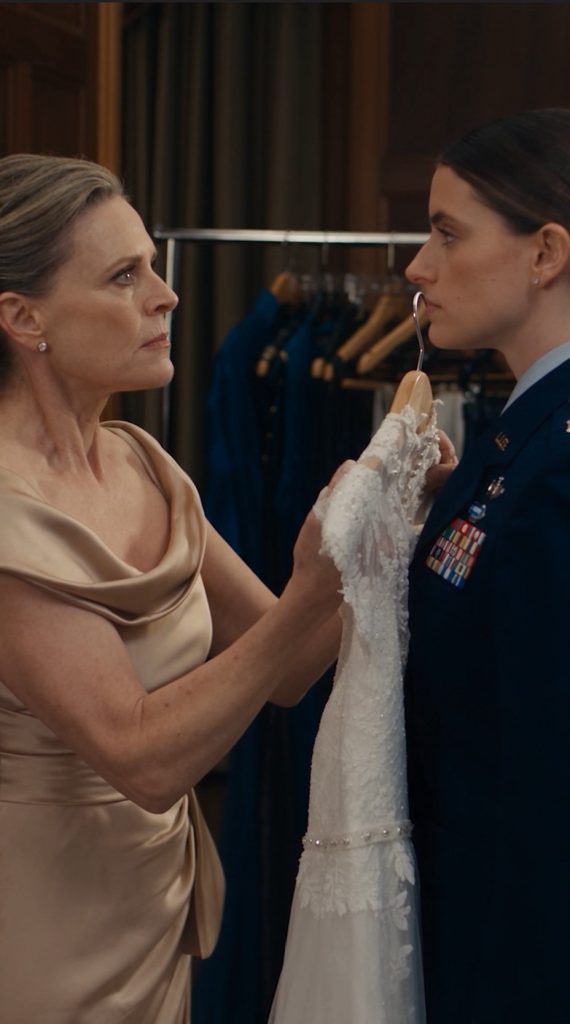
“You are not walking into that chapel dressed like this,” Celeste hissed.
Her fingers pressed against four polished silver stars. I caught her wrist and gently moved it away.
“Touch my uniform again, and you will leave.”
She stumbled against the vanity. A silver hairbrush clattered to the floor.
“For once in your life, Amelia, why can’t you just dress like a normal woman?”
I was fifty-two, General Amelia Hart of the United States Marine Corps. I had commanded Marines in combat and advised presidents. Yet inside the bridal room at the Old Post Chapel near Fort Myer, my sister still treated me like a girl who needed correcting.
Celeste pulled a white lace wedding gown from a garment bag.
“Dad sent this. Put it on.”
My phone buzzed with his message.
Senators and Hartwell Defense partners are attending. Do not embarrass this family in a work costume.
“He called my dress blues a costume?”
“He built a respected company,” Celeste replied. “You could show some gratitude.”
I looked into the mirror. My dark-blue coat fit perfectly, its ribbons holding memories I rarely discussed. Those four stars had never made me less of a woman.
“Noah asked to marry who I am,” I said. “This is who he’ll meet at the altar.”
Celeste laughed.
“Noah analyzes computer systems in a Pentagon basement. Of course he lets you play hero.”
Her words carried me back thirty years.
After college, my officer-candidate selection letter had mysteriously disappeared from our mailbox. Celeste insisted she had never seen it. I applied again the following year and left for Quantico before anyone could interfere.
What followed wasn’t glamorous.
There was exhaustion, mud, and punishing Mojave heat. In Helmand, Gunnery Sergeant Marcus Tanaka and I had crawled through smoke inside a collapsing building to rescue four trapped Marines.
Years later, Staff Sergeant Owen Briggs lost his struggle with post-service trauma. I never forgot the grief in his mother’s voice after she received that devastating call.
That loss inspired me to establish Havenline, a crisis-support network for veterans and military families.
Celeste saw none of that.
Only a uniform she wanted hidden.
Three days earlier, she’d posted a photograph of my dress blues online, mocking my wedding choice.
I had answered with one sentence.
I will be married as myself.
Then I’d switched off my phone, ignoring the unexpected flood of support.
A knock interrupted the silence.
Sergeant Major Tanaka, now retired, appeared in his dress blues.
“Ma’am. It’s time.”
Celeste folded her arms.
“Tell her she’s humiliating herself.”
Tanaka studied her briefly.
“The people outside seem to disagree.”
“What people?” I asked.
He offered his arm without answering.
My father intercepted us in the hallway. His fingers closed around my elbow.
“Change clothes, or I will not walk you down that aisle.”
I looked at the man whose approval I’d once desperately wanted.
“Then I’ll walk without you.”
His grip loosened.
Tanaka and I continued toward the chapel.
Beyond the stained-glass doors came a strange rumbling sound, like distant thunder. Hundreds of boots were striking the wooden floor and courtyard pavement together.
Then the doors swung open.
Four hundred and sixty-three Marines stood at attention, their polished uniforms filling the chapel and courtyard.
A single command shattered the silence.
“GENERAL ON DECK!”
Behind me, Celeste froze.
My father’s face drained of color.
Neither understood why so many Marines had traveled across the country for my wedding.
And neither knew that someone among them carried a truth that had yet to be revealed. 👇
A folded wedding program slipped from my father’s trembling fingers and landed against the chapel threshold.
Nobody bent to retrieve it.
I stood beneath the stained glass, staring at hundreds of familiar and unfamiliar faces. Some belonged to Marines I had commanded. Others belonged to people whose names I recognized from Havenline correspondence.
Near the front stood Major Elena Reyes.
The last time I had seen her surrounded by this many Marines, she had been unconscious beneath the wreckage of a building in Helmand.
Now she was standing straight, tears shining against her carefully composed expression.
“Marines,” I said, struggling to steady my voice. “At ease.”
They moved together.
Then applause began.
Not the polite applause of wedding guests, but something warmer, almost painfully personal.
Tanaka leaned toward me.
“They came because they wanted to, General.”
I swallowed.
At the altar, Noah waited in a dark suit, his eyes already wet.
When I reached him, he took both my hands.
“You look exactly like the woman I fell in love with,” he whispered.
For the first time that morning, I could breathe.
Behind us, my father quietly took an empty seat.
Celeste remained standing near the entrance, staring at the Marines as though their presence were a personal insult.
The ceremony began.
Noah’s thumb moved gently across my knuckles as we exchanged vows. When he promised to stand beside me without asking me to become smaller, my voice nearly broke.
I promised him the same.
We kissed beneath the chapel’s golden afternoon light.
For a few precious minutes, nothing else mattered.
But the trouble waiting at the reception had already been arranged.
The first warning came when I entered the reception hall and noticed a large display beside the head table.
Two logos appeared beneath a silver banner.
Hartwell Defense.
Havenline.
Underneath them were the words:
Celebrating A New Strategic Partnership.
I stopped walking.
“Noah,” I whispered, “did you know about this?”
He followed my gaze.
His expression changed immediately.
“No.”
Before we could investigate, Celeste stepped onto the small stage and tapped a microphone.
“Ladies and gentlemen, before dinner, our family has a special announcement.”
My father stood beside the stage, adjusting his cuff links.
Several Hartwell Defense partners turned toward the display.
Celeste smiled.
“Today isn’t simply about Amelia’s marriage. It’s about bringing her extraordinary military reputation together with the resources of Hartwell Defense.”
My stomach tightened.
She lifted a printed document.
“With General Hart’s endorsement, we’re proud to announce a new initiative supporting veterans through Havenline.”
I looked at Noah.
He was already rising.
Then someone touched my arm.
Major Reyes stood beside me, holding a thick envelope.
“Ma’am,” she said quietly, “there’s something you need to see.”
Inside were copies of promotional letters sent to potential donors, a proposed fundraising agreement, and a document bearing what appeared to be my signature.
I stared at it.
I had never signed anything.
Reyes spoke carefully.
“I’m on Havenline’s volunteer oversight committee now. We discovered this campaign two weeks ago. We contacted Hartwell Defense requesting clarification.”
“Who answered?”
She glanced toward the stage.
“Your sister.”
The reply she showed me claimed that my approval had already been secured.
Another document listed substantial donor pledges that had been solicited under Havenline’s name.
My fingers went cold.
“This isn’t a partnership,” I whispered.
“No, ma’am.”
Reyes hesitated.
“And some of those donors believe their money has already been committed to veterans’ crisis services.”
I looked toward Celeste.
She was still smiling into the microphone.
For thirty-one years, I had endured my family’s disappointment. Their jokes. Their refusal to understand the work I loved.
But Havenline was different.
It belonged to the people who called when they had nowhere else to turn.
And I would not let my family use those people as decorations.
I walked toward the stage.
Noah followed, stopping just behind me.
“Celeste,” I said.
She turned.
“Oh, Amelia. Perfect timing.”
“Give me the microphone.”
Her smile stiffened.
“This is supposed to be a surprise.”
“It is.”
Something in my voice made the room fall quiet.
I took the microphone.
“There is no authorized partnership between Havenline and Hartwell Defense. I have not endorsed this campaign, and the signature on that agreement is not mine.”
Silence spread across the room.
One of my father’s business partners lowered his glass.
Celeste stepped closer.
“Amelia, don’t make this ugly.”
“You used the name of a crisis-support organization to solicit money without its consent.”
“We were going to tell you.”
“When?”
She looked at my father.
He avoided my eyes.
That hurt more than I expected.
“Dad,” I said, “did you know?”
He slowly approached the stage.
“I knew Celeste was preparing something. I thought once you understood the opportunity—”
“You thought I’d cooperate.”
His silence answered.
Then Celeste grabbed the microphone.
“You’ve always been impossible! Everything has to be about your career, your sacrifice, your precious Marines!”
Her voice echoed through the hall.
“Do you have any idea how exhausting it is to have a sister everyone keeps praising?”
I stared at her.
Something old and painful shifted inside me.
“Is that why you took my officer-candidate letter?”
Celeste went still.
My father looked between us.
“What letter?” he asked.
I barely heard him.
“After college,” I continued. “The selection letter that disappeared. You told me it never arrived.”
Celeste’s breathing changed.
“I was trying to stop you from making a mistake.”
The room seemed to tilt.
“You took it?”
She pressed her lips together.
Then, almost inaudibly, she said, “Yes.”
For thirty years, I had wondered whether she had known more than she admitted.
Now the answer stood in front of me.
“I spent an entire year thinking I’d missed my chance,” I said.
Celeste looked away.
“You got another one.”
“That doesn’t give you back the year you stole.”
Nobody moved.
I remembered the young woman I’d been, checking the mailbox each afternoon, wondering why the future she’d worked for had suddenly gone silent.
My sister had watched me suffer.
And said nothing.
“You didn’t want to protect me,” I whispered. “You wanted to decide who I was allowed to become.”
Celeste’s eyes filled, but she said nothing.
I handed the documents to a Hartwell board member standing near the stage.
“These need to go to independent counsel. Havenline will cooperate fully.”
He examined the signature, then turned to my father.
“We were assured this had been authorized.”
My father lowered his head.
The board member faced Celeste.
“Your authority to represent Hartwell Defense in this campaign is suspended immediately.”
Her lips parted.
“You can’t—”
“We will also be reviewing every donor communication issued under your direction.”
For the first time in my life, Celeste had no one willing to finish her argument for her.
She stepped down from the stage.
No dramatic farewell.
No final insult.
Only the sound of her heels crossing a silent room.
My father remained beside the microphone, looking suddenly much older.
“Amelia,” he began.
I shook my head.
“Not today.”
He nodded.
And this time, he listened.
The reception did not end.
Tanaka quietly asked the musicians to begin playing, and Noah returned to my side.
“Do you want to leave?” he asked.
I looked at the people gathered around us.
At Reyes, standing beside the Marines she had once served alongside.
At the families who had traveled so far.
At my husband.
“No,” I said. “I want to have my wedding.”
And we did.
Weeks later, the independent review confirmed that Celeste had authorized the false representations. Hartwell Defense withdrew the campaign, corrected its donor communications, and arranged for any improperly collected funds to be returned.
Celeste lost her position and her authority to speak for the company.
My father resigned as chairman after the investigation established that he had knowingly approved the announcement without seeking my consent.
Neither consequence came from me.
They came from decisions my family had made because they believed my silence was guaranteed.
Celeste sent one message months later.
I know I can’t undo what I did.
I read it without replying.
I hoped she would eventually understand the harm she’d caused. But I no longer confused that hope with an obligation to trust her.
My father took longer.
He began with a handwritten apology, free of excuses or requests.
Then he publicly corrected his statements about Havenline and my military service.
When we finally met, he didn’t ask for forgiveness.
He asked what thirty-one years had been like without his support.
For the first time, I told him.
He listened until I finished.
We were not the family we had once pretended to be. But slowly, carefully, we began building something more honest.
And there was one final truth from my wedding day that I didn’t discover until afterward.
It came from Noah.
On our first quiet evening home, he placed a wooden box on the kitchen table.
Inside were hundreds of handwritten cards.
Four hundred and sixty-three.
I looked at him, confused.
“These were collected before the wedding,” he explained. “Everyone who came wanted you to have one.”
I opened the first.
You answered my call when I couldn’t find a reason to stay. I’m here because you helped me find one.
Another read:
I was one of the Marines you pulled from Helmand. You never asked me for anything in return. Standing beside you was the easiest decision I’ve ever made.
Then I found a letter from Owen Briggs’s mother.
She wrote that after Owen’s death, she’d believed the world would slowly forget him.
But Havenline kept his name connected to people who were still fighting to survive.
And beneath her letter was a photograph.
Tanaka, Reyes, Noah, and dozens of Marines were gathered around a table, planning the wedding surprise.
On the back, Noah had written:
You thought you were walking into that chapel without your father. You never knew how many people were waiting to walk beside you.
My vision blurred.
All those years, I had measured my family’s love by how reluctantly they accepted the person I’d become.
I hadn’t noticed how much family I’d found beyond their walls.
Noah came around the table and wrapped his arms around me.
I rested my forehead against his chest.
For once, there were no orders to give.
No battle to prepare for.
No approval to earn.
Outside, evening sunlight touched the garden, and the house filled with the gentle sounds of a life we had chosen together.
My dress blues hung carefully beside Noah’s wedding suit.
Four silver stars caught the fading light.
For thirty-one years, that uniform had reminded me of everything I’d fought to become.
Now, looking at the handwritten cards spread across our table, I understood something else.
I had spent so much of my life searching for a place where I wouldn’t have to explain who I was.
And somehow, without realizing it, I had already found my way home.