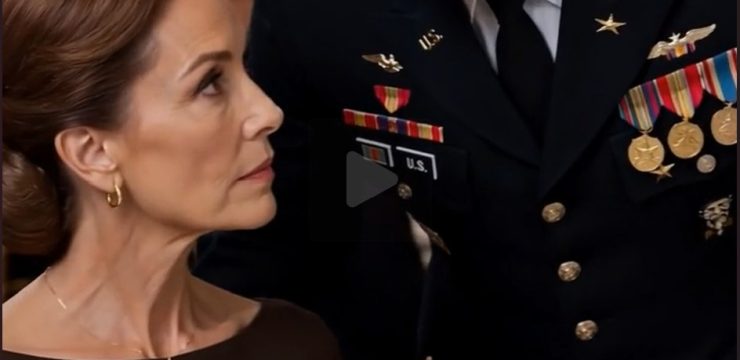
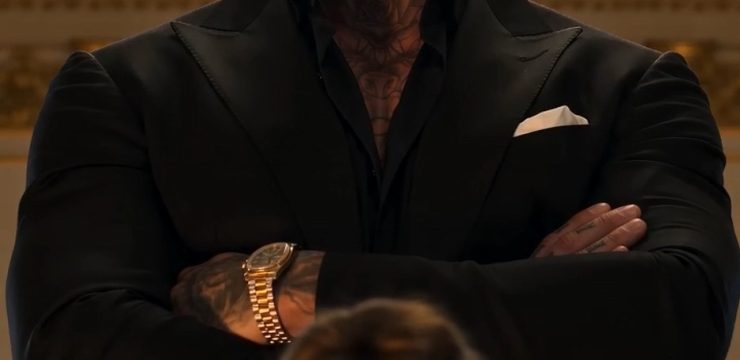
The orchestra had stopped playing.
The guests had stopped pretending not to stare.
Even the waitstaff stood completely frozen, trays in hand, as if the entire room understood that something long buried had just stepped back into the light — wearing a borrowed uniform and carrying a truth no one was prepared to face.
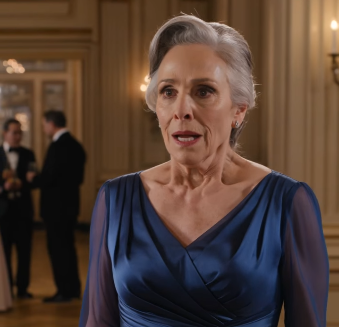
The young waitress looked from the older woman to the silver-haired man standing beside her. Her pulse was hammering so hard she could hear it in her own ears.
“What did you say?” she whispered.
The older woman yanked her arm free from the man’s grip and turned on him with a face full of absolute horror.
“You told me she died,” she said.
His jaw tightened. The muscle in his cheek pulled like a wire under tension.
“I told you what needed to be said.”
That answer shattered whatever remained of the room’s civility. Every candle in the ballroom seemed to flicker at once. The young waitress took a slow step backward.
She had grown up with almost nothing — a shared room in a church home, hand-me-down shoes that never quite fit, a foster mother who loved her fiercely but feared questions even more. And one single necklace she had been warned never to sell, never to show a stranger, never to remove from her neck. She had never once imagined that necklace belonged to a life like this. To a family like this. To a room like this.
The older woman reached for her hand again, both of hers trembling.
“My baby was taken the night the east wing caught fire,” she said through tears that had clearly been waiting decades to fall. “The nursery burned. The staff were locked out. And my husband told me by dawn that there had been nothing left to bury.”
The waitress looked slowly at the silver-haired man.
Husband.
Which meant —
Her whole body went ice cold from the inside out.
“You’re my father?” she asked.
The man’s face darkened like a sky before a storm. “No.”
But he said it too quickly. Far too quickly for anyone in that room to believe.
The older woman shook her head, crying harder now, her voice rising with the force of someone finally seeing the full picture of their own life for the very first time.
“He raised you in secret at first. I know it now. I see it all now.”
The room went dead silent again.
Because this was no longer simply the story of a lost daughter returning. This was the collapse of a lie that had been carefully built and maintained for decades. Every guest in that ballroom was beginning to understand the architecture of the deception — and how many lives it had quietly destroyed.
The older woman’s voice came out with the trembling clarity of someone finally telling the truth they had unknowingly been kept from.
“The night of the fire, he had already learned something,” she whispered. “That you were not his child.”
The waitress stood completely still.
The silver-haired man closed his eyes for half a second — just half a second — but in a room watching that closely, it was more than enough.
The guests understood before she did.
This was not a father terrified of losing a daughter he had wronged. This was a powerful man terrified of a child returning who carried proof of a secret he had spent a lifetime protecting.
The older woman’s voice broke open like something that had been sealed too long.
“I had loved someone before my marriage. Just once. A moment of weakness, of honest feeling, of something real in a life that had been arranged for me. He discovered it. And he could never forgive what I had done.”
The waitress felt the floor shift beneath her feet.
“So you hid me?” she asked.
The man finally spoke again — cold, controlled, composed the way a man who has rehearsed his cruelty can be.
“I removed a scandal.”
A collective gasp cut through the ballroom like a blade.
The older woman moved toward him as if she might strike him with everything she had.
“You stole my child from me!”
But the waitress barely heard them anymore.
Because memories were moving through her for the very first time — things she had never been able to explain or name, now rushing up all at once like water through a broken dam.
The smell of smoke. Church bells ringing in the cold. A woman running through the dark. Hands passing her carefully through shadow and silence. A lullaby no one at the orphanage had ever been able to explain or identify.
And then one more memory rose above the rest.
A priest. Not old. Young. Kneeling in front of her with gentle eyes, holding her small hands in both of his, whispering very quietly: You must never tell anyone your real name.
Her voice came out barely above a breath.
“The priest at Saint Agnes,” she said. “He used to visit my foster mother every single winter. Every year, without fail. Until she passed.”
The older woman went completely still.
The silver-haired man went pale in a way that expensive composure cannot hide.
That was the moment the waitress understood there was still one piece left. One person in the world who had carried the whole truth from the very beginning.
And then, from the top of the grand ballroom staircase, a calm, unhurried male voice said simply:
“She’s right.”
Every single head in the room turned upward.
At the top of the stairs stood an elderly priest dressed in black, one weathered hand resting gently on the rail, the other holding an aged leather file against his chest. His eyes moved slowly — first to the waitress, then to the silver-haired man, and finally, with the greatest tenderness, to the older woman.
“I baptized her myself,” he said quietly. “I have kept this record for many years. And I know exactly whose daughter she truly is.”
The ballroom did not breathe.
The truth had finally arrived — dressed not in silk or silver, but in the plain black clothes of a man who had waited a lifetime to say it out loud.