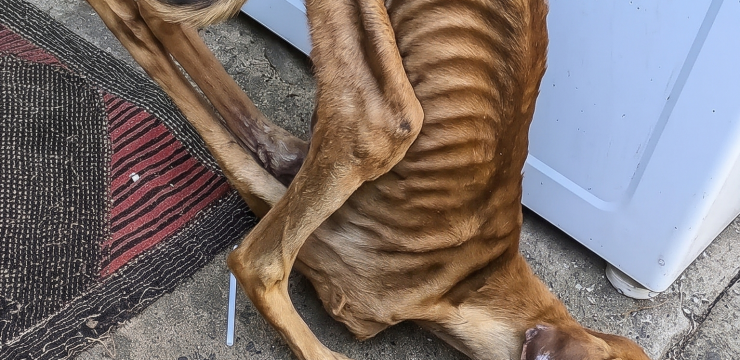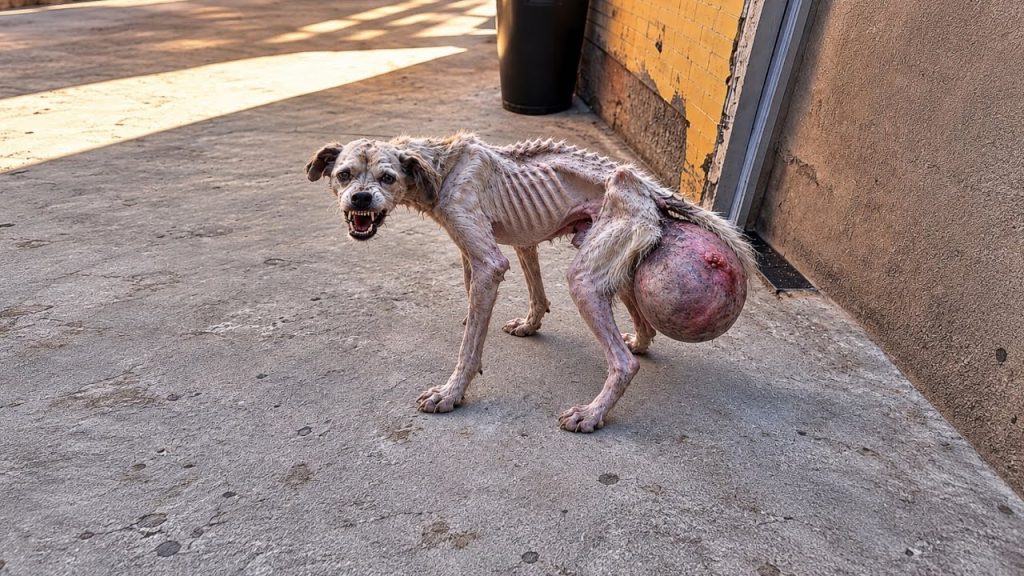
It is difficult to imagine a more lonely sight: a dog still waiting where he had been left, while carrying an illness that made everyday life a struggle. Whatever he felt, he had been left behind. What could be seen was simple enough. He was weak, he was suffering, and he deserved better than the circumstances in which he had been found.
Then Paloma noticed him.
Paloma had dedicated her life to helping vulnerable animals. When she came upon Olafino, she saw more than his frail frame and the enormous growth on his body. She saw a living creature in need of care. She gently lifted him and wrapped him in a warm blanket, offering the protection he had been missing.
Olafino did not resist. He did not try to run away. There is no way to know exactly what he understood in that moment, but his quiet acceptance made the encounter especially moving. For once, somebody was carrying him toward help instead of leaving him alone.
Paloma took him straight to a veterinary clinic. There, the medical team began an examination, assessing the condition of a dog whose problems could not be solved with kindness alone. The tumor had grown so large that removing it presented a serious challenge. The initial outlook was discouraging: surgery appeared nearly impossible, his chances of survival were uncertain, and treatment would be expensive.
These were not small obstacles. Even with a determined rescuer beside him, Olafino faced a medical crisis that required skill, planning, and constant attention. Wanting him to get better would not be enough. His caregivers needed to discover whether there was a safe way to give him the life he deserved.
Paloma refused to abandon that possibility.
She stayed committed to Olafino as he was placed under round-the-clock medical observation. The team watched him closely, knowing that every decision mattered. There was no easy promise to make, no quick answer that could erase the uncertainty. But for Olafino, the effort itself marked a profound change. His needs were finally being treated as important.
His care also included something much simpler than surgery, but meaningful in its own way. Paloma and a specialist carefully trimmed his long, tangled fur and gave him a bath. The grooming relieved an additional burden from his already weakened body. Olafino appeared to enjoy the attention and feel lighter afterward, a welcome moment of comfort during a difficult period.
A warm blanket, a thorough cleaning, and gentle hands could not remove the tumor. Still, they mattered. They were reminders that caring for an animal means recognizing every part of his well-being, not only the most urgent medical problem. After so much time in distress, he was receiving both the practical treatment and the patient attention he needed.
Meanwhile, the veterinarians continued their work. After careful monitoring, they identified a surgical approach with a better chance of success. What had first seemed almost beyond reach became a possibility worth pursuing. It was still an operation, and the risks had not vanished. But Olafino finally had a path forward.
The surgery lasted several tense hours. While the veterinary team worked, everything depended on their ability to handle a complicated case and give his weakened body a chance to recover. This was the turning point Paloma had fought to reach. So much care and determination had led to a moment when medical expertise could make the difference.
At last, the operation was successful.
Olafino had survived the procedure. A few hours later, he woke up, having passed through the most dangerous stage of his treatment. The outcome brought relief, but surgery was not the end of his journey. Recovery would require continued care, nourishment, and watchfulness. His body had been through a great deal, and healing deserved the same patience as the rescue itself.
Paloma remained a steady presence. She prepared nutritious meals for Olafino and visited him almost every day as he recovered. The dog who had once waited alone in the street now had someone returning to see him, not because she was obligated to, but because she cared what happened to him.
There is something affecting about that difference. Being rescued is not only about being removed from danger. It is about what comes afterward: the attention given when the immediate crisis has passed, the willingness to continue showing up, and the understanding that a vulnerable animal depends on human beings to follow through.
As Olafino’s strength returned, the possibility of leaving the clinic became real. Eventually, the veterinarians determined that he was ready to be discharged. Paloma brought him into her own home, where she could continue caring for him herself. He was no longer a neglected dog waiting on a public street. He was safe inside a home, surrounded by the affection he had needed for so long.
The terrible physical pain that had shadowed his life was gone. In its place came comfort, care, and the opportunity to enjoy ordinary days without that overwhelming burden. Nothing could undo the time Olafino had spent abandoned and hurting. Yet the next chapter of his life no longer had to resemble the one he had endured.
His story does not need a grand gesture to carry meaning. It began with one woman noticing a suffering dog and choosing not to look away. It continued through difficult medical news, constant observation, careful treatment, and a demanding operation. And it led to a home where Olafino could finally experience happiness and love.
He had waited for someone who never returned. In the end, someone else came for him, stayed beside him, and gave him a second chance.