The old man stared at the yellowed napkin as though it had been pulled from another life. Across his failing ice cream cart stood a woman in a dark blue suit, watching his hands begin to shake. She knew something about a day he had almost forgotten.
Years earlier, on a sweltering afternoon, a little girl had stopped before that same pastel cart. Her dusty hair fell across her eyes, and her dress was faded from too many washings and too few proper homes. Heat rose from the cobblestones beneath her feet.
She didn’t reach for her pockets or ask for a cone. She only stared at the ice cream, swallowing as her fingers lifted, then dropped again. The young vendor recognized that hesitation, the look of someone already accustomed to hearing no.
Without making her explain, he prepared his tallest soft-serve cone and held it out. “Take it, little one. It’s a gift.”
She hesitated before accepting it, looking up at him as though kindness itself had spoken. “One day,” she whispered, “I’ll pay you back.”
He laughed softly, touched by the seriousness in her voice. Children made promises like that, and adults smiled because they assumed those promises would fade. By the next day, he had forgotten the moment, but she never did.
Years passed, and the street changed around his cart. Tourists came and went, while big chains arrived with brighter signs and cheaper treats. The lines that once curved around the corner grew shorter until people rarely stopped.
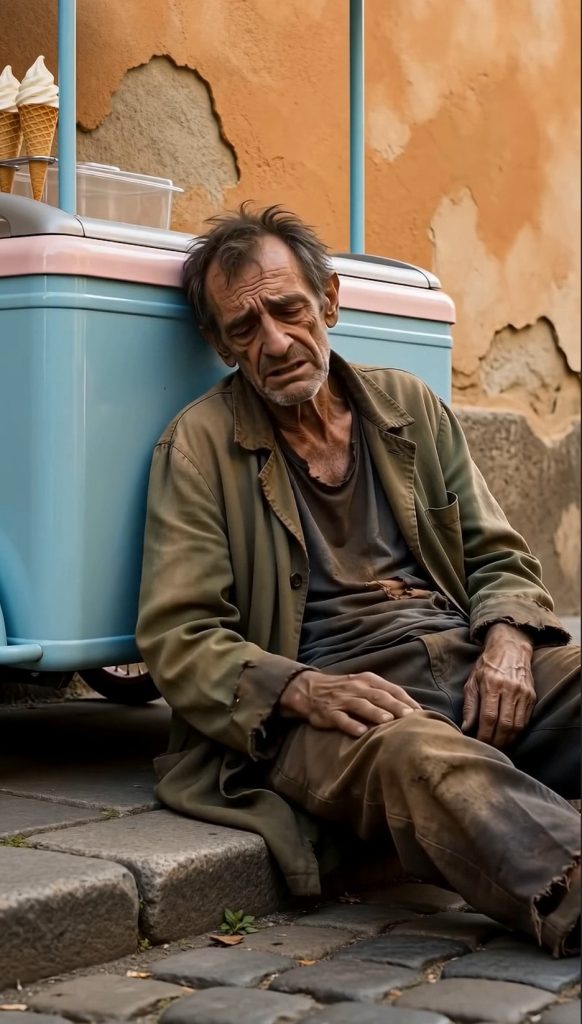
He kept opening anyway. First he sold what ice cream he could, then his belongings, then borrowed against whatever remained. Each summer seemed harder than the one before.
By autumn, the cart was still there, but the man beside it had almost nothing left. Sitting with a friend, he finally admitted what he had feared saying aloud.
“I went bankrupt,” he murmured. “I’ll end up on the street.”
He thought the words would go no farther than that conversation. He had no idea someone else was about to hear them.
Two streets away, a woman sat in a moving car with her phone against her ear. At the news of his bankruptcy, she went silent. Outside, familiar stone streets and sunlit corners passed her window, reminders of the town where she had once been poor and easy to overlook.
“He went bankrupt?” she asked. Her expression changed as she listened, but when she spoke again, there was no pity in her voice.
“I’m coming,” she said. “Today I repay his kindness.”
Twenty minutes later, a black car stopped near the old cart. The vendor barely glanced up, accustomed now to wealthy strangers walking past him without slowing.
Then came the sharp click of heels on cobblestone. A woman approached in a dark blue jacket and white blouse, looking more at home in a boardroom than beside his worn counter.
Embarrassed, he tried to stand, but she gently stopped him. Before he could ask her name, she reached into her handbag and placed something on the counter.
An old napkin lay between them, carefully folded and yellowed with age. When he opened it, he found a dried sugar flake and a line of uneven childhood handwriting: “One day I’ll pay you back.”
His fingers began to tremble. He lifted his eyes to her face and saw that she was struggling to hold back tears.
“Do you remember the little girl who couldn’t afford ice cream?” she asked. The memory returned, faint at first and then unmistakable.
He stared, suddenly pale, but she wasn’t finished. “You gave her your last cone that day,” she said, swallowing hard. “And then you closed early because you had no money left to buy dinner for yourself.”
For a moment, he couldn’t speak. And she still hadn’t told him why she’d really come back. 👇
The old man’s fingers tightened around the napkin. He looked down at the faded handwriting, then back at the woman, searching her face for the child he had once known.
“How could you possibly remember that?” he whispered.
“Because I was still there when you closed,” she answered. “I sat across the street eating that ice cream slowly because I didn’t know when I would have another meal. I watched you count the coins in your hand.”
His lips parted, but no words came.
“You looked at a little bread shop,” she continued. “Then you looked at your empty cart. And you walked home without buying anything.”
The man lowered his head.
“I wasn’t supposed to see that,” she said gently. “But I did.”
For several seconds, the only sound between them was the distant traffic and the dry rustling of leaves against the cobblestones.
Finally, he managed a small, embarrassed smile.
“It was only an ice cream.”
She shook her head.
“No. To you, it was an ice cream. To me, it was the first time someone gave me something without asking what I could give them in return.”
His eyes filled.
The woman opened her handbag again, this time removing a leather folder.
“I heard about your financial troubles. I asked someone to look into them.”
His expression changed immediately.
“Please,” he said, stepping backward. “If you’ve come to offer charity, I can’t accept it.”
She closed the folder halfway.
“Then don’t think of it as charity.”
“I’ve worked my whole life,” he replied, his voice breaking. “I built this cart with my own hands. I survived bad weather, empty streets, years when I barely made enough to eat.”
He ran a trembling palm along the chipped wooden counter.
“But I can’t survive this.”
The woman remained silent.
He looked toward the storefront across the street, where a brightly colored ice cream franchise had recently opened.
“They offered to buy my business,” he explained. “When I refused, things became worse. My suppliers raised their prices. My customers disappeared. Then someone offered me a loan.”
He swallowed.
“I thought it would save me.”
The woman slowly opened the folder again.
“And the man who arranged that loan?”
The vendor’s face tightened.
“Mr. Harrison. He manages the franchise across the street.”
Her eyes moved toward the bright storefront.
She had already seen his name in the documents.
What she hadn’t expected was the old man’s next confession.
“I signed papers I didn’t understand,” he admitted. “And now they say I owe more than I ever borrowed. They want the cart, my equipment, everything.”
He reached beneath the counter and produced a folded notice.
“Tomorrow morning, they’re taking it away.”
The woman read the letter carefully.
Then she took out her phone.
“Please send the documents to my attorney,” she said quietly.
The old man stared.
“Your attorney?”
Before she could answer, a sharp voice interrupted them.
“Well, well. I see you’ve found yourself a wealthy customer.”
A tall man in an expensive gray coat stood beside the cart.
Mr. Harrison.
His polished shoes seemed strangely out of place on the worn stones.
He looked at the woman, then at the folder in her hands.
“This business is no longer worth saving,” he announced. “I’ve given him more than enough opportunities.”
The old vendor visibly shrank.
The woman noticed.
“Are you the person who arranged his loan?” she asked.
Harrison smiled.
“I helped him when nobody else would.”
“And you have an ownership interest in the company that purchased his debt?”
His smile weakened.
“That is a private business matter.”
She turned one page.
“According to these documents, your company imposed additional charges that were never explained to him. You also represented yourself as an independent adviser while negotiating on behalf of the competing franchise.”
Harrison’s face hardened.
“You have no idea how business works in this town.”
The woman looked directly at him.
“Actually, I do.”
She handed him her business card.
His eyes moved across it.
For the first time, he stopped talking.
She was the founder of one of the country’s fastest-growing hospitality investment companies, a firm whose financial backing his franchise group had been seeking for months.
Harrison looked up sharply.
“Perhaps we should discuss this privately.”
“No,” she replied. “You’ve spoken to him publicly. You can answer publicly.”
The vendor stood motionless between them.
The woman opened another document.
“My legal team reviewed the original loan agreement this morning. The lender’s records and the notices sent to him contain discrepancies. Those findings have already been referred for independent investigation.”
Harrison reached for the folder.
She pulled it away.
“Don’t.”
His hand remained suspended in the air.
“You can’t prove anything,” he said.
“Then you should welcome a full examination of the records.”
The silence that followed was uncomfortable.
Across the street, two franchise employees had stopped working to watch.
Harrison glanced toward them, then toward the old man.
“This isn’t finished.”
The woman didn’t raise her voice.
“For him, the intimidation is.”
Harrison turned and walked away, his confident stride suddenly hurried.
But the old vendor didn’t celebrate.
He sank onto his little wooden stool and covered his face.
“I don’t understand,” he whispered. “Why would anyone do this to me?”
She crouched beside him.
“Because sometimes people mistake kindness for weakness.”
He shook his head.
“I should have known better.”
“You trusted someone who deliberately presented himself as trustworthy. That’s different.”
He looked at the cart.
“Even if the loan is challenged, I’ve lost everything. I don’t have enough money to reopen properly.”
She sat beside him, her expensive jacket brushing the dusty wood.
“Then I want to make you an offer.”
He gave a tired smile.
“I don’t have anything left to sell.”
“I’m not asking you to sell.”
She placed a second folder on the counter.
Inside were sketches of a small ice cream shop, with warm wooden tables, wide windows, and a pastel-colored counter.
He stared at the drawings.
“What is this?”
“A business proposal. My company will fund a new shop. You’ll run it, with a salary, a share of the profits, and staff to help you.”
He looked up.
“Why?”
“Because you’re good at something that no franchise can manufacture.”
“Making ice cream?”
She smiled.
“Making people feel welcome.”
His eyes returned to the drawings.
For a long time, he said nothing.
Then he pushed the folder back.
“I can’t let you spend all that money because I once gave you something free.”
Her expression softened.
“That’s exactly why I’m asking you to consider it.”
He looked confused.
She unfolded the old napkin between them.
“When I was little, I thought paying you back meant finding you and giving you enough money to cover that cone.”
Her voice trembled.
“But growing up, I realized that wasn’t what I owed you. You showed me how a person could have almost nothing and still find something to give.”
He closed his eyes.
“And I want that place to exist for other children,” she continued. “Children who stand outside windows wondering whether they’re allowed to want something.”
The old man’s shoulders began to shake.
He tried to hide it, but she gently placed her hand over his.
“You wouldn’t be working for my pity,” she said. “You’d be helping me build something I believe in.”
That was when he finally nodded.
Not because he had stopped being proud.
But because he understood that accepting kindness could require courage, too.
The investigation took several months.
Harrison’s financial dealings were examined, and the evidence eventually established that he had concealed his interest in the lending company and used deceptive charges to pressure the vendor into surrendering his business.
The fraudulent charges were voided, the remaining debt was settled through the legal process, and Harrison lost his position and his authority over the franchise.
When the final decision arrived, the old vendor read it twice.
Then he placed the letter on his kitchen table.
For the first time in months, he slept without fearing that someone would knock on his door the following morning.
The woman kept her promise.
By spring, the old cart had been restored and placed inside a beautiful little shop on the same cobblestone street.
Its pastel paint was fresh, but the scratches along the wooden counter had been carefully preserved.
The vendor had insisted.
“Those are part of its history,” he told the carpenter.
On opening morning, children gathered outside the windows while sunlight spilled across the tiled floor.
His old friend, the man who had listened to his fears that autumn afternoon, was there too.
The woman had offered him a job helping welcome customers, and he accepted with a laugh.
“Someone has to make sure this stubborn old fellow takes his lunch breaks.”
The vendor chuckled.
But when the first customers arrived, he noticed something unusual.
A small wooden sign stood beside the register.
It read:
If You Can’t Afford An Ice Cream Today, It’s Already Paid For.
He looked at the woman.
“Did you arrange this?”
She nodded.
“We’ve set aside enough to make sure nobody has to stand outside feeling ashamed.”
His eyes shone.
Then she handed him a small wooden box.
“There’s something else.”
Inside were dozens of letters.
Some were written in careful adult handwriting. Others were decorated with colorful drawings, uneven hearts, and children’s crooked letters.
He lifted the first one.
It was from a schoolteacher who remembered receiving a free ice cream after her father lost his job.
Another came from a young man who remembered being homeless with his mother and finding comfort at the little cart.
A third described how the vendor had once given two hungry brothers cones on a summer afternoon without asking for payment.
The old man turned another page.
Then another.
His breathing became uneven.
“How did you find these people?”
The woman smiled through tears.
“When I started looking for you, I discovered I wasn’t the only person who remembered.”
She looked around the shop.
“They’ve been helping us build this, too.”
He studied the faces gathered around him.
Several people were crying.
Some he recognized.
Others had grown so much that he could barely connect them to the children they had once been.
And suddenly, the real meaning of the little box settled over him.
All those years, while he had believed his life was becoming smaller, the kindness he had given away had been traveling far beyond his street.
He had never been forgotten.
The woman slipped the original napkin into a simple frame and placed it behind the counter.
Beneath it, she had written a single sentence.
Kindness Is Never Lost.
The old man stood before those words for a long time.
Then the bell above the door rang.
A little boy entered, holding his younger sister’s hand.
Their clothes were worn, and both stared at the ice cream machine with the familiar caution of children who had learned not to ask.
The vendor looked at them.
For an instant, the years disappeared.
He saw a dusty-haired little girl standing on the hot cobblestones, her fingers half-raised, too frightened to hope.
Then he smiled.
“Come here, little ones.”
He prepared two tall soft-serve cones and placed them gently into their hands.
The little girl looked up.
“But we don’t have any money.”
“I know,” he said.
Her brother frowned.
“Then why are you giving them to us?”
The old man glanced toward the woman standing quietly beside the framed napkin.
She was smiling now.
Not the polished smile of someone accustomed to boardrooms and business meetings, but the unguarded smile of the child she had once been.
“Because,” the old man answered softly, “someone already paid.”
The children thanked him and hurried toward a sunny table.
He watched them settle into their seats, their laughter filling the room.
Then the woman reached for his hand.
“Are you happy?” she asked.
He looked at the old cart, the letters, the children, and the people who had returned to a place they once thought was gone forever.
He squeezed her hand.
“I used to think I had nothing left,” he whispered.
She leaned her head against his shoulder.
Outside, the afternoon light fell across the familiar cobblestones, just as it had many years before.
And behind the counter of that little ice cream shop, the old man finally understood that the smallest gift of his life had become something neither poverty nor time could ever take away.
He picked up another empty cone, ready for whoever walked through the door next.