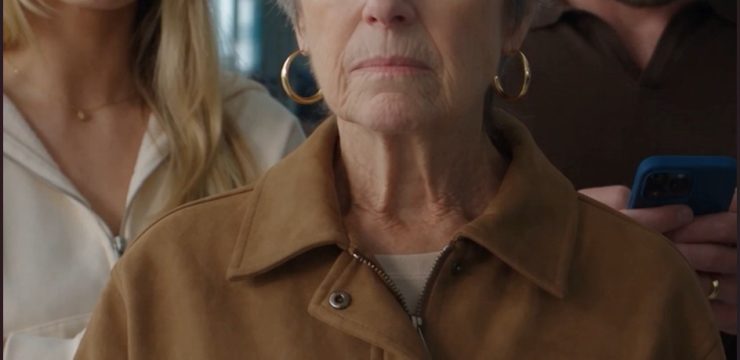
She didn’t say a word at first. The old woman’s eyes filled with tears, glistening in the pale winter light, but she said nothing. Instead, her weathered hands reached beneath the pastry tray — slowly, deliberately — and pulled out something that looked like it had been kept close for a lifetime: a faded blue ribbon, tied carefully around a tiny brass key.
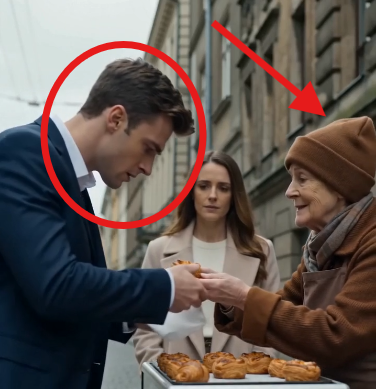
The man standing across from her on that cold, ordinary street froze. He stared at the ribbon the way a person stares at something they were certain no longer existed in the world. His mouth opened, then closed. The noise of the city around them fell away entirely.
“I wore that,” he whispered.
The old woman nodded, just once, steady and certain.
“You cried when they took it from your wrist.”
Standing a few steps away, a woman in a tan coat pressed her hand over her mouth. She had walked into this moment as a stranger — someone just passing by on an unremarkable afternoon — and now she understood, with quiet certainty, that she was witnessing something sacred. This was not a coincidence. This was not a case of mistaken identity. This was a life — a real, broken, beautiful human life — finding its way back to itself in the middle of a cold street.
The man’s voice shattered when he finally spoke again.
“They told me you abandoned me.”
The old vendor shook her head slowly, firmly, with the kind of calm that comes from years of carrying a pain no one could see.
“I searched every station,” she said softly. “Every orphanage. Every winter.”
She placed the small brass key gently into the center of his palm and closed his fingers around it, the way you would with a child’s hand. The way she probably had before, many years ago, in another life that had been taken from both of them.
“It opened our room above the bakery,” she told him.
He turned his gaze toward the old stone building standing behind her stall. It looked like it had survived decades without much attention — weathered walls, narrow windows, the kind of place you’d walk past a hundred times without looking up. But he looked up. And there, in the upstairs window, faded from years of sun and rain and time, was a small piece of paper taped to the glass.
A child’s drawing.
His drawing.
He recognized the lines before his mind could even catch up with what his eyes were seeing. The imperfect shapes, the bright colors gone pale, the innocence of a small hand doing its best to create something meaningful. He had made that. He had been a child in that room above the bakery. And somehow, impossibly, it was still there.
He turned back to her. His face was completely undone.
“You kept it?”
She reached up — slowly, the way only someone who has truly earned their years moves — and placed her hand against his cheek. Her palm was warm despite the cold air. Her touch was the kind that carries a whole history without needing to explain a single part of it.
And she whispered:
“I kept everything.”
Those two words landed like something immovable. Not loud, not dramatic — just true in the deepest possible way. Three syllables that collapsed every year of distance, every false story told, every night he must have spent believing he had been left behind by the one person who should have stayed.
She had not left. She had looked. She had held onto a ribbon, a key, a drawing taped to a window — not as relics of grief, but as promises. Evidence of a love that refused to accept the ending it had been handed.
There is something the world rarely tells us about the people we lose. We assume that separation means forgetting. We believe that time erases. We are taught, sometimes by cruelty and sometimes simply by life’s indifference, that what is gone is gone. And so we learn to let go — or we learn to pretend to. We tuck the pain somewhere quiet inside ourselves and we keep moving because that is what surviving requires.
But some people don’t let go. Some people carry the ribbon. Some people leave the drawing in the window. Some people search every station, every winter, even when no one would blame them for stopping.
This woman was one of those people.
She did not need him to believe her. The evidence was already there — had been there for years, waiting in a faded window above an old bakery on a street he happened to walk down on an ordinary afternoon that turned out to be anything but ordinary.
Reunions like this don’t always look the way we imagine they will. We picture grand gestures, dramatic music, the kind of scene that is easy to recognize as significant. But real life tends to be quieter than that. A key. A ribbon. A hand on a cheek. A whisper.
Sometimes the most profound things are also the smallest.
What this moment holds is a truth that resonates far beyond one street, one family, one lost child and the mother who never stopped waiting. It speaks to something most of us have felt at one point or another — the fear that we were forgotten, the ache of a bond we thought was severed, the desperate hope that someone, somewhere, still had us in their heart.
She did. She kept everything.
And in doing so, she kept him too.