For one long second, nobody in that café moved.
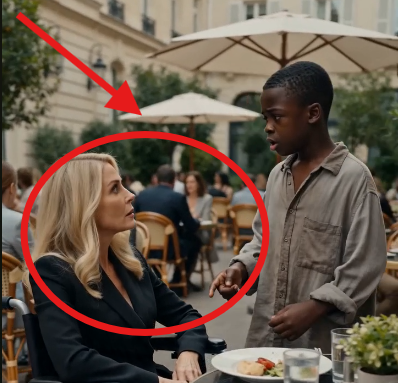
Not the servers balancing plates between crowded tables. Not the patrons stirring coffee they had already forgotten about. Not even the elegantly dressed woman in black sitting near the window, whose lunch had just been interrupted by something no amount of money could have prepared her for.
Because the hunger in the boy’s face had just changed shape.
And everyone in that room felt it — even if none of them could explain why.
This was no longer a child asking for scraps. This was something older, something buried, something that had quietly waited years for exactly this moment to surface. The air in the café shifted the way it does before a storm rolls in — heavy, charged, and impossible to ignore.
The woman stared down at the boy kneeling at her feet. Her face had gone pale, not from embarrassment, not from irritation, but from a far older wound that had just cracked open without warning.
“What did you say?” she whispered.
The boy was still holding her legs, trembling — partly from exhaustion, partly from the weight of the message he had been sent to deliver.
He swallowed hard before answering.
“My mama said you’d know me if your legs remembered first.”
That single line landed harder than anything else could have.
Because years ago — before the wheelchair, before the wealth had wrapped itself around her like polished armor — there had been another life. One she had dismantled piece by piece, quietly, methodically, until even she had half-convinced herself it had never existed at all.
A modest neighborhood on the edge of the city. A one-room apartment filled with dried herbs, handmade linens, and the kind of warmth that doesn’t cost a thing. A woman who practiced traditional healing — pressure points, plant medicines, old methods that educated people mocked in public and secretly sought out in private. A woman she had deeply loved, once, before ambition quietly replaced loyalty as her highest priority.
When that woman became pregnant, the powerful family intervened. Money exchanged hands. Silence was purchased. And she walked away — or at least that was the version of events she had rehearsed so many times it had begun to feel like the truth.
But now, a child was kneeling before her with his mother’s unmistakable eyes.
That same steadiness. That same quiet dignity that no amount of hardship had managed to extinguish.
“She told me not to beg,” the boy said, his voice catching. “She said if I found you and touched your legs, the truth would come first.”
The woman gripped the arms of her wheelchair — not because she feared falling, but because she feared he was right.
She remembered, suddenly and vividly, the day her old lover had spent two hours working the stiffness from her legs after a painful riding accident. No doctors. No prescriptions. Just her hands, steady and sure, moving through the pain with patience and precision. She used to laugh softly and say, your body listens before your pride does.
Now her body had answered before her carefully constructed story could catch up.
She looked at the plate on the table. Then at the boy. Then at the faces around them — curious, suspended, waiting.
None of that mattered anymore.
“Where is your mother?” she asked, and her voice came out more frightened than she intended.
The boy’s lip trembled.
“She’s sick.”
A pause that stretched long enough to hurt.
“She said she didn’t want your money. She wanted to know if your legs still remembered her — before your mouth had the chance to deny us.”
That was the moment something cracked inside the woman.
Not with a dramatic outburst. Not with tears falling publicly for everyone to witness. Just a small, quiet fracture — the kind that happens when a person realizes they have been carrying a debt they never paid and a wound they never properly closed.
Her hand began to shake.
Everyone in that café could see it now.
This was not a street child running a con. This was something the body knew before the mind could argue its way around it. This was the kind of debt that doesn’t disappear when you stop thinking about it — love-debt, truth-debt, the kind that settles quietly into muscle and bone and waits.
The boy looked exhausted now — hollowed out in the way only hunger and heartbreak together can hollow a person. But he didn’t let go. He had come for food, yes. But he had also arrived carrying something far heavier: his mother’s final test.
And then, very softly, he asked the question that undid her completely.
“If you can feel me… why didn’t you ever come back?”
It wasn’t an accusation. It was worse than that.
It was innocence asking a question that adults spend entire lifetimes running from.
Children have a way of finding the exact spot where grown-ups have hidden themselves. They don’t mean to be devastating. They simply haven’t yet learned that some truths are supposed to stay buried.
The woman looked at the child kneeling before her — and for the first time in longer than she could honestly remember, she did not see a complication. She did not see a threat. She did not see evidence of a chapter she had tried to close forever.
She saw her son.
Hungry. Brave. And still choosing to ask for bread before asking for answers.
With trembling fingers, she slid the plate across the table toward him. And then she reached out her hand — slowly, the way a person reaches for something precious they were certain they had lost forever.
The café remained perfectly still.
Because everyone there understood, all at once, what they had just witnessed.
The boy had not walked up to a wealthy woman’s table simply to ask for food.
He had come to make her body confess the truth that her carefully managed life had been quietly lying about for years — and in doing so, he had given her something she didn’t know she still needed.
A way back.