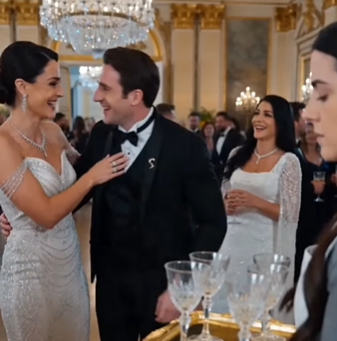
For one long second, nobody in that glittering ballroom moved.
Not the guests in their tailored gowns and pressed tuxedos. Not the musicians whose bows still hovered above the strings. Not even the servers balancing their silver trays. The chandeliers kept glowing. The music somehow still hung suspended in the air like something forgotten. But the room no longer belonged to elegance and pretense. In that single breathless moment, it belonged entirely to truth.
The young maid stared at the man in the black tuxedo as though she had just heard her own name spoken aloud in a language she had been forbidden to remember. And perhaps she had. Because the name he had just spoken — Princess Elena — felt like something impossible. Something cruel. Something that could not possibly belong to a woman who had spent her entire life being handed the castoffs, eating in back kitchens, and learning to lower her gaze before anyone powerful enough to destroy her ever noticed she was looking.
She had been raised as a servant. Dressed in worn hand-me-downs. Fed the leftovers of people who never once asked her name. And she had been taught, silently and consistently, never to ask why certain older women in the household would sometimes look at her too long before quickly turning away with wet eyes.
The man before her reached slowly and deliberately into the breast pocket of his jacket and withdrew a sealed document bearing a royal crest — the mark of a monarchy that most people assumed had buried its last great scandal years ago. His hands were perfectly steady. His voice was not.
“Twenty years ago,” he said quietly, “during the palace fire, the youngest daughter was reported to have died.”
A murmur moved through the ballroom like a current. Everyone in that room knew the story. The royal child was lost in the flames. The bloodline was closed. The kingdom mourned publicly, and then power quietly rearranged itself around the space her absence had created.
But that was not what actually happened.
The child had survived. She had been smuggled out through the hidden servant passages by a loyal palace maid who had discovered, at great personal risk, that the fire was no accident. It had been deliberately set — not simply to destroy, but to eliminate a royal claimant before she grew old enough to stand in the way of those who had grown comfortable with her being gone. The baby was hidden beneath another name. Raised in labor. Raised in silence. Raised close enough to wealth to serve it every single day, but never close enough to inherit even a fraction of what was rightfully hers.
The woman in white silk across the room looked less offended now than she did terrified.
And she had every reason to be.
Because she understood immediately, in the marrow of her bones, what it meant that Elena was alive. Her husband’s title. Her son’s inheritance. Her carefully constructed place in society. Every single stone of it had been laid upon the absolute certainty that the princess was dead and buried and gone forever.
The maid’s hands were trembling so badly now that one champagne flute rolled off the edge of her tray and traveled slowly across the polished marble floor. Not a single person in the room looked at it.
She whispered, barely finding her voice: “My mother told me I was abandoned.”
The man in black shook his head slowly, with the quiet firmness of someone delivering something irreversible.
“No,” he said. “You were hidden.”
Those four words landed harder than anything else spoken that evening. Because abandonment is something a person can learn to survive. But learning that someone loved you so fiercely they risked everything to save your life — and then lost you anyway — that kind of truth breaks something open that was never meant to heal quietly.
The most arrogant man in the room tried to recover first. “This is completely absurd,” he announced, his voice still carrying that familiar entitlement. But even he could hear how thin it sounded now.
The second investigator turned toward him without a word, and the silence in that look communicated everything: the records had been verified, the lineage confirmed by independent parties, and the entire room had already shifted — visibly, unmistakably — away from the people who had spent the past hour mocking a servant girl for the way she held her tray.
Then the maid asked the question that stripped away the final layer of pretense in that room.
“Who knew?”
Nobody answered right away. Because the honest answer was far too ugly for anyone to say first.
Some in the palace had known. Certain members of the family had known. And at least one of them was standing in white silk in the center of that ballroom, staring at the girl she had humiliated not twenty minutes ago as though a ghost had just walked in and handed her the evidence of everything she had done.
The man in black lowered his voice.
“The Queen is dying,” he said. “She has asked for her daughter. By her true name.”
That was the moment everything in the room shifted permanently.
Not because a lost princess had finally been found after all these years. But because the woman every single person in that ballroom had been looking down on — the one holding the champagne tray, the one they had laughed at, corrected, dismissed — was suddenly and irrevocably revealed as the one person in that entire room that none of them had ever had the right to look down on at all.
And the worst part? She had been serving them. For years. Without a single person in that room ever seeing what was standing right in front of them.
She stood there in her gray dress and white apron, no more royal on the outside than she had been thirty seconds before the truth arrived. But now the whole room could finally see it — the face that matched old portraits no one had looked at closely enough, the posture that no servant quarters had ever taught her, the quiet and unbreakable dignity that years of humiliation had somehow never fully managed to destroy.
She had never been small.
They had only dressed her that way.