The champagne glass trembled in Margaret’s hand, the crystal catching the glow of a hundred candles as the evening’s carefully constructed illusion began to crack right down the middle. She had hosted this gala for years — poised, polished, untouchable in her gold gown — and nothing in her carefully managed world had ever dared shake her composure. Until tonight.

The young woman across the room rose slowly from her chair. One arm curved protectively around a small boy at her side, her posture quiet, her expression even quieter. She didn’t raise her voice. She didn’t need to.
“It was never your store,” she said.
The whispers started immediately. Guests in tailored suits and designer gowns turned to each other with raised eyebrows and half-hidden smiles, the electric thrill of real drama cutting through the practiced small talk of the evening. Something was unraveling, and everyone in that glittering room could feel it.
Then the terrace doors swung open. Two managers rushed in, breathless and wide-eyed, their composure stripped away by whatever they had just witnessed outside.
“Ms. Rivera,” one of them addressed the young woman with unmistakable deference, “the flagship location has been closed. Security is removing her staff now.”
The room went utterly still.
Margaret stared at the young woman as though seeing her for the first time. “Rivera?” The name landed like a stone dropped into still water, rippling outward through every corner of the room.
The young woman’s eyes filled with tears, but her voice remained rock-steady, the kind of steady that only comes from years of swallowing pain in silence and deciding, finally, to speak.
“My mother founded that company,” she said. “Before your husband forced her out.”
Margaret shook her head, a dismissive gesture she had perfected over decades of looking down. “Your mother was a seamstress.”
“She was the seamstress who built the brand you spent twenty years pretending was yours.”
There it was. The truth that had been buried under contracts and connections and the comfortable assumption that power, once taken, could never be reclaimed. Margaret had inherited a stolen legacy and called it her own so long that she had genuinely begun to believe it.
The little boy beside Ms. Rivera tightened his grip on his mother’s hand, his small fingers holding on the way children do when they sense that the ground beneath the adults is no longer entirely solid.
Ms. Rivera looked down at her son for just a moment, something tender passing across her face, before she turned back to the gathered crowd and spoke the words that made every assumption in the room collapse.
“I came here as an employee because I wanted to see how you treated people when you thought they had no power.”
The silence that followed was the loudest thing anyone in that room had ever heard.
Margaret’s composure finally broke. The mask slipped, and beneath it was something no one in that elegant crowd had ever seen on her face before — raw, exposed fear.
“You set me up,” she breathed.
“No,” Ms. Rivera replied, her voice gentle and devastating in equal measure. “You revealed yourself.”
Then the little boy looked up at the woman in gold with wet eyes that held no malice, only the simple, crushing honesty that children carry like a gift they don’t yet know they’re giving.
“You made my mom cry.”
Four words. No accusation has ever landed harder.
Ms. Rivera reached into her clutch and placed a folded document on the candlelit table. The paper was crisp, official, final. The kind of document that doesn’t leave room for negotiation.
“The board voted this morning,” she said. “You are removed.”
Margaret stepped backward, her gold gown whispering against the marble floor. “Please. We can discuss this privately.”
But there was no private anymore. There hadn’t been since the moment she had humiliated this woman’s child in front of an audience, assuming she was speaking down to someone who had no recourse, no resources, no name worth remembering.
“You humiliated my child publicly,” Ms. Rivera said, and for the first time, her voice broke — just slightly, just enough to show that beneath the strategy and the patience and the years of quiet preparation, there was still a mother who had been hurt. “So you lose everything publicly.”
Security moved through the crowd. The guests stood frozen, witnesses to something none of them had anticipated when they arrived tonight expecting nothing more than champagne and small talk.
Margaret looked at the boy. Then at his mother. Then at the document on the table that represented the end of everything she had built on someone else’s foundation.
“I didn’t know who you were.”
Ms. Rivera held her son closer and answered with a simplicity that was more powerful than any prepared statement could have been.
“That was the point.”
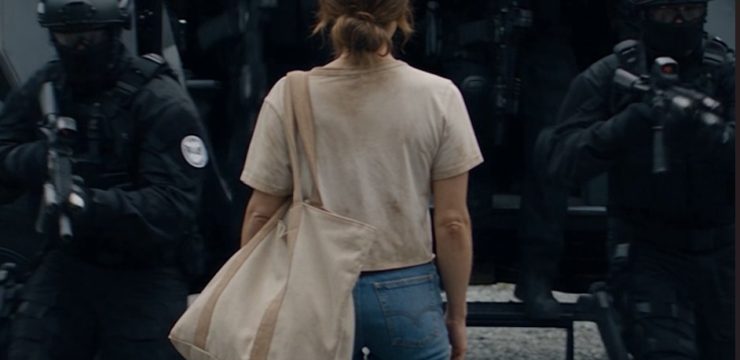
She walked out of that room with her head level and her son’s hand in hers, past the champagne flutes and the city lights twinkling through the floor-to-ceiling windows, past every person who had watched her be diminished and chosen to stay silent.
Her son looked up as they stepped into the cool night air.
“Mommy, are you still sad?”
She wiped a single tear from her cheek, and the smile that followed it was not the practiced smile she had worn for months inside those walls. It was something real, something that had been waiting a long time to come back.
“No,” she whispered, pulling him close. “I’m done being small.”
And just like that, in the quiet space after the storm, a woman who had once been made to feel invisible walked forward into a life that finally, fully, belonged to her.