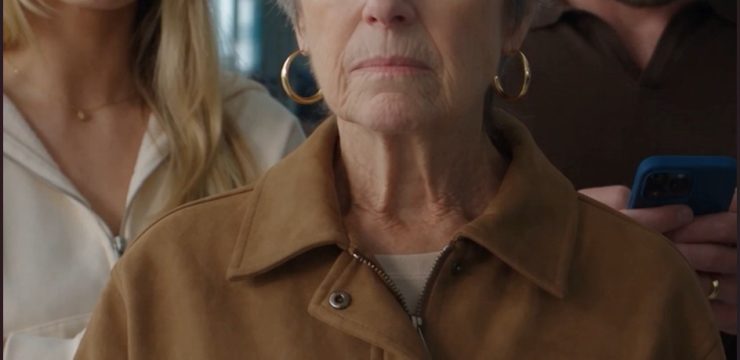
She stood at the door for a long moment before she walked in.
The dance studio smelled the same way it always had — like rosin and wood polish and something else she couldn’t quite name. Maybe time. Maybe memory. Maybe the particular scent of a life that had continued moving even when she had chosen to stand still.
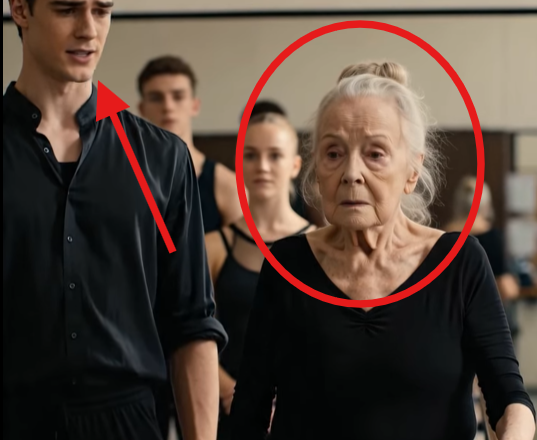
She was the oldest person in the room by at least twenty years, and she knew it. The young women at the barre glanced at her the way young people sometimes do — not unkindly, but with that quiet, involuntary curiosity that comes from seeing something unexpected. An older woman. A trembling hand reaching for the barre. Eyes that already held the weight of the entire walk across the room.
The instructor noticed her right away.
He had been about to call the class to attention, about to begin running through the combination he had planned for the afternoon, when he saw her face. Not the lines in it, not the silver in her hair, but her eyes. There were tears in them. Not the dramatic, spilling kind that demand attention and sympathy. These were quieter than that. The kind that gather slowly over years and years of holding too much, of carrying weight that was never meant to be carried alone, of making yourself smaller so the grief had less of you to reach.
He softened immediately, the way good teachers do when they recognize something real standing in front of them.
“Have you danced before?” he asked gently.
She kept one hand on the barre. It was trembling slightly, but she held on.
“Yes,” she said, her voice barely above a whisper. “A long time ago.”
Behind the instructor, the whispering among the younger students stopped. Something in the room shifted without anyone being able to say exactly what it was. The girls went quiet. They watched without looking like they were watching.
He waited. He did not rush her. He did not fill the silence with small, comfortable words the way most people would have. He simply waited, and that patience was its own kind of kindness.
She swallowed hard. She looked at herself in the mirror — really looked, the way most of us spend years trying not to — and then she spoke.
“My daughter danced here,” she said. “In this room.”
The silence in the studio changed completely in that moment. It was no longer the ordinary silence of a class waiting to begin. It became something heavier, something that pressed gently against every person in the room and asked them to stay present, to pay attention, to not look away.
“She used to beg me to come back to class with her,” the woman continued. Her voice was steady, but only barely. “Every week she would ask me. And every week I told her the same thing. I told her I was too old. Too tired. Too far past the point where any of it would matter.”
Her fingers tightened around the barre.
“I always had a reason,” she said softly. “There was always something more pressing, something more practical, something that seemed to justify standing on the outside of my own life and watching it go by.”
She paused.
“She died last winter.”
One of the young women across the room quietly covered her mouth with her hand. The instructor’s expression fell, and he made no effort to hide it. There are moments when the professional composure that we carry through our days simply cannot hold, and this was one of them.
The woman gave a small smile. It was broken at the edges, the way smiles sometimes are when they come from somewhere very deep and very painful, but it was real. It was wholly, completely real.
“Before she went to the hospital for the last time,” she said, “she held my hand. She looked right at me — she always could see straight through whatever I was pretending — and she said, ‘When I’m gone, don’t stop standing outside the life you still want. Promise me.'”
No one in the room looked away. No one moved. No one reached for their phone or shifted their weight or let their attention drift to somewhere easier and less demanding. Every person in that studio was entirely, completely present, held there by the quiet gravity of one woman’s truth.
She lifted her arm slowly, bringing it up into first position. It shook a little. Her body was not the body she had danced with before, and she knew it. The years had changed things, the way years always do. But something in her movement was still unmistakably beautiful — the kind of beauty that doesn’t come from youth or flexibility or technical perfection, but from the specific grace of someone choosing, after a long and painful absence, to return.
Her body remembered. Beneath all the grief, beneath all the years of standing at the edge and telling herself she had no right to step forward, her body still remembered what it felt like to belong to this.
“I came today,” she said, and now her voice was barely holding itself together, “because she never got to see me be brave.”
The instructor stepped back.
Not away from her. Not in dismissal or retreat. He stepped back deliberately, with intention, with the quiet understanding of someone who recognized what was actually happening in the room. He stepped back to make space. To give her room to begin.
And she did.
For the first time in far too many years, she began.
There is something that happens when a person finally stops waiting for the perfect moment and simply walks through the door they have been standing outside of for years. Something shifts. Not just in them, but in every person who witnesses it. We are reminded that it is never too late to return to who we were before the world convinced us to make ourselves small. We are reminded that the people we have lost still speak to us — through the promises we made, through the courage they believed we had, through the life they urged us not to abandon.
She danced that afternoon not because everything was okay. Not because the grief had passed or the loss had lessened or the world had somehow become easier to bear. She danced because her daughter had asked her to be brave, and for the first time, she was finally ready to try.