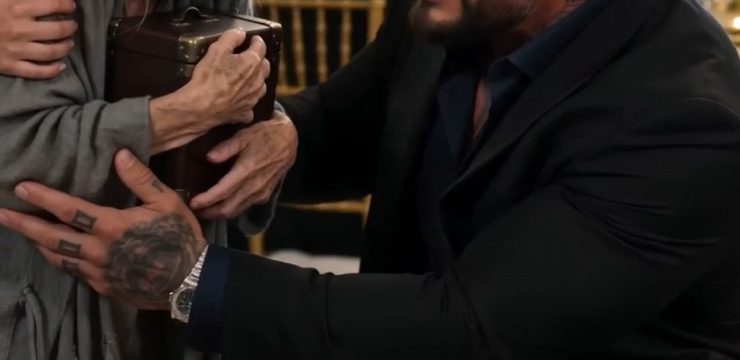
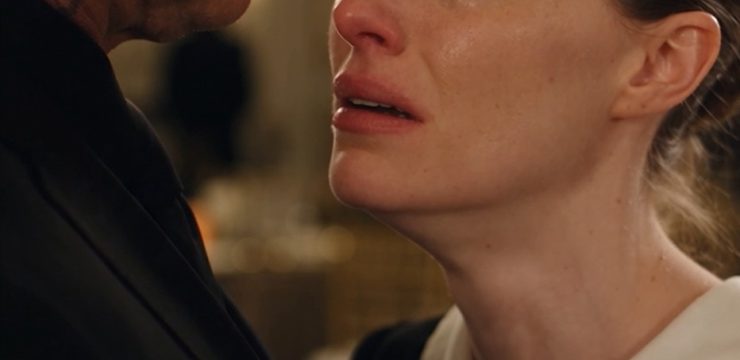
All three of them looked up at the same moment.
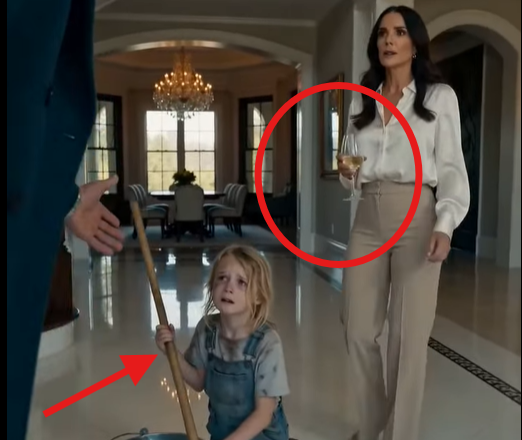
At the top of the sweeping staircase stood Margot Morel, Adrian’s mother, one hand gripping the banister, the other pressed flat against her chest. She had not been seen downstairs in weeks. Celeste had told the household staff that grief had made her too fragile to leave her room, that the loss of her husband had hollowed her out entirely, that she needed silence and rest and the mercy of being left alone.
Now she was standing there in a silk robe, pale as bone and trembling with fury.
Celeste’s face emptied like a room from which all the furniture had been suddenly removed.
“Margot, you shouldn’t be out of bed—”
“Oh, be quiet,” Margot said, and her voice cracked through the foyer like a whip meeting marble.
She descended slowly, one careful step at a time, never once taking her eyes off Celeste. Every movement was deliberate. Every breath was controlled. This was not a woman who had stumbled out of grief. This was a woman who had been waiting.
Adrian stood frozen beneath her.
“Mother,” he said, but even he did not know which part of the moment he was reacting to first.
Margot reached the final stair and looked directly at Lucie.
The child stood beside the mop bucket, frightened but still upright, her small wrist bare now where the bracelet had been carefully opened and examined. She had not run. She had not spoken. She simply stood the way children stand when they have learned very early that movement sometimes makes things worse.
Margot’s mouth trembled.
Then she whispered, barely audible above the silence of the house, “She has Elena’s eyes.”
Adrian felt the name land like a blade between his ribs.
Elena.
A woman from his father’s old estate office. Kind, quiet, long gone by the time Adrian returned from years spent abroad building a life that felt like it belonged to someone else. Celeste had once dismissed her in a single sentence — a passing matter, a servant girl who had asked for money and disappeared, nothing worth discussing at the dinner table. Adrian had accepted that explanation the way people accept explanations when they are not yet ready to ask the harder questions.
Now he understood why the subject had always died so quickly in his house.
He turned to Lucie. “Elena was your mother?”
Lucie nodded, just once.
“She died when I came out,” she said, using the language of a child who had never been given gentler words for the cruelest kinds of truth. “Grandpa said she loved you before she got sick.”
Adrian shut his eyes.
For one unbearable second he saw it all at once — the years that had passed without him, the lies that had been layered so carefully they had become architecture, the child hidden in the shadow of his own name while he had gone on living his half-finished life completely unaware.
Margot stepped closer to Lucie, then turned and looked at Celeste with an expression that contained no warmth whatsoever.
“You told me the baby did not survive the winter,” she said. “You brought me a death certificate. I held it in my own hands.”
Celeste lifted her chin, but her hands had begun to shake.
“I did what was necessary.”
Adrian looked at her slowly, the way a man looks when he is making himself be certain before he speaks.
“Necessary for what?”
And now she broke open.
“For this house!” Celeste said, her voice rising as she gestured around the foyer she had presided over for years like a queen who had never been officially crowned. “For your name, your inheritance, your entire future. Do you think your father wanted some child from a village estate taking everything he had built?”
Margot’s hand met Celeste’s face so hard the sound echoed off the marble floor and rose all the way to the ceiling.
Celeste staggered sideways.
Lucie flinched.
Adrian did not move at all.
He only stared.
Because the slap had not shocked him nearly as much as what Celeste had said before it landed. She had not denied a single word. She had simply explained herself. She had looked him in the eyes and justified it.
Margot turned to her son, breathing hard.
“Your father changed the will before he died,” she said. “He told me he would tell you himself. He said if anything ever happened, the proof would be inside the bracelet and inside the blue file locked in his study safe.”
Celeste moved at that.
Too fast.
Toward the dining room. Toward the back corridor. Toward the door at the end of the hallway that led to the part of the house she still controlled.
Adrian caught her wrist before she had taken three full steps.
His voice, when it came, was terrifyingly calm. The kind of calm that has nothing left to lose and nothing left to protect except the truth.
“Where is the file?”
Celeste looked at him with the desperation of a woman whose carefully constructed world had run out of walls.
“You don’t understand what happens if this comes out,” she said. “Your father’s name, the papers, everyone asking where the child came from, who the mother was—”
“My daughter,” Adrian said quietly, “was already on her knees scrubbing my floor.”
That ended it.
Lucie had not cried again. That somehow made everything worse than tears would have.
She was standing very still, both small hands still wrapped around the handle of the mop, as though she was not yet certain she was allowed to let it go. As though letting it go might mean something had changed and then might change back.
Adrian released Celeste’s wrist and crossed the foyer. He knelt in front of Lucie. He looked at her the way a man looks when he is seeing something he should have recognized long before now, and the recognition is arriving too late and too completely all at once.
There was fear in her face. But there was also something more heartbreaking than fear — the kind of caution that only settles into a child who has learned that hope is a door that closes.
“Did she hurt you?” he asked, his voice barely above a whisper.
Lucie’s lower lip trembled just once before she steadied it.
“Only when I called you Daddy.”
Adrian broke. Not loudly. Not with any of the drama the moment might have called for. Just quietly, in the eyes first, then in the mouth, then in the way his shoulders lowered as though his own blindness had finally found its full weight and placed it directly on him.
He reached out slowly, the way you reach toward something you are terrified of startling.
“Lucie,” he said, his voice unsteady in a way it had never been in any boardroom or any courtroom or any room in this house before today, “you never have to clean this floor again.”
For a long second she did not move.
Then, with the smallest motion in the world, she let go of the mop.
It hit the tile with a soft, hollow clatter.
And she threw herself into his arms.
He caught her the way a man catches something irreplaceable — not perfectly, not gracefully, but completely.
Behind them, Margot pressed one hand to her mouth and wept without making a sound, her tears the kind that come after years of carrying a grief that was not entirely her own.
In the deeper rooms of the house, staff had begun to gather at doorways, drawn by the sound of shattering glass, by raised voices, by the impossible reversal happening in the foyer none of them had ever seen disrupted before.
Celeste stood alone in the center of the room she had ruled so precisely, looking suddenly smaller than the child she had tried to erase from it.
Adrian rose with Lucie held against his chest.
He did not look at Celeste for a long time.
When he finally did, his face held nothing that still belonged to their marriage.
“Call my lawyer,” he said to the nearest member of staff.
No one hesitated.
Celeste’s voice cracked behind him. “Adrian, please—”
He turned away before she finished the sentence.
Margot stepped beside her son and rested one trembling hand gently on Lucie’s hair, the way grandmothers touch children they thought they had lost forever.
Then she looked at Celeste one final time and said, with the quiet satisfaction of a woman who had waited long enough:
“The heir is home.”
And for the first time since walking through that door, Lucie stopped trembling.