Not the glittering chandeliers overhead. Not the elegantly dressed guests standing shoulder to shoulder. Not even the musicians who had quietly lowered their instruments and waited in the kind of silence that only happens when something truly human is unfolding before you.
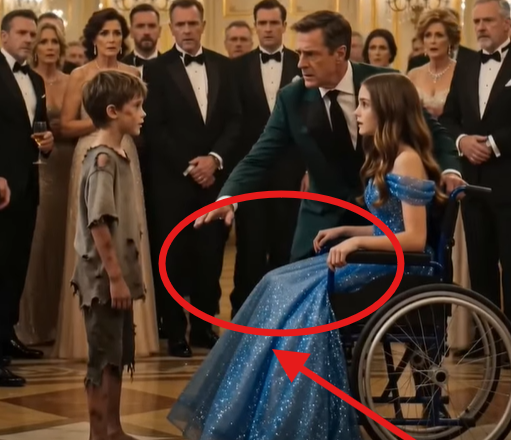
In that frozen moment, there was only the girl.
Her hand reached out and found the boy’s hand waiting for her — small, bare, and impossibly steady. She pushed herself forward from her wheelchair with an expression on her face that no one in that room would ever fully be able to describe afterward. It was terror and hope pressed so tightly together that they had stopped being two separate feelings. They had become one.
Her father moved half a step toward her, then stopped himself.
Because sometimes love wants to protect so desperately that it quietly becomes a prison. And something in the boy’s eyes told him — without a single word spoken — that if he stepped into this moment, he would shatter it beyond repair.
The girl placed one foot on the marble floor.
Then the other.
Her legs trembled beneath the shimmer of her blue dress. A soft collective gasp moved through the crowd like a wave — not because anyone believed she would fall, but because every person standing in that ballroom understood, in their bones, how many times she had already fallen before this night ever arrived.
The story had started months earlier, after the accident that changed everything. The doctors had used careful, measured language when they spoke to the family. Recovery would be long, they said. Walking again was uncertain. Dancing was never mentioned at all — not even as a distant possibility. Her father had responded the way fathers do when they love someone more than words can hold. He hired the best therapists. He found the finest specialists. He purchased the most comfortable wheelchair money could provide.
But every expensive kindness he gave her carried grief tucked quietly inside it. He stopped allowing her to hope out loud, because watching hope fail her was something he simply could not survive. He thought he was protecting her. He was. He just didn’t realize that in doing so, he had slowly begun protecting her from the one thing she needed most — her own courage.
The girl understood what was happening. Children always do, even when we think they don’t. And so, gradually, she stopped saying the thing she wanted more than anything in the world. She stopped saying she wanted to dance again.
But the boy had known. Not because anyone pulled him aside and told him. He had figured it out the quiet way — by watching from the edges of rooms, the way people without power always do. He was the stable hand’s son. He ran errands through back corridors. He polished shoes in kitchens where invisible people still hear everything that matters. He had seen the girl at the ballroom doors late at night, staring at the empty floor with her fingers moving gently against the arm of her chair, tapping softly to music that only lived inside her now. He had seen the way everyone around her was so focused on protecting her from disappointment that they had accidentally protected her from herself.
And so on this night, in front of everyone, he simply extended his hand.
No announcement. No grand speech. No performance designed to impress the room. Just a hand, offered honestly, belonging to a boy who believed she could do it even when she had stopped believing it herself.
“Just one step,” he whispered.
She took it.
The room broke — not loudly, not dramatically, but emotionally, the way only real moments can break a room full of people who came expecting nothing more than an ordinary evening.
Her father’s face was the first to give way.
Not because she was fully healed. Not because some miracle had erased the pain or undone the months of fear and grief that had settled into their family like weather. But because she was trying. She was trying in public, in front of everyone, in fear, with her whole heart exposed. There is nothing on this earth more devastating or more beautiful than watching someone you love choose courage when they had every reason to choose safety instead.
The boy guided her gently toward the center of the floor. Step by careful step. Her blue dress caught the chandelier light and scattered it across the marble as the wheelchair sat behind her, looking somehow smaller than it had sixty seconds ago, like it had already begun to belong to a version of her that was passing away.
The music rose. The crowd began to clap — softly at first, then louder, then all at once, the kind of applause that has nothing to do with performance and everything to do with witnessing something true.
The girl laughed through her tears, genuinely stunned by the sound her own shoes made against the floor beneath her.
And when the boy turned her slowly beneath the golden light — one gentle, unhurried turn — she looked across the room at her father with a face that seemed lit from somewhere deep inside, and she said the six words that undid him completely:
“Daddy… I’m really here.”
That was the line that destroyed him. Because the cruelest part of watching a child’s life change overnight is not the medical equipment or the hospital hallways or even the fear that never fully goes away. It is the quiet morning you realize your child has started living beside themselves rather than inside themselves — present in body but somewhere else entirely, behind a wall of grief they can’t figure out how to climb.
She had been behind that wall for months.
Now she was back.
Not all the way. Not without trembling. Not healed in the way the movies would have you believe healing looks. But back — present, standing, laughing, real.
The boy let go for one single breath of a second, and she stood alone in the center of the ballroom. The guests erupted. Her father covered his mouth with both hands, shaking in the way that only happens when relief and love and gratitude arrive all at once.
And in that moment, everyone understood what they had really just witnessed.
The barefoot son of a stable hand had not interrupted the evening.
He had walked into that ballroom and returned the one thing that money, doctors, and even a father’s fierce and devoted love had never been able to give back — her belief in herself.