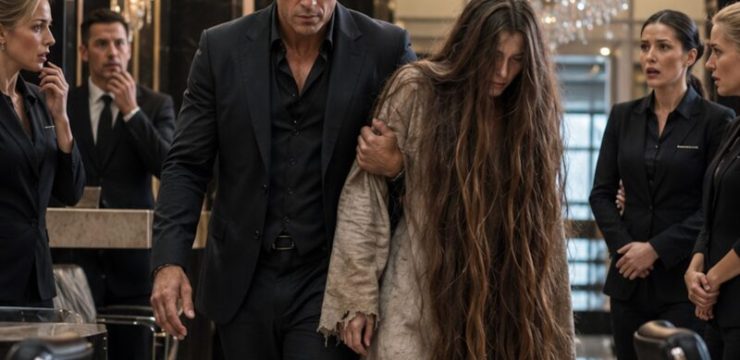
The rain had been falling for nearly an hour when the door to the small jewelry shop swung open, letting in a cold rush of evening air and a young woman who looked like she hadn’t slept in days.

She was soaking wet. Her coat was thin for the weather. Her eyes darted around the shop the way people’s eyes do when they’re desperate but still trying to look calm — when pride is the last thing standing between them and breaking down completely.
The old jeweler looked up from behind the glass counter. He had seen all kinds of people walk through that door over the years. People selling wedding rings after divorces. People pawning heirlooms to cover rent. People who came in angry and left quietly, or came in quietly and left angry. He thought he had seen everything a small shop on a rainy evening could show him.
He was wrong.
The young woman reached into her coat with trembling fingers and placed a small gold locket on the glass counter between them. It landed with a soft clink that somehow seemed louder than the rain drumming against the windows.
He didn’t touch it right away.
He couldn’t.
Because the moment he saw it, the air left his lungs like something had pressed its hands flat against his chest and pushed. He knew that locket. He knew every scratch on its surface, every tiny engraving along the edge, the exact way the hinge caught slightly before it opened all the way. He had held it a thousand times. He had given it, long ago, to someone he had never stopped loving and never stopped grieving.
His daughter. Clara.
For one long second, neither of them moved. The rain kept pounding the glass. The warm shop lights reflected in the gold between them. And the jeweler stared at the young woman like the past had just walked back in wearing wet clothes and a stranger’s face.
She looked exhausted. Scared. Cornered. But now that he really looked at her, truly looked, he saw something that made his breath catch in his throat. Not just in the shape of her eyes. Not just in the line of her mouth. But in the tiny mole near her jaw — the same place Clara had one.
His voice came out rough, barely above a whisper.
“Who are you?”
The woman’s hand trembled on the doorknob, like she was still deciding whether to run or stay. Then she answered, and those three words rearranged every corner of his world.
“I’m her daughter.”
The shop went silent — not because the rain had stopped, but because the meaning of those words landed too hard for anything else to matter.
His missing child had not died. She had lived long enough to have a daughter of her own.
He took one slow step forward, his heart pounding in a way it hadn’t in years.
“Where is Clara?”
The young woman shut her eyes for just a moment, like even hearing the name out loud caused her physical pain. When she opened them again, her voice was barely a whisper.
“She’s alive. But not for long.”
That sentence shattered whatever distance remained between them. What followed was a truth that had been buried beneath decades of deliberate silence and carefully constructed lies.
Clara had not drowned all those years ago. She had been taken. Not by strangers — but by her own mother’s family, people who believed the jeweler was too poor, too ordinary, too far beneath their station to remain connected to their name. They sent Clara away. They altered records. They buried the truth so deeply that even Clara herself, growing up, had been made to believe her father never wanted her back.
But she searched anyway. She never fully stopped. She held onto the locket the way you hold onto something when every other piece of evidence has been taken from you — because some things survive even the most deliberate erasure.
Clara had grown too ill to make the journey herself. So she sent her daughter with the only thing she had left — the one object no lie had been able to destroy.
The young woman looked down at the locket and said, her voice breaking open like something long sealed.
“She needed medicine. I had nothing left to sell.”
That was why she had come. Not because the locket meant nothing. Because it was the very last thing that still meant everything, and love sometimes asks us to let go of what we treasure most in order to save what we love even more.
The jeweler reached out. Not for the locket this time. For her shaking hand. And for the first time since she had walked through his door, she didn’t pull away.
Then she said the words that broke him completely open.
“She told me… if you cried when you saw it, then I found my real grandfather.”
There are moments in a person’s life that divide everything into before and after. This was one of them.
The little jewelry shop on that rainy evening was no longer just a place where people came to sell what they could no longer afford to keep. It became something else entirely — the place where a story that everyone had been told was finished turned out to have never ended at all. The place where a family that had been deliberately scattered found the first thread that could draw it back together.
Some losses are not permanent. Some doors that close do not lock forever. And sometimes the truth, no matter how deeply it is buried, finds a way to walk back in through a quiet door on a rainy night, trembling and exhausted, carrying everything that still matters in the palm of one hand.