The coffee machine gurgled in the corner. Old fluorescent lights buzzed low above the booths. A handful of regulars murmured over their plates, not paying attention to anything in particular. It was a Tuesday afternoon like every other Tuesday afternoon — unremarkable, unhurried, forgettable.
Until the old woman walked in alone.
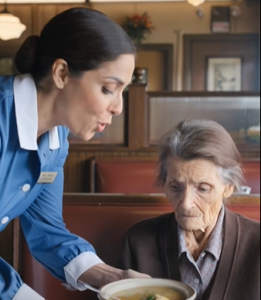
She was small and frail, wrapped in a worn brown cardigan despite the mild weather outside. She sat down at the counter without picking up the menu, folded her hands over each other, and looked at the waitress with eyes that carried something heavy. Not sadness exactly. More like a burden she had been holding for a very long time and was finally ready to set down.
The waitress brought her a bowl of tomato soup without being asked. It was something she did sometimes — noticed when people came in looking not just hungry but lost. She never asked what they could pay first. She just fed them. It was a small habit, barely conscious, the kind of thing you do when it’s simply in your nature.
The old woman watched her do it. Said nothing at first.
Then she reached into her cardigan pocket and pulled out a small folded piece of paper, smoothed at the creases like it had been opened and closed many times over many years.
“I have been looking for you for a long time,” the old woman said softly.
The waitress paused, dish towel still in her hand. “Me?”
“Your mother asked me to give this to you.”
The word landed like a stone dropped into still water.
Mother.
The waitress had grown up carrying that word like an open wound. Her mother had vanished when she was six years old. No note left behind. No phone call. No body ever found. The explanations people offered over the years never quite fit together — she owed money, she ran away, she just couldn’t handle it anymore. Her father had offered nothing but silence and whiskey until he passed with the same non-answers he had always given.
She had spent her whole life quietly wondering what she had missed, what she had done wrong, or whether the woman who gave birth to her had ever thought about her at all.
She opened the folded paper with trembling hands.
Inside, written in faded blue ink that she recognized the instant she saw it, were these words:
If my daughter ever feeds someone for free before asking what they can pay, tell her she is still mine.
The waitress stopped breathing.
She knew that handwriting. She had kept it tucked away in a drawer for years — an old grocery list, the last physical proof that her mother had once existed in the same world she did. The loops of the letters. The way the ink pressed harder at the end of each word. It was unmistakable.
Her hands were shaking so badly she had to set the note down on the counter.
The old woman reached across and covered her hands gently with her own.
She explained, in a voice barely above a whisper, that on a freezing winter night long ago, she had collapsed in an alley behind a pharmacy. Her husband had recently passed. Her sons had sold the family home without consulting her. She had nowhere to go and no strength left to look for somewhere. People walked past her. No one stopped.
Except one young woman walking home after a long double shift, still wearing her uniform, tips still in her pocket.
That woman bought her medicine. Paid for a room she could not truly afford. Stayed through the night to make sure she was alright. And when morning came and the old woman asked why she had done all of that for a stranger, the young waitress just shrugged and said some people need someone to stay.
“That woman was your mother,” the old woman said.
Tears were falling freely now — from both of them.
“She told me about her little girl,” the woman continued. “She said she was afraid the world might make you hard someday. She asked me that if I ever came across a young woman with her eyes — and her same quiet way of giving without being asked — I should find a way to give you that note.”
The waitress pressed her hand over her mouth.
“What happened to her?” she finally managed to ask.
The old woman was quiet for a moment. Then she reached back into her cardigan and pulled out a photograph, slightly yellowed at the edges.
In the photo, a young woman stood outside this very diner, wearing the same style of uniform the waitress herself wore today. She was smiling. And standing beside her, arm around her shoulder, smiling just as warmly, was a man the waitress recognized immediately.
The owner of the diner.
The man who had hired her without much explanation. Who had always been unusually generous with her schedule, her pay, her breaks. Who checked in on her more than any employer she had ever had. Who seemed, now that she thought about it, almost protective of her in a way that never quite made sense.
The old woman looked at her with careful, sorrowful eyes.
“She did not leave because she wanted to,” the woman said quietly. “She disappeared the same week she told him she was going to have a child.”
The noise of the diner seemed to fall completely away.
The waitress sat very still, the photograph in one hand and her mother’s words in the other, while everything she had ever believed about her own story began to quietly rearrange itself into a shape she was only now, after all these years, beginning to see clearly.
Some truths do not arrive loudly.
They come in on a Tuesday afternoon, wrapped in a brown cardigan, carrying a note written by someone who loved you enough to make sure you would find your way back to her — even after she was gone.