Nobody in that gleaming hotel lobby saw it coming. Not the guests in their tailored suits. Not the staff quietly moving through their routines. Nobody expected that the small, quiet boy sitting in a wheelchair — clutching a worn, hand-stitched rag doll — was about to bring down the most powerful man in the building.
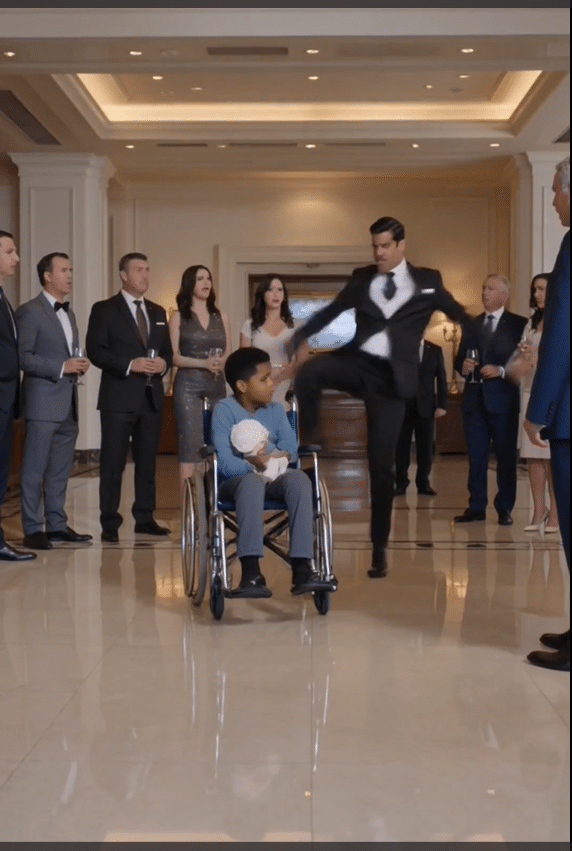
The Grand Elysium was exactly the kind of place that made ordinary people feel small. Crystal chandeliers hung from ceilings so high they seemed to touch heaven itself. The marble floors were polished to a mirror shine. Every detail whispered one message: you either belong here, or you don’t.
Richard Sterling believed he decided who belonged.
He was the kind of man who wore his power like a weapon — custom Italian suit, diamond-studded Rolex, a permanent sneer carved into his face. As general manager, he ruled the Grand Elysium like a personal kingdom. Staff feared him. Guests endured him. And for years, nobody dared challenge him.
Then he saw Leo.
The boy was fourteen, small for his age, sitting quietly in a manual wheelchair near the center of the lobby. He held a tattered rag doll close to his chest — faded, patched, clearly well-loved. He wasn’t causing trouble. He wasn’t making a sound. He was simply there, existing in a space Richard had decided he didn’t deserve to occupy.
Without hesitation, Richard crossed the lobby. His face twisted with contempt.
“Get out of here,” he barked, loud enough for half the lobby to hear. Before Leo could even look up, Richard delivered a hard, sweeping kick to the side of the wheelchair. The chair tipped violently. Leo was thrown sideways, his small body hitting the marble floor with a terrible sound. His rag doll skidded across the polished floor and came to rest against a velvet rope.
Guests gasped. Hands flew to mouths. A ripple of horror moved through the crowd. But nobody stepped forward. Richard’s authority was a wall nobody was willing to climb.
And then the front doors of the Grand Elysium exploded inward.
A sleek, armored SUV blasted through the towering glass entrance, sending tempered glass raining across the lobby like a burst of frozen fireworks. The vehicle screeched to a halt right in the middle of the floor. Doors flew open. A squad of large men in sharp black suits poured out, instantly forming a perimeter as panicked guests scrambled backward.
From the rear door stepped Marcus — a man who carried authority in every measured step he took. He didn’t look at Richard. He didn’t acknowledge the chaos around him. He walked directly to where Leo had fallen and knelt down with the careful gentleness of someone who deeply respected the person in front of him.
“Young sir,” Marcus said quietly, “forgive our late arrival.”
The color left Richard’s face completely.
“H-how…?” he stammered.
The answer came swiftly and without mercy. As Marcus carefully helped Leo back into his righted wheelchair and another bodyguard retrieved the rag doll with quiet respect, the full weight of the truth began to descend on Richard like a collapsing building.
Leo Vance was not a vagrant child who had wandered in from the street. He was the only son of Jonathan Vance — the legendary founder of the Vance Hospitality Group — kept hidden from the public eye for his own protection. Three months earlier, Jonathan had passed away. And with his passing, every hotel, every contract, every share in the sprawling hospitality empire transferred to his fourteen-year-old son.
Leo was not a guest at the Grand Elysium. He was its owner.
Richard’s mind scrambled for solid ground and found none. He blurted that the board of directors would protect him, that his profit numbers were bulletproof, that Leo was just a child. Every word that left his mouth felt flimsier than the last. Because Marcus was already speaking about ghost payrolls, about diverted salaries, about shell companies in the Cayman Islands where stolen money had quietly been rerouting for eighteen months. About the kickbacks from unregulated vendors. About safety equipment failures in Chicago that had put real people at risk.
And then Leo opened the rag doll.
Sewn inside its back, hidden in plain sight for months, was a sleek, military-grade encrypted drive containing a forensic audit of every fraudulent transaction Richard had ever authorized. Every falsified ledger report sent to the board. Every salary stolen from a housekeeper working double shifts without overtime.
The boardroom on the fiftieth floor was already in session when Leo arrived. Twelve board members sat around a glass table, mid-presentation under interim CEO Arthur Pendelton — until the doors were kicked open and a teenager in a wheelchair rolled to the head of the table and claimed his seat.
The evidence on that drive was absolute. It didn’t just expose Richard. It exposed Arthur, too. The emails. The wire transfers. The private communications between two men who had decided a grieving, disabled boy would never come looking for what was his.
They were wrong.
By the time the police arrived, Richard was weeping openly in a corner chair, his diamond watch catching the light one last time before cold handcuffs clicked around his wrists. Arthur was silent, head bowed, the fight already gone out of him. Leo instructed the officers to march them through the main lobby — past the guests, past the staff, past the housekeeper who had been quietly yelled at for years — so that everyone could witness what accountability looked like.
As the evening sun cast its amber light through the shattered entrance, Leo sat on the mezzanine balcony, his rag doll resting in his lap, watching his hotel settle back into stillness.
He asked the maintenance crew to leave one piece of that broken glass — set it in clear resin in the new doorframe. A permanent reminder. Not of violence or chaos, but of what happens when arrogance goes unchecked, and of what this hotel truly stands for.
“This place belongs to everyone who works hard for it,” he told Marcus quietly. “Not just the people wearing diamonds.”
Then he turned his wheelchair toward the penthouse hallway and smiled — tired, aching, but unbroken.
“Let’s go get the most expensive burger on the menu, Marcus. I think we’ve earned it.”