The church was filled with soft music, white flowers, and the quiet hum of anticipation. Every seat was taken. Candles flickered at the altar. The bride stood radiant in her gown, bouquet clutched gently in both hands, her eyes bright with the kind of joy that only comes once in a lifetime.
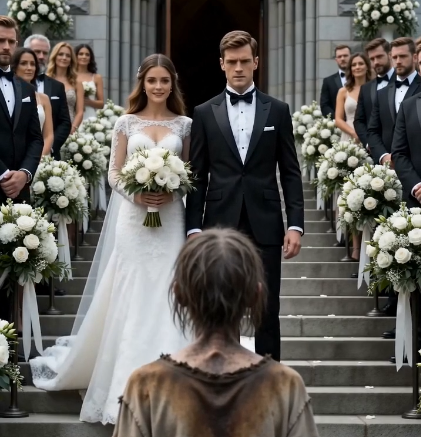
The groom could barely breathe — not from nerves, but from love.
Then the doors opened.
Not the way they were supposed to. Not with another guest slipping in late, smoothing their jacket and finding a seat in the back. The doors opened with a kind of weight, a heaviness that made heads turn and conversations die mid-sentence.
A woman stood in the doorway.
Her coat was torn at the hem. Her shoes were worn through. Her hair was silver and tangled, and her hands — trembling visibly from where the groom stood — gripped the doorframe as though the ground beneath her might give way at any moment.
Nobody moved.
Then the groom looked at her face. Really looked. And something inside him split open — something old and buried and never fully healed.
“No,” he whispered, barely audible above the silence. “My mother died.”
The woman shook her head slowly.
“That’s what your father told everyone.”
The words fell like stones into still water. Every guest heard them. Nobody breathed. The groom turned, almost involuntarily, toward the older man standing just behind the bride — his father, dressed impeccably, jaw set, hands folded in front of him with the practiced calm of someone who had kept a secret for decades.
His face had gone completely white.
The bride looked between them, clutching her bouquet tighter.
“What is going on?” she asked, her voice small and trembling.
The woman reached slowly into her torn coat and pulled out something small — a silver bracelet, thin and delicate, catching the light from the stained glass windows above. She held it out in her weathered palm.
The groom stopped breathing entirely.
He had seen that bracelet before. In photographs — old ones, kept in a locked box in his father’s study. Baby photos. Photos his father had never explained and never offered to share. Photos the groom had stumbled upon as a teenager and been quickly steered away from, told they were private, told they were from “another time.”
The woman’s voice broke as she spoke.
“He paid me to disappear after you were born. When I refused to go quietly, he had me removed from the hospital. He told them I was unwell. That I was a danger. They believed him because he had money and I had nothing.” Her breath caught. “He took you from my arms, and I never stopped looking for you.”
Every eye in that church moved to the groom’s father.
The groom’s voice was low and controlled in the way that voices get when someone is holding themselves together by the thinnest thread.
“Is this true?”
His father’s jaw tightened. He didn’t deny it. He simply said, quietly, without a trace of remorse that anyone could see: “She was poor. Unstable. She would have ruined everything I built for you.”
The silence that followed was the loudest thing that room had ever held.
The groom’s eyes filled — not with the tears of a groom on his wedding day, but with something older and rawer, grief that had been waiting years for a name.
“You didn’t protect me,” he said. “You destroyed her.”
The bride had stepped back from the altar without realizing it. Her heels caught the edge of the runner beneath her feet. She was pale. Her hands gripped her bouquet so hard the stems bent.
Then the woman turned to her — gently, with something almost like an apology already written across her face.
“I’m sorry, child,” she said softly. “But there is more you need to know.”
The bride went perfectly still.
The woman gestured to the phone in the groom’s hand — he hadn’t even remembered picking it up. With shaking fingers, he opened the last file she had sent before walking through those doors.
A document filled the screen.
A birth record.
He read it once. Then again. His lips moved slightly, silently.
Then he looked up at the bride — the woman he loved, the woman he had planned to spend the rest of his life beside — and his face said everything before his voice could find the words.
The bride’s bouquet slipped from her fingers and hit the floor.
White petals scattered across the marble.
“No…” she breathed.
The same father. Listed on both records.
The woman who had walked through those doors in a torn coat, who had been sent away with nothing and silenced for years, had given birth to both of them — and neither had ever been told.
Her tears fell openly now, without apology, without shame. The tears of a mother who had lost everything and come back with the only thing she had left: the truth.
“You were never supposed to marry each other,” she whispered. “You were supposed to know you were family.”
The candles at the altar still burned. The flowers were still perfect. The music had long since stopped.
And in that church full of witnesses, a secret thirty years in the making finally came apart — quietly, completely, and with no way left to put it back together.
Some truths arrive too late to save us from the pain. But they arrive nonetheless.