Every mother has that moment — the one where something small, something easy to dismiss, suddenly doesn’t sit right in your chest. For me, it started with a bathroom door.
My ten-year-old daughter Emma had a routine that never changed. The second she walked through our front door after school, she dropped her backpack right there by the entrance, kicked off her shoes, and bolted straight to the bathroom. No hello. No snack. No flopping on the couch the way kids do. Just the sound of small feet padding down the hall and then — click — the lock sliding into place.
At first, I told myself it was nothing. Kids get sweaty. School is long and exhausting, and coming home to a warm shower feels good. I’d done the same thing myself as a girl. But days turned into weeks, and the pattern never broke. Not once. And something about the way she moved — urgent, almost mechanical — started to gnaw at me in a way I couldn’t quite name.
One evening I waited until she came out, towel around her shoulders, hair dripping, and I asked as casually as I could manage.
“Emma, how come you always shower the second you get home? Every single day?”
She looked at me and smiled — but the smile came just a half-second too late.
“I just like being clean, Mom.”
I nodded. I smiled back. But I stood there in the hallway long after she went to her room, and I couldn’t shake the feeling that something was off. Emma had never been a neat freak. She was the kid who forgot to change her socks, who left her jacket on the floor, who didn’t care about grass stains on her jeans. “I just like being clean” wasn’t Emma’s language. It sounded like something she had prepared.
Weeks passed. I pushed the worry down the way mothers do when they’re hoping they’re wrong.
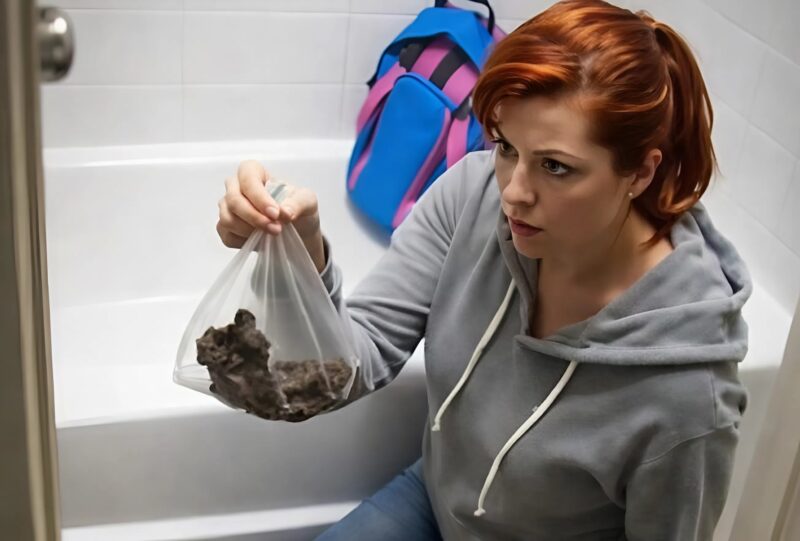
Then the bathtub started draining slowly. Water pooling around my ankles, a gray film collecting on the porcelain. I figured it was a hair clog — the usual culprit — so one afternoon while Emma was at school, I put on rubber gloves, unscrewed the drain cover, and worked a plastic snake down into the pipe.
It caught on something almost immediately. I pulled, expecting the usual tangle of hair.
What came up wasn’t just hair.
It was a wet, matted clump — strands twisted around something else, something thin and fabric-like. I pulled harder and out came a piece of cloth, compressed and soap-soaked, stuck together like it had been shoved down there deliberately.
I ran it under the tap. As the grime washed away, a pattern emerged. Light blue plaid.
My hands went completely still.
I knew that pattern. It was Emma’s school skirt.
Fabric doesn’t end up inside a drain pipe by accident. It gets pushed there. Hidden there. By someone trying to make sure it isn’t found. I turned the piece over slowly, and that’s when I saw the stain — brownish, faded, but unmistakable against the pale blue fabric.
The room felt like it tilted.
My mind started spinning through explanations, each one worse than the last. A fall. A scrape. Something that happened at school that she didn’t want me to see, didn’t want to explain. Every single one of those rushed, locked-door showers suddenly looked completely different. Not a habit. A cover-up.
I didn’t wait. I picked up my phone and called the school right then.
“I need to ask about my daughter Emma,” I said, trying to keep my voice steady. “Has anything happened? Any incidents, any injuries? She comes home and showers immediately every single day, and I just found part of her uniform pushed into the drain with what looks like a stain on it.”
There was a pause on the other end of the line. Long enough that my stomach dropped.
Then the school secretary said quietly, “Mrs. Miller… could you come in? Right now, if possible?”
“Why?” I whispered.
“Because you’re not the first mother who has called about this.”
By the time I got to the school, the principal and the school counselor were already seated and waiting. The look on their faces told me this was serious before either of them said a word.
What they explained shook me to my core.
An online game had been spreading through the student population — organized, the principal said carefully, by older students. A private group chat. A points system. Daily challenges sent to younger kids who wanted to be included. At first the tasks were trivial. Wear mismatched socks. Go a whole day without speaking. Leave a note somewhere without getting caught.
Then the challenges escalated.
Lock yourself in a bathroom for a precise amount of time and photograph the timer as proof. Stain part of your uniform and hide it before your parents see. Keep a secret from your family — no matter what. For every completed task, a child earned points. Enough points, and they were promised entry into an exclusive inner circle. “The Chosen.” Special status. Belonging.
Emma had wanted to belong.
When they brought her in, she sat across from me and stared at the table.
“Mom,” she said finally, her voice barely above a whisper, “it was just a game. Everyone wanted in. If you said no, they left you out.”
I reached across and took her hand. I didn’t trust my voice to say anything for a long moment.
What stayed with me — what still stays with me — isn’t the relief that she wasn’t physically hurt. It’s the weight of what I realized sitting in that office. Our children will hide almost anything from us if it means feeling chosen, feeling like they belong somewhere. And they’ll do it so quietly, so carefully, that the only clue we get is a strange piece of fabric in a drain and a smile that comes just a half-second too late.
Pay attention to the small things. They’re never really small.