She wasn’t supposed to be there. That much was clear from the moment she walked through the gilded doors of the ballroom, her dress slightly torn at the strap, her eyes wide with the kind of wonder that only belongs to someone who has never stood in a room like this before. She looked out of place among the glittering gowns and polished shoes, and everyone in attendance seemed to notice it at once.
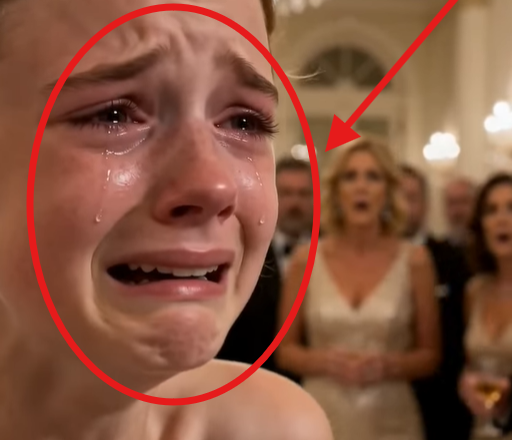
But no one moved to help her.
The evening had been everything a formal gathering of that caliber was supposed to be — elegant, composed, and perfectly rehearsed. Champagne flutes caught the light from the chandeliers above. Laughter floated through the air in careful, measured tones. And at the center of it all stood the older man, silver-haired and distinguished, the kind of figure who commands a room simply by existing in it.
Then the girl moved through the crowd, and everything changed.
It was the necklace that did it.
Around her neck hung a piece of jewelry that stopped him cold — a delicate chain bearing a crest, set with diamonds that caught every flicker of candlelight in the room. His breath became shallow. His hands, steady through decades of composure, began to tremble. He stared at that crest the way a man stares at something he buried long ago and never expected to see again.
Before he could speak, the blonde woman stepped forward with a sharp urgency that cut through the music and the murmur of the crowd.
“Take it off her,” she said, her voice tight with something that wasn’t quite authority. “Now.”
But the older man did not move. He couldn’t. His eyes were locked on the girl, on the necklace, on the impossible truth dangling right in front of him.
“This crest,” he said slowly, “was made for one child.”
The girl looked up through tears she hadn’t meant to shed. “I don’t understand,” she whispered.
He reached forward with the gentleness of a man afraid to shatter something fragile. He turned the necklace over and revealed a tiny hidden clasp — the kind of detail that only someone who commissioned the piece would ever know to look for. Inside was a miniature portrait, no larger than a thumbnail, painted with extraordinary care. A young woman. A baby wrapped in blue satin. A moment frozen in time that was never meant to be forgotten.
The girl stopped crying.
The room went still around her.
“That’s my mother,” she breathed.
Three words. Barely a sound above a whisper. But they landed in that ballroom like a stone dropped into still water, sending ripples through every person standing within earshot.
The blonde woman’s face drained of color in a single, terrible moment.
The older man turned his gaze toward her slowly, the way a storm gathers before it fully breaks. There was no shouting. No dramatics. Just the quiet devastation of a man confronting a truth he had been denied for too long.
“You told me the baby died,” he said.
The silence that followed was the kind that swallows a room whole. Conversations stopped mid-sentence. Glasses were set down without a sound. Even the musicians seemed to understand that something irreversible was happening, and let the music die.
The girl stood at the center of it all, clutching the torn strap of her dress, trembling not from cold but from the weight of something she couldn’t yet fully name. She had walked into this room as a stranger. She was beginning to understand that she might be something else entirely.
The blonde woman stepped back. One step, then another, as if distance could undo what had already been revealed. Her head moved slowly from side to side, a gesture caught somewhere between denial and confession.
“She was supposed to disappear,” she said.
It was not a defense. It was not an explanation. It was simply the truth slipping out of her before she could stop it — the kind of truth that has been held so tightly for so long that when it finally escapes, it comes out raw and unguarded.
The older man’s eyes filled with something that lived in the difficult space between rage and grief. Two emotions that should not coexist so quietly, and yet there they were, written plainly across his face for every person in that room to witness. A man who had mourned. A man who had been made to mourn. And a man who now understood the difference between the two.
He took the girl’s hand in his.
It was a simple gesture, unhurried and deliberate, the kind of choice a person makes when they are absolutely certain. He turned to face the guests — the friends, the associates, the witnesses who had gathered that evening for a celebration and stumbled instead into a revelation.
“Then everyone here,” he said, his voice steady and clear and carrying to every corner of that glittering room, “just witnessed the return of my granddaughter.”
No one spoke.
No one needed to.
The girl stood beside him, still trembling, still holding the necklace in her fingers, still trying to absorb the enormity of what had just unfolded around her. She had come into that ballroom with nothing but a torn dress and a piece of jewelry she had always worn without fully understanding why.
She left it as someone’s family.
The blonde woman stood alone on the other side of the room, surrounded by people and utterly isolated, finally facing the long and inevitable consequence of a secret she had carried far too long. Some lies protect the person who tells them. Some lies destroy the people who never knew they were being told.
And some truths, no matter how long they are buried, find their way home.