She was the blacksmith’s daughter. Nothing more, nothing less — at least, that’s what everyone in town assumed. Her father was a quiet man who spent his days at the forge, hammering iron into shape, earning just enough to keep the lights on. They weren’t wealthy. They weren’t connected. By every measure that mattered in that city, they were invisible.
But the girl was anything but invisible.
There was something about the way she carried herself that made people stop mid-sentence. Her back was straight, her gaze was clear, and she never — not once — lowered her eyes when powerful men walked into the room. In a city where fear had become the native language, she walked like someone who had never learned a single word of it.
People talked about her beauty, sure. But what really kept the whispers going was her spirit. Word spread from corner to corner: that girl cannot be bought, cannot be broken, and will not be anyone’s possession. Not for any price.
The mob boss heard those whispers, too.
Men like him don’t take kindly to being told no. He had built his entire empire on the simple premise that everyone had a number — a figure at which their dignity quietly packed its bags and walked out the door. He had never met anyone who proved that theory wrong.
Until her.
He started the way he always did. Gifts arrived at her doorstep — jewelry that caught the light like captured stars, bolts of rare fabric, envelopes thick with cash that could have completely transformed her family’s circumstances. Her father said nothing. The girl sent everything back. No shouting, no dramatic confrontation. She simply looked the messenger in the eye and said, with a calm that was almost unsettling, that she was not for sale.
That quiet refusal infuriated him far more than any screaming match ever could.
So he decided to try a different approach. He would use fear. Fear, after all, had never failed him before.
One evening, his men took her right off the street. No one stepped in. Neighbors looked away. Shop owners suddenly found something important to study on the floor. She was driven out of the city to a remote property where an old concrete enclosure sat behind rusted fencing. Inside that enclosure lived dogs that had become the stuff of local nightmares — massive animals trained specifically for violence, kept hungry, given only raw meat, conditioned to know one thing and one thing only: attack, and don’t stop.
The boss stood outside the enclosure in the cool evening air, watching her with the relaxed confidence of a man who had already decided how this evening would end.
“You have a choice,” he said, his voice almost gentle. “Become mine. Or go in there.”
She was pale. Her hands were trembling. But when she opened her mouth, her voice held steady.
“I would rather face those dogs than spend a single day belonging to you.”
He gave the signal.
The door slammed behind her with a sound like a coffin lid.
A crowd had gathered — word travels fast in a city built on secrets. Some people came out of morbid curiosity. Others came with dread sitting heavy in their chests. But everyone stayed. Everyone watched.
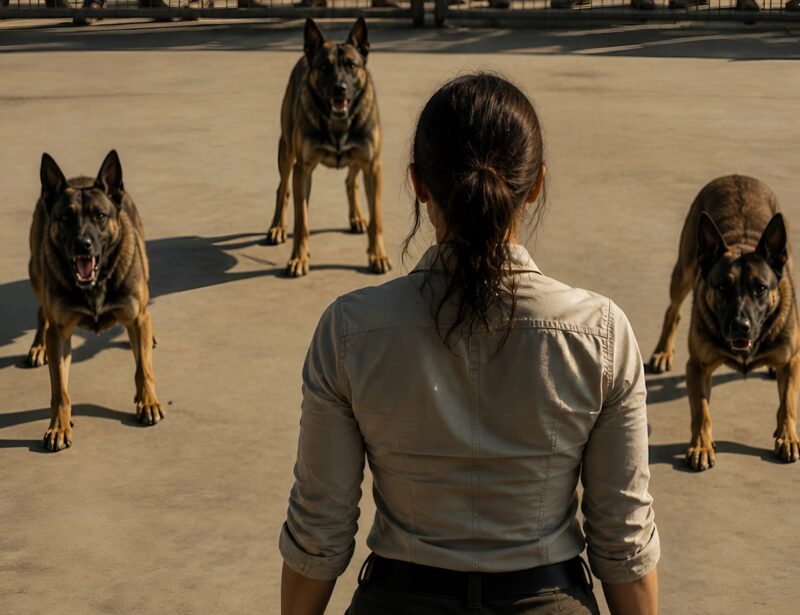
The dogs appeared from the shadows at the far end of the enclosure. Three of them, enormous, moving with the slow and deliberate certainty of animals that have never lost. Heads low, muscles coiled, saliva catching the fading light. The girl backed against the concrete wall. There was nowhere to go.
One of the dogs broke into a charge.
The crowd stopped breathing.
And then — something happened that no one in that crowd would ever be able to fully explain, no matter how many times they told the story in the years that followed.
The dog stopped.
Not because of a command. Not because of a fence or a barrier. It simply stopped, mere feet from her, its charge dissolving into something quieter, something confused. The growl that had been building in its throat changed pitch — turned into a low, searching sound. The animal took one slow step forward and then lowered its enormous head.
The second dog circled her carefully, nose working, and then sat. The third approached her side and let out a soft, mournful whine — the kind of sound a dog makes when it recognizes someone who has been hurt, someone who carries sorrow in their bones.
The girl stood perfectly still. She hadn’t run. She hadn’t screamed. Slowly, almost involuntarily, her hands came down to her sides, and one of the dogs pressed its muzzle gently against her trembling fingers.
Silence fell over the enclosure like a held breath that refused to release.
The animals that the entire city feared were not attacking her. They had surrounded her — but not as predators circle prey. They surrounded her the way a pack protects one of its own. One lay at her feet. One stood at her side, facing outward, watching the crowd. One turned its gaze toward the man standing outside the fence and growled — slow, low, and deliberate. Not at the girl. At him.
People began stepping backward. The whispers grew louder.
The boss shouted a command. Nothing moved.
One of the dogs turned its head and looked directly at him — and growled again.
In that moment, in front of everyone who had gathered to watch a young woman be destroyed, the truth landed like a stone dropped into still water: the most dangerous creatures in that enclosure were not the ones with four legs.
They were the ones who had built cages, weaponized hunger, and called it power.
She walked out of that enclosure that night without a scratch. The boss never recovered his reputation in that city. And the blacksmith’s daughter, the girl no one had bothered to look at twice — she never lowered her eyes again. She never needed to.