The military cafeteria was loud that afternoon — the kind of noise that fills a room after hard work, when young soldiers finally get to breathe, eat, and laugh without someone barking orders at them. Dozens of men poured in from training, exhausted, hungry, and restless. Some gathered in groups, reliving the morning drills with exaggerated hand gestures. Others moved quickly through the food line, eyes already fixed on their plates.
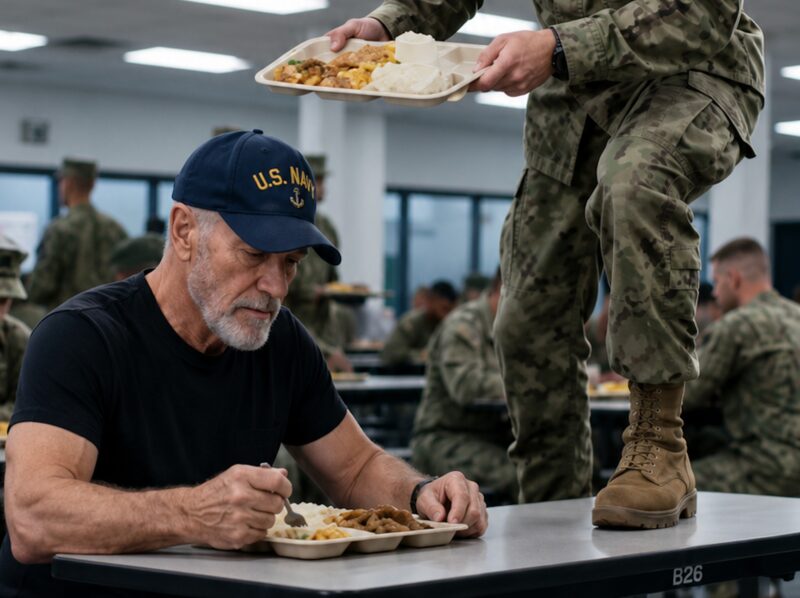
Nobody paid much attention to the old man sitting quietly in the corner.
He looked to be somewhere in his mid-sixties. Simple black T-shirt. Worn jeans. A dark cap pulled low. He wasn’t trying to stand out, and he wasn’t trying to blend in either. He was just eating — calm, deliberate, completely unbothered by the noise around him.
Most of the soldiers had no idea who he was. A few assumed he was maintenance staff or maybe someone’s relative visiting the base. Nobody asked. Nobody really cared.
That changed the moment Ryan walked in.
Ryan was the kind of young man who filled a room with his presence — and not always in a good way. Built like a wrestler, which he was, he carried himself with the kind of confidence that borders on arrogance. He was loud, competitive, and used to being the most dominant person in any space he entered. His fellow soldiers either admired him or stayed out of his way. Usually both.
He grabbed his tray, scanned the crowded room, and spotted the one open seat — right across from the quiet old man in the corner.
He walked over without hesitation.
“Hey, old man. Move over,” he said. Not quietly. Not politely. Loud enough for the nearby tables to hear.
The man looked up slowly. No panic. No urgency. Just calm, steady eyes.
“There’s plenty of room for both of us. Have a seat,” he said.
Ryan didn’t like that. He was used to people moving when he spoke. He was used to getting what he wanted without negotiating for it.
“You don’t understand. That’s my seat.”
“I don’t see your name on it,” the man replied, and went back to eating.
A few heads turned. Ryan noticed. And when Ryan noticed people watching, something in him shifted — the way it always does with men who confuse an audience with an opportunity.
“Listen carefully, Grandpa. I’m not going to repeat myself.”
“And I’m not going anywhere,” the old man said. Same tone. Same calm. Like he was commenting on the weather.
What happened next shocked everyone in that room.
Ryan picked up his tray — potatoes, gravy, chunks of meat — and flipped it directly over the old man’s head.
Food splattered across the cap, the shoulders, the table. The cafeteria went dead silent for one long, suspended second. Then a few nervous laughs broke the quiet. Ryan stepped back, grinning, arms open like he’d just scored a point.
“Maybe now you’ll get the message, old man.”
More laughter. Scattered, uncomfortable, but real.
The old man didn’t flinch. He didn’t shout. He didn’t stand up in outrage or demand an apology. He simply reached up, removed his cap, set it gently on the table, and wiped his face with a napkin. Every movement was slow and deliberate — like a man who had absolutely nothing to prove to anyone in that room.
“Finished?” he asked.
Ryan smirked. “And what exactly are you going to do about it? Go complain to someone?”
That’s when the man stood up.
And the room shifted again — because standing, he was something else entirely. Broad shoulders. A frame that carried decades of discipline. Not the kind of build you get from a gym membership — the kind you build through years of doing things the hard way. Despite his age, he looked remarkably, almost unsettlingly, powerful.
“Young man,” he said, voice still calm, “it’s clear no one ever taught you how to respect another person.”
Ryan, emboldened by the crowd, stepped forward and shoved him in the shoulder.
It was the worst decision he had ever made in his life.
What followed happened almost too fast to follow. The old man caught Ryan’s arm, rotated his body with practiced precision, and executed a throw so clean and controlled that Ryan literally flew over the table and crashed hard onto the floor. Ryan scrambled back up — because men like Ryan always get back up, especially in front of an audience — and charged again.
He hit the floor a second time. Then a third.
Each time, the old man moved with economy and grace. No wasted energy. No emotion. Just technique — the deep, muscle-memory kind that only comes from spending a lifetime mastering something completely.
Within sixty seconds, one of the physically strongest soldiers on the base was lying on the floor, breathing hard, unable to understand what had just happened to him.
The cafeteria doors opened.
The base commander walked in with several senior officers. He took one look at the food on the floor, the stains on the old man’s shirt, the soldier lying near the table — and his expression said everything before he spoke a word.
“What is going on here?”
Silence.
The commander walked directly to the old man and extended his hand — an act of deference that confused every soldier watching.
“I apologize for this,” he said quietly. Then he turned to face the room.
“Since this has come out earlier than I planned, let me introduce you all to Victor Harris. Former Army wrestling and hand-to-hand combat champion. Twenty years training elite instructors for special operations units. And, as of my personal request, your chief instructor for the next month.”
The color drained from Ryan’s face.
The commander looked at him for a long moment — the kind of look that doesn’t need words, but gets them anyway.
“Congratulations, soldier. You just dumped your lunch on the head of the man who will be running your training starting tomorrow.”
Nobody laughed this time.
Some lessons about respect can only be learned the hard way — and some men only truly listen once they’re flat on their back, staring up at the ceiling, wondering exactly where it all went wrong.