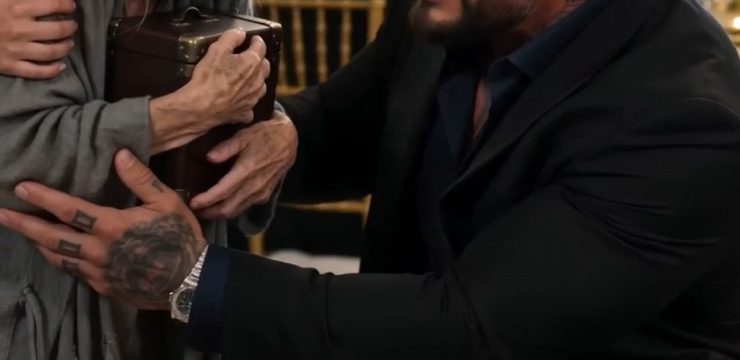
Every parent knows there are moments in a child’s life that cannot be undone. Moments that leave a mark, for better or worse, long after the music stops and the decorations come down. This is one of those stories — about a seven-year-old girl named Emma, a father who kept his promise against all odds, and a gymnasium full of people who learned something important about grace, sacrifice, and the kind of love that crosses oceans to come home.
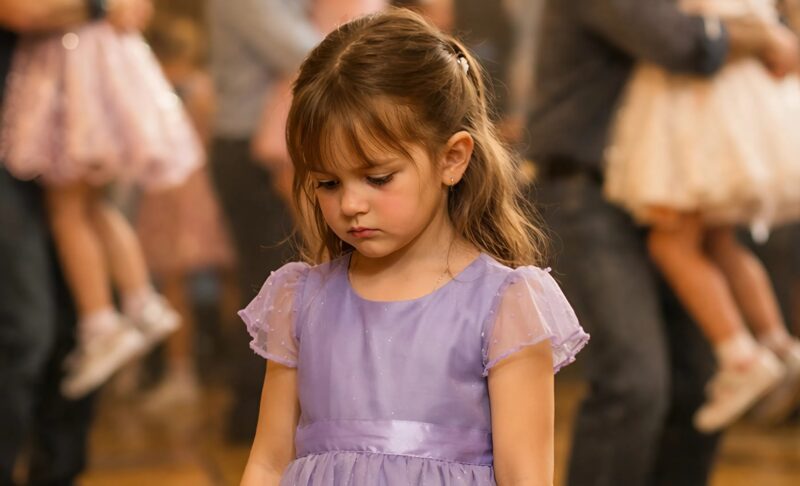
The father-daughter dance at Emma’s school was supposed to be a joyful celebration. Paper streamers hung from the ceiling. Soft music played through the speakers. Little girls in their prettiest dresses twirled and giggled alongside their fathers, and the room hummed with the warmth of a community gathering together.
But Emma stood alone.
She had worn her lavender dress — the one her mother had pressed carefully the night before, smoothing out every wrinkle with quiet hope. She had fixed her hair. She had arrived with a smile ready on her face, because children carry hope in a way that adults often forget how to do.
Her father was a captain in the military. He had been away on an overseas mission for six months. Emma knew this. She understood it in the way that children of service members learn to understand it — not fully, not without ache, but with a kind of quiet acceptance that is both heartbreaking and deeply admirable in someone so young.
She had told herself he might still make it. Children do that. They hold on.
But as the other girls danced with their fathers, spinning and laughing in the warm gymnasium light, Emma stood on the edge of the dance floor, watching. Waiting. Her small hands clutched the fabric of her lavender skirt, and she kept her eyes forward with a dignity that a seven-year-old should never have to summon.
That was when it happened — the moment that would stay with everyone in that room for the rest of their lives.
A girl named Melissa, surrounded by her own group of friends, looked over at Emma and said it loudly enough for those nearby to hear.
“If you don’t have a father here, you shouldn’t have come. You’re just getting in the way.”
A hush fell in that corner of the room. Not a full silence — the music kept playing, couples kept dancing — but in the small circle where those words landed, people grew still. Teachers glanced over. Parents shifted uncomfortably. And yet, no one stepped in. No adult crossed the room to kneel down beside Emma and say, that was wrong, you are valued, you belong here.
People looked away. They pretended they hadn’t heard.
Emma didn’t cry. She didn’t argue back. She simply lowered her gaze toward the floor and held her dress a little tighter, as if she could hold herself together through sheer willpower. And perhaps she could. Because she was her father’s daughter, after all.
Then the gymnasium doors swung open.
It was not a dramatic entrance, not loud or showy. But the air in the room changed immediately — the way it changes when something real and significant enters a space. A man in military uniform walked through the doorway. He moved with the quiet confidence of someone who has learned to carry great weight without letting it show on his face.
Behind him came another uniformed man. Then another. Then another. Twelve in total, all in matching dress uniforms, standing tall, composed, and purposeful.
Emma’s father had come home.
He had not been able to send word ahead. Missions do not always allow for that. But he had made it — on this exact evening, at this exact hour — and his fellow soldiers, his brothers in service, had come with him. Not because they were asked to make a scene or prove a point. But because when one of your own needs you to show up, you show up. That is simply what you do.
For a moment, Emma did not move. She stood on the dance floor in her lavender dress, staring at the man walking toward her, as if her mind needed a few extra seconds to catch up with what her heart already knew.
Then she ran.
Her father dropped to one knee before she reached him, and when she threw her arms around his neck, he held her with the steadiness of a man who had been counting the days to do exactly that.
“I’m here, sweetheart,” he said softly. Just that. Nothing more was needed.
The music was still playing. But the room had gone quiet in the way that only happens when something genuinely moving is unfolding in front of you — when you forget to keep up your conversation, forget to check your phone, forget everything except what is happening right there in front of your eyes.
He took Emma’s hand and led her to the center of the dance floor. His fellow soldiers spread out beside them, each one moving with calm respect, joining the moment not to overshadow it but to honor it. Together, they danced — a little girl in lavender and twelve men in uniform — and there was something in it that reached into the chest of every person watching and squeezed gently.
This was not performance. This was love made visible. This was sacrifice showing up, literally and without fanfare, and choosing a daughter over exhaustion, over distance, over every obstacle that stood between a father and this one night.
Melissa stood quietly to the side. She did not say anything. There was nothing left to say.
And the people who had looked away when a child needed someone to stand up for her — they watched now. They could not look away. Because sometimes the world reminds you, in the most unexpected and tender ways, what actually matters.
Emma danced. Her father held her hand. And for that moment, everything was exactly as it should be.