Every guest, every glittering chandelier, every soft breath in that grand room seemed to pause at once — because something was happening in the center of that polished floor that no one could fully explain, yet everyone could feel deep in their chest.
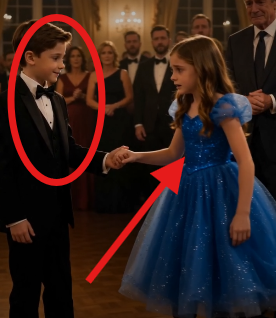
A little girl stood there, trembling. Not from weakness — but from the overwhelming weight of a moment she never expected to arrive. She stood on her prosthetic legs, her whole body shaking, staring at the boy in front of her as though he had just reached through time and pulled her back from another life entirely.
Behind her, the older man — her father — took one unsteady step forward. His throat had closed. His eyes burned. He could not process what he was witnessing, only that it was breaking him open in the most beautiful way imaginable.
The boy looked at the girl with tears shining in his eyes and a small, quiet smile resting on his lips. But it was not a smile of pride in himself. It was something far more tender than that — it was the smile of someone who had watched another person do something extraordinary and felt nothing but awe.
“You just forgot,” he said softly.
The girl blinked at him, confused. Her brow furrowed. Her lips parted but no words came.
The father’s face tightened. Forgot? What on earth could she have forgotten? What could possibly explain why this boy was standing here, in this ballroom, looking at his daughter like she was the bravest person he had ever seen?
The guests shifted quietly in place, glancing from the boy to the girl and back again, sensing that what they were watching carried a weight far heavier than a simple dance.
The girl’s breath came in shallow, uneven waves. The boy stepped a little closer.
“When we were in the hospital garden,” he said, his voice barely holding together, “you told me that when your new legs came, I had to be your first dance.”
The father froze where he stood.
The girl stared at the boy as if the ground beneath her prosthetic feet had just shifted.
And then — it hit her. All at once. Like a wave breaking over everything.
A memory. A wooden bench in a rehab garden bathed in afternoon light. A smaller, weaker boy sitting beside her in a hospital gown, his face pale but his eyes kind. Her own young voice making a promise that had felt impossible and innocent and full of hope all at the same time.
Tears streamed freely down her cheeks now.
“You were that boy?” she whispered.
He nodded.
The father covered his mouth with his hand, his shoulders trembling.
He knew this story. He had lived on the edges of it for years without ever knowing the boy’s name or face. When his daughter was learning how to survive pain, how to endure fear, how to carry the cruel and heavy burden of being different in a world that did not always make space for different — she had found a friend in a hospital garden. A sick child who made her laugh when she had forgotten how. A boy who had disappeared after his treatment ended and left a quiet hole in her heart that she had carried for a long time.
She had talked about him for months.
She had never seen him again.
Until tonight.
“I heard you were here,” the boy said. “And I heard you still wouldn’t dance.”
A soft, broken laugh escaped through the girl’s tears — sudden and real and so full of warmth that several guests nearby had to look away to compose themselves. Then a sob followed the laugh, raw and relieved all at once.
The father moved closer now, no longer able to hold himself at a distance. His voice cracked when he finally spoke.
“You came back for her?”
The boy looked up at him with steady, clear eyes and answered with the simplest truth in that entire room.
“I came back because she kept me brave first.”
That line destroyed what remained of the father’s composure.
He looked at the empty wheelchair sitting near the edge of the floor. He looked at the boy. He looked at his daughter — standing in the center of that grand ballroom, glowing beneath the soft golden light of the chandeliers — and he wept without shame.
Then the girl reached for the boy’s hand again.
Not because she needed help staying upright. Not because she was afraid of falling. She reached for his hand because there was a promise between them that had waited long enough to be kept.
“Then dance with me,” she said.
The boy smiled through his tears.
He took her hand.
And there, in the middle of that grand ballroom, surrounded by strangers who were no longer strangers, the two children turned slowly together beneath the gold light. Not perfectly. Not flawlessly. But with a grace that had nothing to do with technique and everything to do with what they had each survived to be standing there.
The room erupted.
Applause filled every corner, louder and more alive than before, carrying something in it that pure celebration rarely holds — the sound of people who have just witnessed something they will never forget and cannot entirely explain.
The father was openly weeping now, shaking with emotion, watching his daughter do the very thing he had quietly grieved as something stolen forever.
The girl looked up at the boy, laughing and crying at once, her face luminous.
“You kept your promise,” she said.
And the boy, his voice breaking softly on every word, answered her with the truest thing either of them had ever said.
“No. You kept yours.”
The chandeliers glittered high above them. The empty wheelchair remained behind them, still and quiet and no longer a symbol of limitation — but of how far she had come.
And the whole room finally understood what they had been watching all along.
This was never just a dance.
This was a miracle — small and human and achingly real — that two children had carried faithfully back to each other across years and distance and pain, until the night it was finally ready to be given.