Nobody in Terminal B saw it coming.
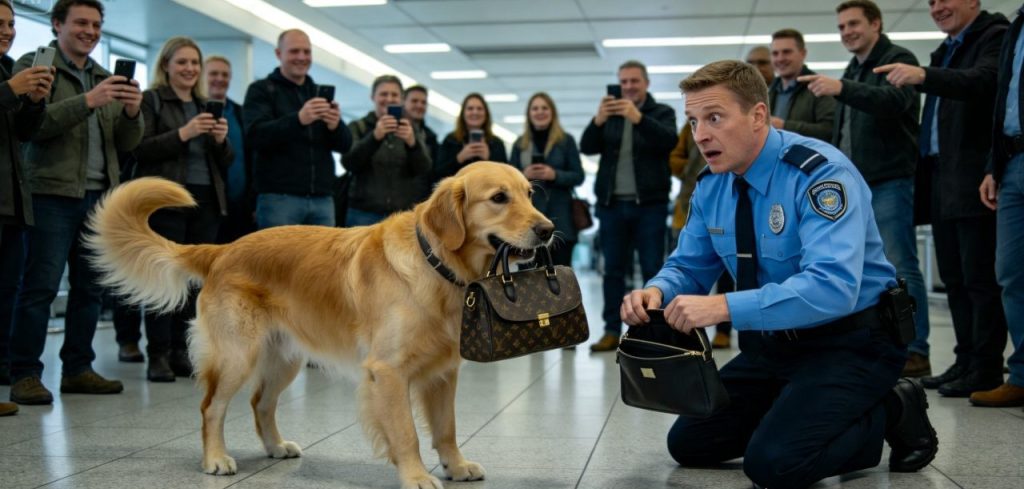
One second, laughter was rippling through the crowd — warm, ordinary airport laughter, the kind that happens when a goofy dog steals the show. The next second, the air was completely sucked out of the room. A TSA officer’s face had gone chalk white. His hand was shaking so badly that the radio on his shoulder rattled.
“Lock down Terminal B!” he screamed, his voice cracking in a way that no trained officer’s voice should ever crack. “Code Red! Bomb squad! Tactical unit! Get everyone out now!”
And just like that, the world exploded.
Chairs scraped. Luggage was abandoned mid-stride. A woman’s coffee splattered across the polished floor as she ran, her heels clicking frantically against the tile. Hundreds of people, all moving at once, all pushing toward the exits. Red strobe lights pulsed along the ceiling, painting every panicked face in harsh flashes of crimson. The alarm was deafening — a sharp, relentless wail that cut straight through to your bones.
I stood completely still. I couldn’t move. I couldn’t think.
Thirty seconds ago, a sweet Golden Retriever had been playing tug-of-war with my purse. I had laughed. People around me had laughed. It was the most harmless thing in the world.
Now, officers were dragging that same dog away by his collar, the animal digging his claws into the carpet, refusing to let go. And every single one of those officers was staring at my black leather purse like it was the most dangerous thing they had ever seen.
When I took one instinctive step toward my bag, the shout came immediately.
“Do not move!”
Within moments, two heavily armed airport police officers had me by the shoulders, spinning me around, snapping cold steel handcuffs around my wrists. I was being arrested in the middle of O’Hare International Airport. I had done nothing wrong. I didn’t even know what was happening.
They marched me down a narrow, unmarked corridor behind a plain “Authorized Personnel Only” door and sat me in a windowless gray room with a metal table bolted to the floor. It looked exactly like every interrogation room from every crime show I’d ever watched on a quiet Sunday evening. Except this time, I was the one in the chair.
I sat there for what felt like an eternity, my wrists throbbing, my mind spinning furiously backward through every single moment of that morning. I had woken up at four-thirty in the morning, packed that purse myself, and kept it on my lap the entire Uber ride to the airport. The only moment it had left my hands was when it passed through the TSA X-ray conveyor belt.
The side pocket. That stiff little outside zipper I never used. I hadn’t opened that pocket in months.
When the door finally swung open, the man who walked in wasn’t TSA. He was tall, suited, and carried the unmistakable weight of federal authority. He introduced himself as Agent Miller and placed a manila folder on the table without a word of small talk. Behind him stood a woman in a dark navy windbreaker with three bold white letters on the back.
CDC.
The Centers for Disease Control and Prevention.
My heart dropped to the floor.
Dr. Thorne opened a silver case — not a laptop, but a protective transport case — and slid a photograph across the table. It showed a small glass vial, barely the size of a tube of lipstick, sealed with a heavy tamper-proof cap. Inside, a thick, cloudy purple liquid caught the light. A small yellow biohazard symbol was affixed to the side.
“Preliminary analysis indicates this is a synthesized strain of a weaponized neuro-virus,” Dr. Thorne said, her voice steady and clinical. “If this vial had shattered inside the terminal — if the dog had bitten through it, if someone had dropped a bag on top of it — we would not simply be evacuating O’Hare. We would be locking down the entire city of Chicago. The casualties would have been catastrophic.”
I could not breathe. I literally could not pull air into my lungs.
But Agent Miller leaned forward and showed me something far worse than any biological weapon.
He showed me the security footage.
There I was on the screen, sitting quietly at the gate, typing on my phone. A man in a dark gray hoodie, surgical mask, and sunglasses walked slowly down the aisle behind me and deliberately stumbled, dropping his heavy duffel bag against my seat. I remembered looking up, annoyed. I remembered him apologizing.
What I could not see from where I was sitting — but what the overhead camera captured in perfect clarity — was his left hand. In less than two seconds, with practiced, terrifying precision, he unzipped that small side pocket, slipped a metallic object from his sleeve directly inside, and zipped it shut before picking up his bag and walking away.
The entire transfer took less than two seconds.
Agent Miller zoomed in on the frozen frame of the man’s face and ran it through facial recognition software. The screen split in two. On the left, the man in the disguise. On the right, a driver’s license photo that I recognized so instantly and so completely that the room seemed to tilt sideways beneath me.
It was Mark. My fiancé. The man who had kissed my forehead that very morning and told me to have a safe flight.
The man I was supposed to marry in three months.
What followed was the most agonizing unraveling of a life I had ever lived through. Agent Miller explained everything with a quiet, sorrowful directness. Mark had stolen the vial from the medical supply company where he worked, using security clearances he had spent years building. He needed a carrier with no criminal history, no suspicious travel patterns, and a perfectly legitimate reason to board a flight to Seattle.
He had used me. He had chosen me. He had bought me that specific purse — with that specific stiff little pocket — one year ago, knowing exactly what he would one day need it for.
Agent Miller placed my unlocked phone on the table and asked me to do the one thing I believed I was incapable of doing.
He asked me to call Mark.
My hands were trembling so badly I nearly dropped the phone. The screen background was a photo of us at a Cubs game, Mark’s arm wrapped around my waist, both of us grinning without a care in the world. I stared at that photo for a long moment.
Then I pressed call.
He answered on the third ring, smooth and warm and loving, exactly the way he always had. He said he was pulling into his parents’ driveway in Wisconsin. He was lying. Federal agents had already traced his phone to an abandoned industrial park near Gary, Indiana, where he was waiting to collect payment from the buyers in Seattle — a domestic group planning something unspeakable in a densely populated city.
I kept him talking. I asked him if he remembered the night he proposed, out on Navy Pier in the freezing cold, the city lights reflecting on the dark water. He laughed softly and said of course he did. He said I was his whole world.
And then I told him I knew exactly what he had done at Gate B14.
The silence on the other end of that phone line was the loudest thing I have ever heard in my life.
A moment later, the sound of a steel door being blown off its hinges came crashing through the speaker. Shouting. Boot steps on concrete. Mark’s voice, finally stripped of all its charm and warmth, screaming my name in pure, helpless terror.
I pressed the red button and the line went dead.
Agent Miller confirmed the arrest. No casualties. Target secured.
By the time they let me walk out of O’Hare, the sun was setting over Chicago, painting the skyline in shades of gold and deep amber. My entire life — my engagement, my future, every quiet morning I had believed was real — had been exposed as an elaborate, cold-blooded lie.
But as the black government SUV pulled away from the terminal and I pressed my forehead against the cool tinted window, watching my city glow in the fading light, I felt something underneath all the grief and the shock and the exhaustion.
My own heartbeat. Slow and steady and impossibly, stubbornly alive.
Chicago was still standing. The people in that terminal had gone home to their families. And a scruffy, relentless Golden Retriever named Buster had earned himself the largest steak dinner in the history of the Chicago field office.
The sun would rise again tomorrow. And so, somehow, would I.