The steel catch-pole rattled against the bars of the quarantine cage, and my stomach dropped the moment I heard it.
Inside that small enclosure, the tiny terrier mix wasn’t just growling. He was screaming — a raw, guttural sound of pure, cornered desperation that bounced off the cinderblock walls of the county animal shelter like something I had never heard before and never wanted to hear again.
Dr. Harris stepped back and wiped sweat from his forehead. “He’s too far gone, Elena,” he muttered, adjusting his heavy bite-proof gloves. His eyes never met mine. They stayed fixed on the black-and-brown furball throwing himself against the chainlink door like his life depended on it — because it did.
The puppy couldn’t have weighed more than ten pounds. He was essentially a scrap of dirty, matted fur and sharp teeth. But right then, he looked like a creature ready to tear the world apart.
“He’s a massive liability,” Harris continued, his voice tight. “We can’t let this one out the door.”
I had been volunteering at the shelter for three years. I had seen fearful dogs, aggressive dogs, broken dogs. But something about this one stopped me cold. The aggression didn’t feel offensive. It felt entirely, desperately defensive — the way a wounded animal fights when it has been hurt so many times it no longer believes kindness exists.
Harris reached for the clipboard on the cage door. The bright red sheet of paper at the bottom told me everything. Red meant euthanasia. Immediate. No appeal.
I read the intake form. Stray. Caught by animal control. Unprovoked attack on a six-year-old child in a residential park. Suspected rabies.
My heart hammered as I handed it back. “Just give him a second,” I whispered. “He’s terrified.”
Harris didn’t listen. He raised the catch-pole toward the door.
And then something happened that changed everything.
The puppy didn’t charge. He didn’t snap at the wire. Instead, he threw himself backward so violently that his tiny body slammed against the concrete wall. He pressed into the corner, trembling so hard his whole frame blurred, and let out one single, heartbroken whine.
That was not the body language of a vicious killer. That was the body language of a creature that expected to be hurt.
Without thinking, I stepped between Harris and the cage.
“I’ll foster him,” I said. “I’ll sign the waiver. Total legal and financial responsibility. Just let me try.”
Harris stared at me like I had lost my mind. Maybe I had. But twenty agonizing minutes later, that little dog was in a plastic carrier in the back of my SUV, and I was driving home with my heart in my throat.
My husband Mark was waiting. Our eight-year-old son Leo was asleep upstairs. Bringing a known biter into our home was reckless. I knew that. But I also knew what I had seen in that dog’s eyes — not violence, but survival.
I set him up in the locked spare room, sat down on the cold floor five feet from the open carrier, and waited. An hour passed in silence. He watched me from the shadows with those bright, amber eyes. Wary. Calculating. Exhausted.
I tossed him a piece of freeze-dried liver. He didn’t move.
Then the door swung open, and Leo stood in the doorway holding his tablet.
Everything happened in an instant. The puppy scrambled to his feet and charged — not at my son, but directly in front of him, planting his small body between Leo and the open hallway. He wasn’t attacking. He was guarding. Barking furiously at nothing, his back pressed against Leo’s legs like a shield.
“Mom, why is he yelling at the hallway?” Leo asked, completely unbothered.
I pushed myself off the floor, shaking, my mind reeling. In the park, he hadn’t attacked that child. He had protected one. And now he was doing it again.
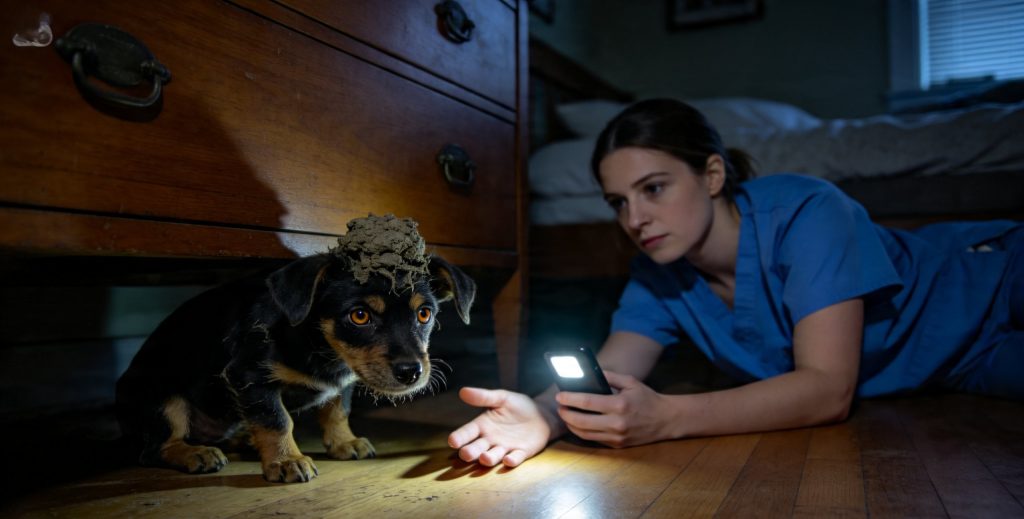
That night, long after Mark and Leo were asleep, I crept back into the room and laid flat on the cold floor. I shined my flashlight under the heavy oak dresser where the puppy had retreated. Two amber eyes reflected the light back at me.
I extended my hand, palm flat against the floor, and waited.
Ten long minutes passed.
Slowly, he stretched his neck forward, sniffed my fingers, and rested his chin on my knuckles.
It was the first time he had trusted anyone in what I can only imagine had been a very long time. Tears blurred my vision. He wasn’t a monster. He was just broken.
Gently, I reached toward the thick, matted fur on top of his head — and he let out a sound I will never forget for as long as I live. Not a growl. Not a bark. A scream of sheer, blinding agony.
I grabbed my phone and shined the light directly onto his skull. As he panted heavily, the dense mat of fur parted just a fraction of an inch, and the breath left my body completely.
It wasn’t mud. It wasn’t matted hair alone. Someone had wrapped a thick, braided steel wire tightly around the base of his skull — cranked down so hard it had sliced through skin and embedded into muscle. His body had tried to heal around it. The fur had grown over it like a shell, perfectly concealing what had been done to him.
What happened next — what was discovered beneath that wire, what was bolted into that tiny skull, and what that device revealed about where this dog truly came from — would unravel a secret so dark that a man in a tailored suit would show up on my front porch surrounded by sheriff’s deputies, threatening to take my son.
He wasn’t just a stray. He was evidence. And the people who built him wanted him back — or buried.
But he had already survived the worst they could do to him. Twice.
Because they had tried to wire him for war, and instead, they had built something they never anticipated — a dog whose love for children was stronger than every volt they sent through his brain.
We named him Ninja. And he never slept anywhere but pressed against Leo’s side, snoring softly, finally safe, finally home.