The metal door of Kennel 42 rattled so violently I was certain the hinges were about to give way.
I stood there gripping the heavy leather catchpole, my heart hammering so hard I could feel it in my throat. Inside that concrete run, the Golden Retriever didn’t look like a Golden Retriever at all. His lips were peeled back, exposing a full set of yellowed, gleaming teeth. A low, rolling growl rumbled deep in his chest, echoing off the cinderblock walls of the isolation ward like a warning from something ancient and broken.
“Leave him, Sarah,” Mark said from the doorway, arms crossed tight over his shelter uniform. Mark had handled dogs for twenty years. He didn’t scare easily. But right now, his jaw was locked and his eyes never left the dog. “He almost took a chunk out of the vet tech’s arm this morning.”
I looked down at the clipboard hanging from the kennel grate. A bright red sticker glared back at me from the corner. Euthanasia list. Tomorrow morning. Six o’clock.
“He’s just terrified,” I said, though my own voice betrayed me with a tremble.
What I noticed next stopped me cold. The dog was backed into the corner, but his posture was all wrong. His front legs were braced wide and rigid, trembling with adrenaline. But his back legs were pressed firmly beneath his body, glued to the concrete floor. He refused to lift his hindquarters. Every time someone approached, he pivoted his upper body like a turret and snapped wildly — but he never moved that rear end. Not even an inch.
Something was wrong. I set the catchpole down, pulled a soft red slip lead from my pocket, crouched low, and pushed the kennel door open.
Mark yelled. The dog lunged. His jaws snapped shut half an inch from my wrist with a hollow, terrifying crack, and I fell backward onto the cold concrete. But he didn’t follow through. An aggressive dog that breaks your space will press the advantage. This dog lunged, snapped, and immediately threw himself back into the corner — slamming his hindquarters onto the floor so hard I heard the impact. Then came the sound that changed everything. A tiny, high-pitched whimper. Small and heartbroken. Completely at odds with the violent display of teeth.
He wasn’t dangerous. He was guarding something.
I got the slip lead over his head before he could react. He thrashed, he fought, but I held firm. When I finally coaxed him down the long corridor toward the bathing room, he didn’t walk. He dragged himself entirely on his front legs, pulling his back end across the wet concrete floor with a low, miserable groan every time his hind legs scraped the ground.
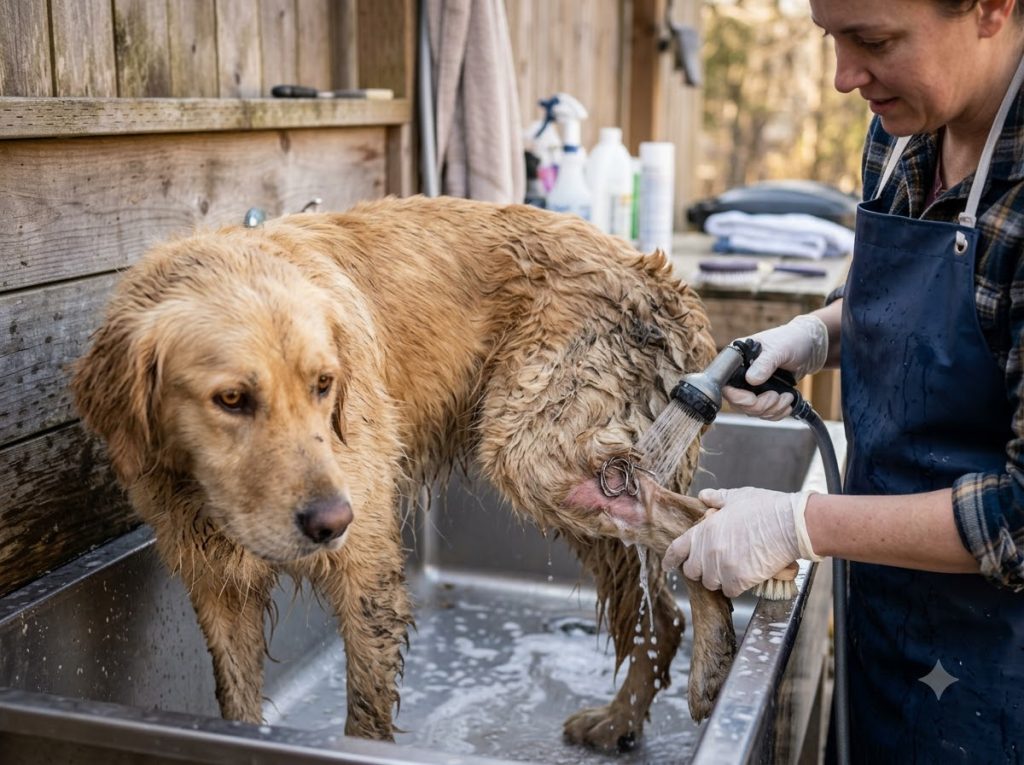
In the bathing tub, the warm water slowly dissolved layers of filth that looked like liquid tar swirling down the drain. He tolerated his neck. His shoulders. His back. But the moment the water moved past his ribcage toward his hips, his entire body went rigid. His ears pinned flat. His lip curled in a silent warning.
Plastered against his upper thigh and tailbase was a solid mass the size of a grapefruit — hardened mud, debris, and matted fur packed together with unnatural deliberateness. And the smell rising off it as the hot water hit the crust was unmistakable. Sweet, metallic, foul. Old copper and infection.
I worked carefully, massaging degreasing shampoo into the crust while the dog trembled against me — not from cold, but from absolute terror. He wasn’t protecting dirt. Dogs don’t guard dirt. They guard injuries. They guard pain. They guard what matters most.
When I finally pulled the hardened chunk free with steady, gentle pressure, the dog let out a sharp cry that cut through the room like a blade. The water in the tub instantly changed color. No longer black. Brilliant, vivid red.
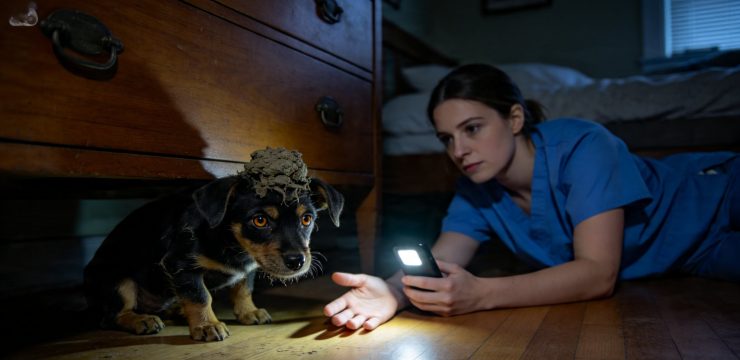
And there, in the bloody crater left behind, pressed against the raw flesh of his thigh — was a patch of pitch-black fur. Moving with its own tiny, fluttering heartbeat.
A puppy. Newborn. Eyes still sealed shut. A Pitbull mix no bigger than my fist.
Dr. Evans, the head shelter veterinarian, had to be called in immediately. The chunk of mud hadn’t only been a nest. It had been acting as a pressure bandage over a severely torn artery. With it gone, the dog was hemorrhaging fast. What followed was the most desperate, chaotic twenty minutes of my career — a crash team, a syringe of emergency epinephrine, chest compressions on a dying dog in a blood-soaked stainless steel tub, while I held the trembling newborn puppy against my chest.
He came back.
When Dr. Evans shouted “We have a heartbeat,” my knees nearly gave out entirely.
But as I dried the tiny black puppy, my fingers caught something hard beneath a layer of crusted mud wrapped around its small body. Cold, smooth, metallic. A silver pendant. A child’s medical alert bracelet. I scraped the mud away with my thumbnail, tilting it beneath the fluorescent lights to read the engraving.
CHLOE HARPER – TYPE 1 DIABETIC.
The name that had been blasting on every news station, every amber alert, every missing persons broadcast for four agonizing days. A seven-year-old girl who had vanished without a trace from her own backyard.
The Golden Retriever hadn’t been a feral, broken, unpredictable dog. He had heard a child crying in a flooded drainage pipe deep inside an abandoned rail yard. He had squeezed through a jagged, razor-sharp iron grate — shredding his own leg open in the process — to reach her. He couldn’t pull her out. The walls were too slick, and he was too big. So as Chloe slipped into a diabetic coma in the freezing dark, she removed her medical bracelet, tied it to the one surviving puppy from the litter, and pushed that tiny life toward the only creature left to trust.
He built a living pouch from mud and his own blood. He carried the proof of where she was for miles through the city. He ran from animal control not to escape — but trying desperately to lead them back to her. And when no one understood, when they locked him in a concrete cage and scheduled him to die, he kept fighting. Not out of aggression. Out of a promise he had made to a dying little girl in the dark.
Police followed the dog’s instinct to that drainage culvert. Detective Russo crawled into the tunnel and found Chloe Harper — unconscious, blue-lipped, pulse faint but present. Emergency glucose and oxygen brought her back.
Weeks later, I walked a shining Golden Retriever on a red leash down the shelter corridor, his bandaged leg moving with a gentle limp, his tail sweeping slow circles of pure contentment. In the lobby, Chloe sat in a wheelchair, the little black puppy she had named and saved asleep in her lap. When she saw him, her face broke open with a smile that filled every corner of that room.
He walked to her and rested his enormous head gently on her lap, right beside the sleeping puppy he had bled to protect.
Mark stood next to me, quietly wiping his eye with the back of his hand. “I was wrong about him,” he whispered.
“We all were,” I said.
Because sometimes what looks like aggression is the most profound, desperate kind of love. And sometimes the greatest heroes arrive covered in mud, carrying secrets no one thought to look for — right in the place everyone had already given up on.