My name is Ryan Carter, and I was thirty-seven years old when a five-year-old girl hiding behind my kitchen wall looked at me through the darkness and whispered the word that shattered everything I thought I knew about my own life.
She called me Dad.
People in Baltimore had many names for me. Boss. Mr. Carter. The Black Harbor King. The press liked to call me a mafia prince when they wanted clicks, and prosecutors preferred the word criminal when they were hunting headlines. Young men on the streets whispered the word legend, though they had no real idea what that word cost. My grandfather Joseph Carter had built something in this city. My father Vincent carried it forward. By the time the organization passed to me at thirty-two, I had inherited not just the power and the weight of that name, but also something Vincent never fully grasped — the undeniable reality that the world had changed completely around us. Banks demanded disclosure. Corporations had compliance teams. Every phone in every pocket was a recording device. Federal prosecutors did not care how many loyal men stood outside your office door. Power had limits. Anyone who believed otherwise had spent too much time watching movies instead of watching courtrooms.
At home, though, none of that was supposed to matter. At home I was simply Dad.
My son Ethan was seven years old, all brown hair and striped shirts, full of questions about sharks and helicopters and whether a person could technically survive on grilled cheese alone. My wife Claire was thirty-four, a woman I had married nine years before because she was the kind of person who could look at one of my accountants across a conference table and make him confess an arithmetic error before I even opened my mouth. She managed the Carter Family Foundation. She sat on two nonprofit boards. She was nobody’s decorative wife, and I respected her more than I had ever told her clearly enough. Our marriage had its seasons, like every long marriage does. But I trusted her. That part, I had never questioned.
The afternoon my entire world cracked open, I came home early from Washington without telling anyone.
A civil case involving one of our older trucking subsidiaries had stalled when opposing counsel asked for another week. I had committed no personal wrongdoing in the matter — a sentence that had become a routine part of my life. I texted no one because Ethan always loved a surprise. I came through the mudroom quietly, set my keys on the kitchen counter, and heard whispering.
“Here.” A pause. “Take it.”
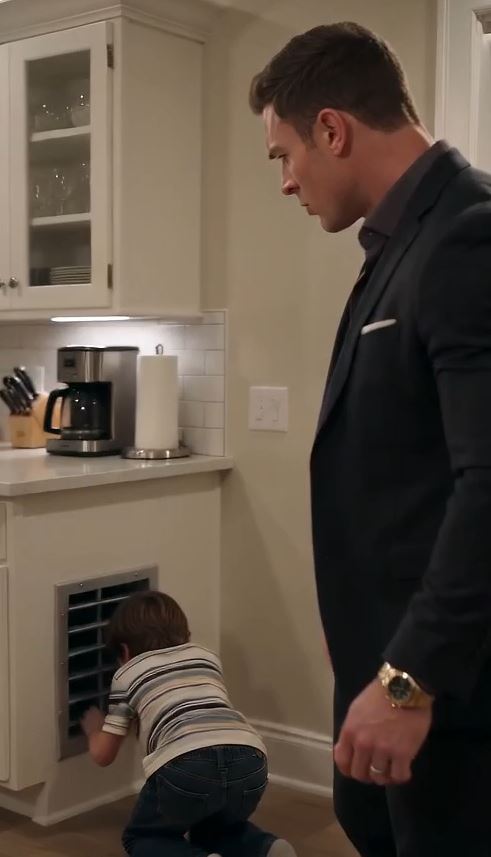
My son was kneeling beside a low metal vent near the pantry wall, pressing three pieces of bread between the slats. His small hands worked carefully, deliberately, the way a child does something he has practiced more than once.
“Ethan. What are you doing?”
He spun around, and the color drained from his face the way it only does when a child knows he has been caught doing something far larger than he can explain.
“Nothing,” he said, which was the first real warning.
I crouched down to his level. I kept my voice calm, the way I had learned to keep it calm in rooms far more dangerous than a bright kitchen. “Tell me.”
He looked toward the hallway before he answered, and that single glance told me everything I needed to know about how long this secret had been kept, and by whom.
“Mom told me not to tell you,” he whispered. “But that little girl is hungry.”
I did not move for a moment. Our house had been built on three wooded acres outside the city, large and modern, full of light because Claire had always hated dark rooms. During renovation, most of an old service channel behind the pantry wall had been sealed off. A narrow maintenance compartment remained, perhaps three feet wide and six feet long, original to the architect’s plumbing design. No reasonable person would have called it a room.
I stood and moved toward the pantry.
Claire appeared from the hallway, moving quickly. Her blouse was pressed. Her hair was styled. Her wedding ring caught the afternoon light. She positioned herself between me and the pantry door with a steadiness that told me she had rehearsed this moment, or at least feared it.
“Ryan.”
“What’s behind the wall?”
“Nothing.”
From somewhere behind us, Ethan whispered, “Mom,” in the voice children use when they know the grown-up world is about to break.
I looked at my wife. “What did you ask our son to promise you?”
She spread her arms across the pantry door. Her composure, usually unshakeable, was fracturing at the edges in ways I had never seen before. “You need to let me explain first,” she said.
“Move, Claire.”
“No.”
We stood there for a long moment, husband and wife, each of us on opposite sides of something neither of us could yet name. And then we both heard it.
A child crying.
Faint. Muffled. Unmistakable.
I knelt beside the vent and placed my fingers gently against the metal slats. “Hey,” I said quietly. “You can hear me?”
The crying stopped.
“You’re not in trouble,” I said. “I’m going to get you out.”
A small hand appeared between the slats. Pale fingers. Dirty nails. Ethan stepped backward without making a sound. I leaned closer, and a face appeared in the narrow darkness — messy brown hair, large frightened eyes, light-colored pajamas. She looked five years old, maybe younger. She stared directly at me, and something shifted in her expression. Not confusion. Not fear. Something that looked painfully, impossibly like recognition.
“Daddy,” she said softly. “Please help me.”
I stood slowly. I turned and looked at my wife.
Claire took one step back. Then another.
And I asked the only question I had left.
“Why is she calling me Dad?”