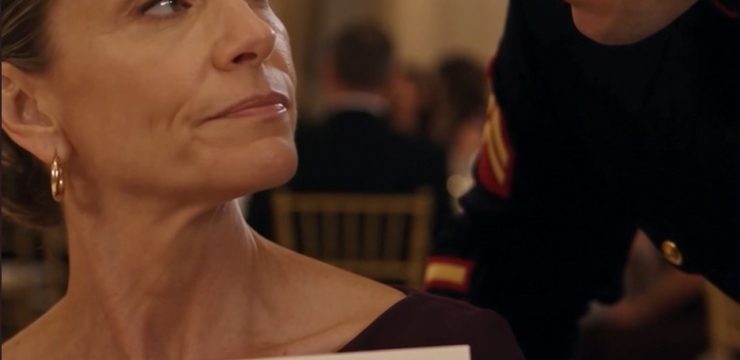
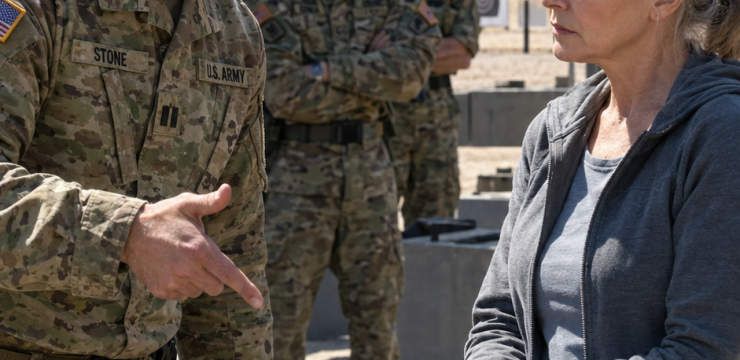
“Move away from this table before you embarrass yourself,” Major Derek Mason said, dragging the empty chair from Margaret Hayes’s hand.
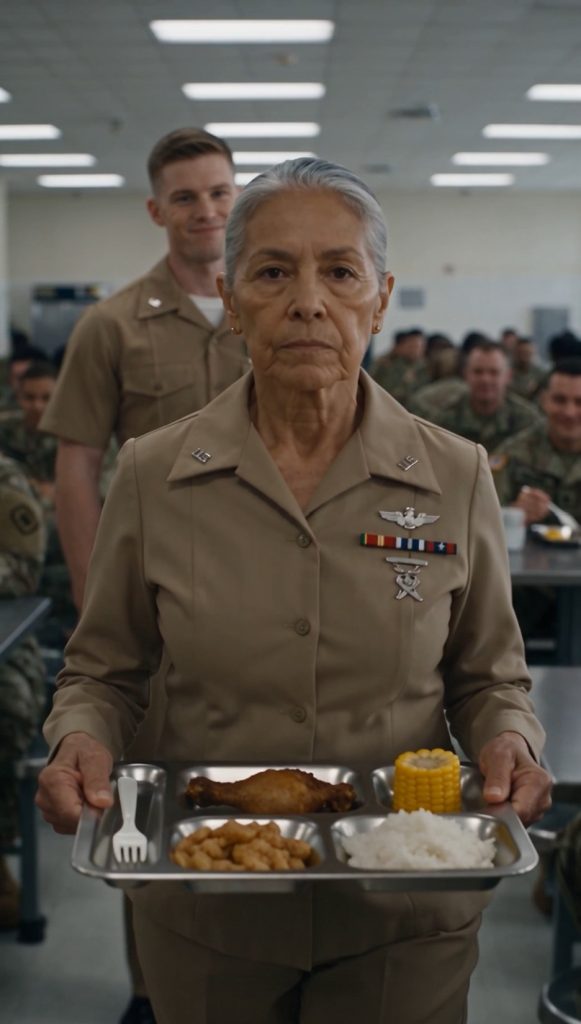
The metal legs screeched across the cafeteria floor, silencing everyone close enough to hear.
Margaret remained standing beside her lunch tray.
Her old brown coat hung loosely over her shoulders.
Nothing on her clothing suggested rank.
Nothing revealed authority.
Derek glanced at her coat, then at the officers seated around him.
His smile sharpened.
“This section is for people who earned the right to sit here.”
Margaret rested one hand against the edge of the table.
“I only need somewhere to eat.”
A captain across from Derek lowered his fork.
Another officer glanced down quickly.
Nobody challenged him.
Derek leaned back and laughed.
“There’s a table beside the trash return.”
He pointed across the bright cafeteria.
“Honestly, that looks more appropriate for you.”
Several younger officers laughed.
One laughed too loudly.
Another smiled because everyone else did.
Margaret looked at each of them without responding.
Her expression remained steady.
A young female lieutenant named Emily Ross suddenly pushed her chair backward.
“You can take mine, ma’am.”
Derek turned instantly.
“Lieutenant, sit down.”
Emily froze halfway upright.
“Sir, there are plenty of seats.”
“I didn’t ask for your opinion.”
His voice became harder.
Emily slowly returned to her chair.
Derek pointed toward the table again.
“Do not turn my officers’ lunch into a retirement-home charity event.”
That sentence killed the remaining laughter.
Margaret’s fingers tightened briefly around her tray.
Emily saw it.
The movement lasted less than a second.
Then Margaret lifted the tray.
“Enjoy your lunch, Major.”
Derek smirked.
“I always do.”
Margaret walked away.
No one followed her.
She crossed the crowded cafeteria while conversations gradually returned.
Forks touched plates.
Boots moved between tables.
Coffee poured from silver dispensers.
Margaret reached the small table near the tray-return station.
A trash bin stood five feet away.
The smell of disinfectant mixed with grilled chicken and coffee.
She sat alone.
Across the room, Derek remained watching.
He raised his voice deliberately.
“Some people retire and still can’t stop pretending they matter.”
Several officers heard him.
Nobody laughed this time.
Margaret picked up her napkin.
She unfolded it carefully.
Then she reached into her coat.
Derek watched for another reaction.
Instead, she removed a plain black phone.
She typed one short message.
Emily noticed.
Derek noticed too.
He leaned toward Captain Luke Harris beside him.
“Probably complaining to somebody’s secretary.”
Luke gave a weak smile.
Derek took another bite of his sandwich.
Margaret placed her phone face down.
Then she began eating.
Emily looked toward Margaret again.
Something bothered her.
Margaret did not look humiliated.
She looked disappointed.
That felt worse.
Emily had seen angry civilians before.
She had seen retired soldiers demand respect.
She had seen angry parents confront commanders.
Margaret behaved like none of them.
She watched the room.
Not nervously.
Professionally.
Her eyes moved toward the serving line.
Then toward the junior officers.
Then toward Derek.
Emily noticed another detail.
Margaret barely touched her food.
She appeared more interested in observing everyone else.
Derek caught Emily staring.
“Something fascinating over there, Lieutenant?”
Emily faced forward.
“No, sir.”
“Good.”
Derek wiped his mouth.
“Because officers who get distracted easily usually stay lieutenants.”
Luke glanced toward him.
The comment sounded casual.
Everyone at the table understood the warning.
Emily had been waiting six months for a recommendation from Derek.
Her next assignment depended partly upon it.
Derek knew that.
He used it often.
Emily lowered her eyes.
Margaret heard everything.
The tray-return station did nothing to hide voices.
Derek continued speaking.
He complained about a sergeant who had challenged a scheduling decision.
He mocked a captain who had requested family leave.
He criticized a warrant officer for refusing an unsafe shortcut during training.
Margaret’s fork stopped halfway to her mouth.
She lowered it without making a sound.
Across the cafeteria, Derek continued talking, unaware that the room had become quieter around him. Not silent. Just quieter in the subtle way a room changes when people begin listening instead of merely hearing.
“The problem now,” Derek said, “is everyone thinks caution makes them professional.”
Luke shifted in his chair.
Derek noticed.
“What?”
“Nothing, sir.”
“Then don’t look like you have something to say.”
Luke looked down.
Margaret reached for her coffee.
Her phone vibrated once beneath her hand.
She did not immediately turn it over.
Emily saw the vibration.
So did Derek.
His mouth curved.
“Looks like somebody’s secretary wrote back.”
Margaret finally picked up the phone.
There were only three words on the screen.
ON OUR WAY.
She locked it and slipped it back into her coat.
Then she looked directly at Emily.
Emily’s breath caught.
Margaret gave the smallest nod.
It was not reassurance exactly.
It felt more like acknowledgment.
I saw that.
Emily straightened almost without realizing it.
Derek pushed his plate away.
“All right. Enough wasting time.”
He stood.
The officers around him began moving automatically.
Emily rose too.
Margaret remained seated.
Derek buttoned his uniform jacket, then glanced toward her one last time.
“You found your proper place after all.”
Margaret looked up.
“Did I?”
Something in the question made Luke stop.
Derek laughed once.
“You tell me.”
Margaret folded her napkin.
“I think everyone in this room has been telling me quite a lot.”
Derek’s smile faded by a fraction.
Before he could answer, the cafeteria doors opened.
The change was immediate.
Not dramatic.
No one shouted.
No alarm sounded.
But conversations near the entrance stopped first, then silence moved through the room in widening circles.
Three senior officers entered.
The man in front carried no lunch tray.
Neither did the two officers behind him.
Derek’s posture changed.
His shoulders pulled back.
His chin lifted.
Emily recognized the instinct because everyone around Derek had learned it: when power entered the room, Derek became a different man.
“General,” he said.
The senior officer did not answer immediately.
His eyes crossed the cafeteria.
They passed over Derek.
Then stopped at the table beside the tray-return station.
Margaret rose.
The general walked directly toward her.
Derek’s confidence began to thin.
“Ma’am,” the general said.
Margaret extended her hand.
“Thank you for coming.”
The general shook it.
Around them, no one moved.
Derek stared.
The color slowly drained from his face.
“Sir,” he said carefully, “I wasn’t aware we had a scheduled—”
“You weren’t.”
The general’s answer was quiet.
That made it worse.
Margaret looked toward the officers at Derek’s table.
Emily could hear her own heartbeat.
The general turned slightly.
“Major Mason, do you know who you’ve been speaking to?”
Derek swallowed.
“I assumed she was a retiree visiting the installation.”
Margaret’s gaze stayed on him.
“You assumed quite a bit.”
Derek’s eyes flicked toward her old coat.
For the first time, the coat no longer looked shabby to Emily.
It looked deliberate.
The general took a breath.
“Margaret Hayes was asked to come here as part of an independent command climate review.”
No one at Derek’s table moved.
The words seemed to settle individually.
Independent.
Command.
Climate.
Review.
Derek’s lips parted.
Margaret continued before he could speak.
“I requested that my visit remain unannounced.”
Her voice carried without effort.
“I also requested that nobody identify me unless I chose to identify myself.”
Derek looked toward the cafeteria doors as if searching for an explanation that might still rescue him.
“This is some kind of test?”
“No,” Margaret said.
“That would imply I created the behavior I witnessed.”
Silence.
Emily looked down at her hands.
They were trembling.
Margaret noticed.
Then she looked back at Derek.
“You dragged a chair from my hand because you believed I had no status here. You publicly humiliated me because you believed there would be no consequence. And when Lieutenant Ross offered me her seat, you used her career progression to silence her.”
Derek’s jaw tightened.
“With respect, ma’am, that is not what happened.”
Emily’s eyes lifted.
Margaret did not react.
“What happened?”
“It was banter.”
Nobody breathed normally after that.
Derek glanced around the table.
“Everyone here knows that. We have a certain culture. People joke. It keeps morale from becoming too stiff.”
Luke stared at his plate.
Margaret waited.
Derek’s eyes landed on him.
“Captain Harris?”
Luke slowly looked up.
There was a plea hidden inside Derek’s expression.
Not friendship.
Not trust.
Instruction.
Luke had seen that look before.
He had obeyed it before.
His throat moved.
“Sir…”
Derek’s face hardened.
“Tell them.”
Luke’s fingers curled around the edge of the table.
Margaret said nothing.
The general said nothing.
That silence gave Luke something Derek never had.
Space.
Luke exhaled.
“It wasn’t banter.”
Derek went still.
Luke’s voice shook, but he continued.
“It hasn’t been for a long time.”
The cafeteria seemed to shrink around them.
Derek stared at him.
“Think carefully about what you’re saying, Captain.”
Luke almost flinched.
Then Margaret spoke.
“No.”
Her voice remained soft.
“You think carefully about what you just did.”
Derek turned.
“You threatened him in front of the officer conducting your command climate review.”
“I did no such thing.”
“You reminded him that speaking honestly carries consequences.”
Margaret stepped closer.
“That is exactly what Lieutenant Ross heard from you five minutes ago.”
Emily’s stomach tightened.
Every instinct she had developed over the previous six months told her to stay quiet.
Her recommendation.
Her assignment.
Her career.
Derek had never needed to say the threat directly because everyone understood it.
Margaret turned toward her.
“Lieutenant Ross.”
Emily looked up.
“I will not ask you to speak.”
Derek’s shoulders loosened slightly.
Margaret continued.
“But if you choose to, nobody in this room gets to punish you for telling the truth.”
Emily looked at Derek.
He was no longer smiling.
That frightened her more than the smile ever had.
Then she remembered Margaret standing beside the empty chair.
The old woman had been surrounded by people who outranked her appearance.
She had still looked everyone in the eye.
Emily took one breath.
Then another.
“He does it all the time.”
Derek’s face changed.
“Lieutenant—”
“He does.”
Her voice cracked on the second word.
She steadied it.
“He delays recommendations when people disagree with him. He gives the worst assignments to officers who question him. He talks about family leave like it’s weakness. He tells us safety concerns are excuses.”
The general’s expression became unreadable.
Emily’s eyes burned.
She hated that.
She did not want to cry in front of Derek.
Not now.
“He told me last month that if I wanted my next assignment, I needed to learn the difference between having an opinion and having a future.”
Derek stepped toward her.
“That conversation has been completely misrepresented.”
Luke stood.
It happened so suddenly that Derek stopped.
Luke moved between them.
Not aggressively.
Just enough.
Derek looked at him with disbelief.
Luke’s hands were shaking too.
But he stayed there.
The general turned toward one of the officers who had entered with him.
“Document that statement.”
“Yes, sir.”
Derek laughed under his breath.
The sound was dry and desperate.
“So this is it? A few hurt feelings and suddenly I’m some kind of monster?”
Margaret’s face changed for the first time.
Not anger.
Pain.
“You still think this is about hurt feelings.”
She reached into her coat.
Derek watched her hand.
She removed the black phone.
Then she placed it on the table.
“I was sent here because this command has received multiple reports involving retaliation, intimidation, ignored safety objections, and manipulated evaluations.”
Derek said nothing.
Margaret continued.
“The reports did not all come from the same unit.”
Luke closed his eyes briefly.
“They did not all come from officers.”
Emily stared at Margaret.
“And they did not begin this month.”
Derek’s confidence finally cracked.
“How far back?”
The question escaped before he could stop it.
Margaret looked at him.
The general noticed too.
“How far back should we be looking, Major?”
Derek’s mouth closed.
No answer came.
The next hour did not happen in the cafeteria.
Derek was escorted to a conference room and instructed to surrender access to command personnel systems pending review. He was not arrested. Nobody staged a public spectacle.
That somehow made the collapse more complete.
His authority simply stopped working.
Orders he gave were no longer automatically obeyed.
People he summoned did not move until the general confirmed it.
When Derek demanded to know who had accused him, Margaret refused to provide names.
When he insisted on calling the reports malicious, the general placed a folder on the table.
It was thick.
Derek stared at it.
Then at Margaret.
“You came here already believing I was guilty.”
“No.”
Margaret sat across from him.
“I came here believing people were afraid.”
She folded her hands.
“You showed me why.”
Derek looked away.
Outside the conference room, Emily sat on a bench with Luke.
Neither spoke for several minutes.
Finally Emily whispered, “I think I just destroyed my career.”
Luke rubbed both hands over his face.
“No.”
She looked at him.
“I think we nearly destroyed ourselves trying to keep his approval.”
Emily’s eyes filled.
Luke looked toward the closed conference-room door.
“I should have spoken sooner.”
“So should I.”
“That doesn’t make what he did ours.”
Emily pressed her palms together to stop them shaking.
Luke nodded toward the cafeteria.
“You stood up first.”
“I sat back down.”
“You stood up first.”
The distinction broke something open inside her.
She covered her mouth.
Luke looked away, giving her the privacy of not being watched while tears finally slipped down her face.
Inside the room, Derek was being shown the first piece of evidence he could not explain away.
It concerned the warrant officer he had mocked over lunch.
The unsafe shortcut had not been hypothetical.
Training records showed the officer had formally objected to a procedure that reduced required safety checks to meet Derek’s schedule.
The objection had been documented.
Two weeks later, the warrant officer’s evaluation had changed.
Derek called it coincidence.
Then came the sergeant.
Then the captain who requested family leave.
Then three junior officers whose recommendations had stalled after disagreements.
Each event alone could be explained.
Together, they formed a pattern.
Derek stopped calling it banter.
He began calling it leadership discretion.
Margaret listened.
When he finished, she asked one question.
“Did they know they could disagree with you safely?”
Derek stared at her.
“That isn’t how command works.”
Margaret’s expression became very still.
“That is exactly how lawful command must work when safety and integrity are involved.”
He looked toward the general.
No rescue came.
By evening, Derek had been temporarily relieved of command responsibilities pending formal investigation.
He left the building without the group that usually surrounded him.
Emily happened to be standing near the corridor when he passed.
For one terrifying second, their eyes met.
The old instinct returned.
Look down.
Disappear.
Protect your future.
Emily kept her eyes level.
Derek looked away first.
The following weeks were quieter than anyone expected.
Investigators interviewed officers separately.
Some spoke immediately.
Others needed time.
A few denied ever seeing anything wrong, then returned days later asking whether they could amend their statements.
Luke did.
His second interview lasted nearly three hours.
He admitted there had been moments when he laughed because Derek laughed.
Moments when he stayed silent because silence was easier.
Moments when someone else absorbed humiliation while he protected his place at the table.
When he emerged, Margaret was waiting in the hallway.
“I don’t feel better,” he told her.
“You’re not supposed to yet.”
Luke looked at her.
“Then what was the point?”
“To stop making someone else carry what belongs to you.”
He understood.
Emily’s interview was harder.
She brought emails.
Notes.
Dates.
A copy of the recommendation Derek had repeatedly promised but never completed.
She also brought something she had almost deleted months earlier: a message from Derek sent after she questioned a training decision.
Ambition requires loyalty, Lieutenant. Decide which matters more.
Margaret read it once.
Then she returned the phone.
Emily whispered, “I thought maybe I was being too sensitive.”
Margaret leaned back.
“Did he tell you that?”
“Not in those words.”
“He didn’t need to.”
Emily looked toward the window.
Rain had begun tapping softly against the glass.
“What happens to my assignment?”
“I don’t know.”
Emily turned back, surprised.
Margaret did not offer false reassurance.
“What I can tell you is that Derek Mason will have no role in deciding it.”
Emily’s shoulders dropped.
Only then did she realize how long she had been holding them tight.
The formal findings took months.
They substantiated a pattern of retaliation, misuse of evaluative authority, intimidation, and disregard for documented safety concerns.
Derek contested them.
He challenged witnesses.
He argued context.
He insisted his leadership style was demanding, not abusive.
But the records remained.
So did the messages.
So did the evaluations that changed after objections.
And so did the testimony of people who had never spoken to one another before the investigation yet described the same pattern.
His removal became permanent.
Administrative action followed.
His command career was over.
The day the final decision reached the unit, nobody celebrated.
That surprised Emily.
She had imagined relief would sound louder.
Instead, people worked.
Doors opened.
Phones rang.
Someone laughed down the hallway about something completely unrelated.
The world did not explode when Derek lost his power.
It simply stopped arranging itself around his moods.
That was the freedom.
Emily understood it gradually.
A captain requested family leave and received a straightforward answer instead of a lecture.
A sergeant disagreed during a planning meeting, and the meeting continued.
A warrant officer stopped a training evolution over a safety concern.
Nobody mocked him.
Nobody threatened his evaluation.
They fixed the problem.
Then they resumed.
Weeks later, Emily received an email asking her to report to the general’s office.
Her stomach tightened the moment she read it.
Old fear did not disappear just because its source was gone.
She arrived ten minutes early.
Margaret was inside.
Emily stopped at the doorway.
“Ma’am?”
Margaret smiled.
“Come in.”
The general motioned toward a chair.
Emily sat.
A folder rested on the desk.
For a terrible second she thought of Derek’s missing recommendation.
Then the general pushed the folder toward her.
“Your assignment package was reviewed independently.”
Emily looked at Margaret.
Margaret shook her head slightly.
“I didn’t make the decision.”
The general continued.
“You were selected.”
Emily did not move.
The words reached her, but her body seemed unable to follow.
“For the assignment?”
“Yes.”
Her lips parted.
“I thought…”
She stopped.
The general waited.
Emily looked down.
“I thought what happened might follow me.”
“It will,” Margaret said.
Emily’s eyes lifted.
Margaret’s expression was gentle.
“But not in the way you mean.”
She leaned forward.
“You will remember what it felt like when someone used your ambition against you. Someday, someone junior to you will walk into your office frightened that honesty might cost them their future.”
Emily’s eyes began to burn.
Margaret smiled faintly.
“Remember which officer you needed Major Mason to be.”
Emily looked down at the folder.
A tear landed on its corner.
She laughed once, embarrassed, and wiped it away.
“I will.”
Luke’s closure came differently.
He was offered an opportunity to remain in his position.
He asked for a transfer.
When Margaret questioned why, he took a long time to answer.
“Because I need to know whether I can lead somewhere I’m not spending every day trying to prove I’m different from him.”
Margaret considered that.
“That sounds less like running away than you think.”
Luke nodded.
Before leaving, he found Emily in the cafeteria.
She was sitting at the same table where Derek once held court.
There were junior officers around her.
One empty chair remained.
Luke pointed at it.
“Taken?”
Emily smiled.
“No.”
He sat.
For several minutes they ate without discussing Derek.
That mattered.
Then Luke glanced across the room toward the tray-return station.
The small table was empty.
“You ever think about that day?”
Emily followed his gaze.
“Every time I see that chair.”
Luke nodded.
“I laughed.”
Emily knew exactly which laugh he meant.
“So did other people.”
“I’m not other people.”
“No.”
She put down her fork.
“You’re also not required to spend the rest of your life being the worst five seconds of it.”
Luke stared at her.
Emily’s mouth trembled into a small smile.
“Someone taught me that careers can follow you in more than one way.”
Luke understood who she meant.
He looked down at his tray.
“Tell her thank you for me.”
“Tell her yourself.”
Margaret had returned.
She stood several feet behind him in the same brown coat.
Luke rose so quickly his chair nearly tipped.
Margaret laughed.
“Please don’t start making people stand every time I enter a cafeteria. We’ve made enough trouble with chairs.”
Emily laughed first.
Luke followed.
The sound was different from the laughter months earlier.
Nobody was being diminished by it.
Margaret carried a tray.
Emily immediately touched the empty chair beside her.
“Ma’am.”
Margaret looked at it.
For a moment, no one spoke.
Emily’s smile softened.
“You can take mine if you want.”
Margaret remembered.
Of course she remembered.
“So can you.”
Emily pulled out the empty chair instead.
“Then take this one.”
Margaret sat.
No one moved her.
They ate together.
Halfway through lunch, Emily finally asked the question that had bothered her since the investigation began.
“Why the coat?”
Margaret looked down at the old brown fabric.
Luke smiled.
“I wondered too.”
Margaret touched the cuff.
The material had been repaired near the wrist with stitching almost invisible unless someone looked closely.
“I wanted to know how people here treated someone they believed couldn’t help or hurt their careers.”
Emily’s smile disappeared.
“That was the whole reason?”
“Partly.”
Margaret looked toward the cafeteria windows.
“There was another reason.”
She became quiet.
Emily waited.
Margaret rubbed the worn cuff between two fingers.
“My husband bought me this coat.”
Neither Emily nor Luke spoke.
“He died twelve years ago.”
Margaret’s voice remained steady, but her thumb continued moving across the repaired seam.
“He bought it when we had almost no money. I told him it was too expensive. He told me everyone deserved one good coat that made them feel safe walking into a cold room.”
Emily looked at the coat again.
Suddenly its age meant something entirely different.
“I wore it on difficult days after he died.”
Margaret smiled to herself.
“Job interviews. Funerals. Meetings where I knew people had already decided who I was before I spoke.”
Luke lowered his fork.
Margaret looked toward the table beside the tray return.
“So when I was asked to observe this command anonymously, I knew exactly what I would wear.”
Emily swallowed.
“That’s why you looked disappointed.”
Margaret turned toward her.
Emily continued quietly.
“That first day. I thought you should have looked humiliated. But you didn’t.”
Margaret’s eyes softened.
“I had been humiliated before, Lieutenant.”
She paused.
“It loses some of its power when you finally understand the shame belongs to the person doing it.”
Emily looked down.
The words settled somewhere deep.
Margaret reached for her coffee.
“But I was disappointed.”
“In us?”
“In what fear had taught good people to tolerate.”
Luke absorbed that without defending himself.
Margaret looked at him.
“And I was watching to see whether anyone still remembered they had a choice.”
Emily’s eyes filled again.
“I sat back down.”
“You stood up.”
Emily stared at her.
Margaret smiled.
“Both things are true.”
The cafeteria continued around them.
Trays slid across counters.
Coffee poured.
Someone called across the room.
Life moved without waiting for anyone to become perfect.
Months turned into a year.
Emily left for her new assignment.
Luke transferred to another unit and eventually received command responsibility of his own.
Before his first day, he placed a small card inside his desk drawer.
It contained one sentence.
Make disagreement safe.
He never told Margaret.
He did not need to.
The warrant officer whose safety objection had helped expose Derek remained in service and was later asked to help revise the training procedure he had once been punished for challenging.
The captain who had requested family leave took it.
He came back with a photograph of himself holding his newborn daughter.
For a while, he kept the picture inside his notebook.
Eventually he put it openly on his desk.
Nothing happened.
That small fact meant more than most people understood.
Margaret completed the review.
Her report did not describe heroes and villains.
It described systems, decisions, failures, retaliation, silence, and the ways fear spreads when authority stops being accountable.
It also documented the people who interrupted that pattern.
Emily’s name appeared only where necessary.
Luke’s too.
Margaret had no interest in turning courage into mythology.
Courage, she believed, was usually less impressive from the inside.
Often it looked like shaking hands.
A cracked voice.
A chair pushed backward.
A sentence someone nearly swallowed.
Two years after the cafeteria incident, Margaret received an envelope at home.
She almost placed it with the rest of the mail.
Then she recognized Emily’s handwriting.
Inside was a photograph.
Emily stood in a bright office wearing her uniform, older somehow, though only two years had passed.
Beside her stood a young lieutenant.
On the back Emily had written:
She disagreed with me today.
She was right.
I thanked her.
Margaret sat at her kitchen table for a long time.
Late afternoon sunlight crossed the wood.
The house was quiet except for the soft ticking of the clock and the hum of the refrigerator.
She read the three lines again.
Then again.
Finally she laughed.
It became a small, broken sound halfway through.
She covered her eyes.
For the first time since the investigation ended, Margaret allowed herself to cry about the cafeteria.
Not because Derek had insulted her.
Not because of the chair.
Not even because of the cruelty.
She cried because something had continued beyond it.
Something good.
A choice had become another choice.
Then another.
Her phone rang.
Emily.
Margaret wiped her face and answered.
“You have terrible timing.”
There was a pause.
“Are you crying?”
“No.”
“You sound like you’re crying.”
“I’m retired. I’m allowed to sound however I want.”
Emily laughed.
Margaret looked again at the photograph.
“She disagreed with you?”
“Right in front of everyone.”
“And?”
“I wanted to interrupt her.”
Margaret smiled.
Emily continued.
“I felt it happen. That little reaction. That feeling that because I was in charge, disagreement meant disrespect.”
Margaret said nothing.
“I heard his voice for half a second.”
Derek.
Neither needed to say the name.
“What did you do?”
“I asked her to finish.”
Margaret closed her eyes.
“And she was right?”
“Completely.”
“That must have been irritating.”
“It was awful.”
They both laughed.
Then Emily became quiet.
“Ma’am?”
“Yes?”
“I think I understand now.”
“What?”
“Why you didn’t tell me I was brave that day.”
Margaret leaned back.
Outside her window, evening light settled over the yard.
“Why didn’t I?”
“Because if you had, I would’ve thought courage was something I either had or didn’t.”
Margaret smiled.
“And now?”
“Now I think it’s something you practice.”
Margaret looked at the brown coat hanging near the door.
“That sounds about right.”
Another year passed before Margaret visited the installation again.
This time there was no investigation.
No anonymous observation.
No hidden purpose.
Emily happened to be visiting too, back for a training conference.
They arranged to meet for lunch.
When Margaret entered the cafeteria, she paused.
The room looked almost exactly as it had before.
Same bright lights.
Same serving line.
Same silver coffee dispensers.
Same tray-return station.
Even the small table beside the trash bin remained.
But something else had changed.
Nobody had reserved Derek’s old table for rank.
Junior officers sat there with captains.
A warrant officer was arguing cheerfully with someone over a training schedule.
Nobody lowered their voice when a senior officer passed.
Emily spotted Margaret and waved.
“Over here.”
Margaret crossed the room.
Emily had saved her a seat.
Not her own seat.
Just a seat.
Margaret removed her coat and draped it across the back.
Emily touched the sleeve.
“You still wear it.”
“I told you. It’s a good coat.”
They collected lunch.
When they returned, a nervous young officer was standing beside the table.
Every seat was occupied except Margaret’s.
The officer looked around.
“Sorry. I’ll find somewhere else.”
Margaret looked at Emily.
Emily looked at the empty chair.
For half a second, both women remembered metal legs screaming across the floor.
Derek’s hand.
The laughter.
The table beside the trash.
The black phone.
Emily moved her tray.
“We can make room.”
Someone shifted.
Another officer pulled over a chair from the next table.
No one asked the young officer’s rank.
No one asked whether he had earned the right to sit there.
He sat.
Conversation resumed.
Margaret said almost nothing for the next minute.
Emily noticed.
“You okay?”
Margaret looked around the table.
Then toward the small table beside the tray-return station.
It was occupied now by two young soldiers eating lunch and laughing over something on a phone.
Nothing about it looked lonely anymore.
“I’m fine.”
Emily studied her.
Margaret smiled.
“Actually, I think I’m done.”
“With lunch?”
“With this place.”
Emily understood.
There were no more tests to perform.
No more truths Margaret needed to extract from frightened people.
No more reason to watch the room professionally.
She could simply be an older woman having lunch.
The realization seemed to settle into her body.
Her shoulders softened.
She ate.
When they finished, Emily reached for Margaret’s tray.
Margaret pulled it away.
“I can carry my own tray.”
“I know.”
“Then stop trying to outrank my knees.”
Emily laughed.
They walked together toward the tray return.
Near the door, Margaret stopped to put on her coat.
Emily helped straighten the collar.
Her fingers paused at the repaired seam near the cuff.
“Your husband was right.”
Margaret looked at her.
“About what?”
“Everyone deserves one good coat that makes them feel safe walking into a cold room.”
For a moment, Margaret could not answer.
Her face tightened almost imperceptibly.
Then she looked down and smoothed the old brown sleeve.
“He would have liked you.”
Emily smiled through wet eyes.
“I wish I could’ve met him.”
Margaret reached up and touched Emily’s cheek once.
“He would have told you the same thing he told me.”
“What?”
Margaret opened the cafeteria door.
Cool afternoon air moved against them.
“That a room doesn’t get to decide your worth before you enter it.”
They stepped outside.
Behind them, the door began to close.
Just before it did, Margaret heard the scrape of a chair across the cafeteria floor.
Her body stopped automatically.
Emily stopped too.
They looked back.
A young officer was pulling out an extra chair for someone carrying a tray.
That was all.
No humiliation.
No laughter.
No warning.
Just room being made.
Margaret watched for another second.
Then she smiled.
The door closed softly behind them.
She slipped one hand into the pocket of the old brown coat, felt the familiar warmth of its lining, and walked beside Emily into the afternoon without looking back.