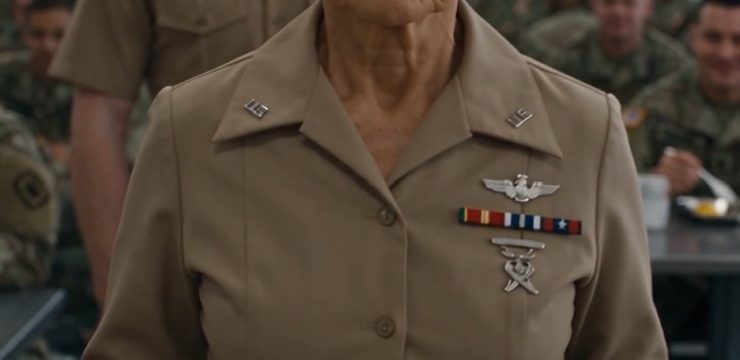
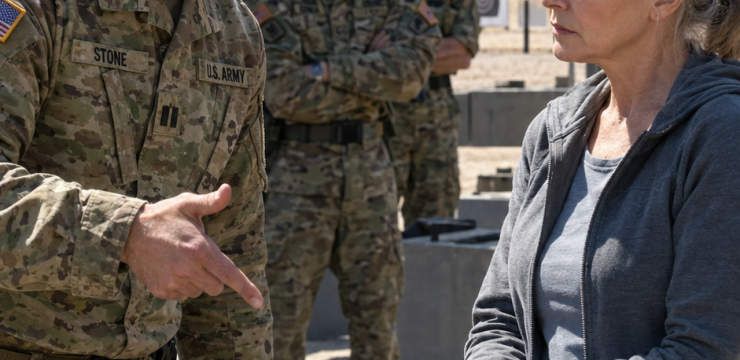
“You’re only the mother of a soldier.”
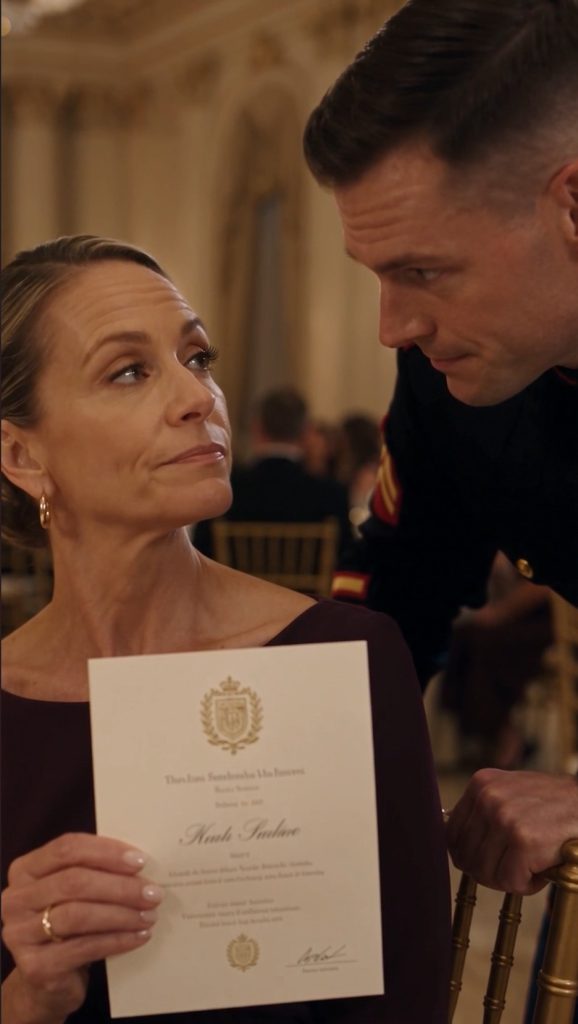
The words landed quietly beneath the chandeliers, but the people close enough to hear them stopped talking. Eleanor Bennett looked up at the decorated colonel standing beside her chair, and for one long second, neither of them moved.
Colonel Derek Maddox had approached before she had even unfolded her napkin.
“You need to move, ma’am.”
Eleanor glanced at the place card beside her plate. The table sat only a few yards from the stage, surrounded by senior officers, donors, and honored guests.
“I believe this is where I was assigned.”
Derek didn’t check the card.
Instead, his eyes moved over her simple navy dress, pearl earrings, and silver hair.
“This table is reserved for honored guests.”
Eleanor rested her hand beside the invitation she had carried into the ballroom.
“Yes.”
Something tightened in Derek’s face.
Around them, Fort Liberty’s annual military families memorial gala continued beneath brilliant chandeliers. A string quartet played near the wall while servers moved between hundreds of officers, veterans, spouses, donors, and Gold Star families.
Derek leaned closer.
“What rank was your son?”
Eleanor’s fingers went still.
“He isn’t serving anymore.”
A faint, knowing smile appeared on Derek’s face.
“Then there’s even less reason for you to be sitting here.”
A young server slowed behind Eleanor. Two guests at the neighboring table fell silent.
Eleanor studied Derek.
“Are you certain?”
He straightened and signaled toward a banquet employee.
“Move her to the back.”
Then, lowering his voice, he delivered the words that seemed to change the air around them.
“You’re only the mother of a soldier.”
Eleanor didn’t argue.
She simply picked up her purse.
“All right.”
Her chair slid softly across the floor as she stood.
Several people watched her cross the ballroom toward the final row of tables. Derek returned to his seat near the stage, his smile already restored.
A banquet employee pulled out a chair for Eleanor.
“I’m very sorry, ma’am.”
She noticed his name tag.
Caleb.
“You didn’t make the decision, Caleb.”
He glanced toward Derek. “I still don’t like it.”
“That speaks well of you.”
When Caleb noticed her invitation, he hesitated.
“That card really had the front table number?”
“It did.”
His jaw tightened.
“I thought so.”
Eleanor quietly warned him not to get himself into trouble.
Then she sat.
From the rear of the ballroom, she could see Derek laughing with business donors beside Brigadier General Marcus Hale.
Derek had spent months preparing for this night.
A new military family scholarship foundation was being formed, and its first executive director would control one of the largest privately funded education programs associated with the installation.
Derek wanted that job after retirement.
The prestige.
The salary.
The connections.
Most of all, continued access to powerful people.
Tonight, he believed those people were sitting beside him.
He had learned their companies, remembered their spouses, asked about their children’s universities, and laughed at precisely the right moments.
He never once looked back at Eleanor.
A woman at the rear table leaned toward her. A small gold pin marked her as a Gold Star family member.
“Did they change your table?”
“It seems they did.”
“I saw what happened.” The woman paused. “My name is Susan Parker.”
“Eleanor Bennett.”
Susan’s expression shifted.
“Bennett?”
“Yes.”
For a moment, Susan simply stared at her.
“Have we met?”
“I don’t believe so.”
Susan looked as though she wanted to ask something else.
Then the string quartet stopped.
The ballroom slowly quieted.
An announcement asked everyone to take their seats.
Near the stage, Derek adjusted the front of his dress uniform and settled comfortably among the people whose approval he had spent months pursuing.
At the back of the room, Eleanor placed her folded invitation beside her plate.
Susan was still looking at her strangely.
And Derek still had no idea why Eleanor Bennett’s name had made a Gold Star mother go silent.
Then the program began—and nobody in that ballroom was prepared for what came next. 👇
The first photograph appeared on the enormous screen behind the stage before the master of ceremonies said a word.
Eleanor stopped breathing.
A young man in uniform smiled down at the ballroom, one shoulder angled slightly toward the camera, his expression carrying the same crooked warmth she remembered from childhood photographs taken long before the uniform had entered their lives.
Susan made a small sound beside her.
Not quite a gasp.
Not quite a word.
Eleanor’s hand closed around the edge of the tablecloth.
The room had gone completely quiet.
Then Brigadier General Marcus Hale rose from the front table.
Derek turned toward him with an attentive smile.
Marcus stepped onto the stage, thanked the families, veterans, donors, and community leaders who had gathered, and then paused beneath the photograph.
“There are names,” he said, “that become part of an institution because of rank.”
He looked up at the screen.
“And there are names that remain because of sacrifice.”
Eleanor lowered her eyes.
The invitation beside her plate suddenly felt impossibly bright against the white linen.
Marcus continued.
“The Bennett Family Education Initiative began with a promise made after the loss of a soldier whose family believed that grief should not be allowed to end only in grief.”
Derek’s smile disappeared.
His head turned slowly.
Across the ballroom.
Past the center tables.
Toward the back.
Eleanor saw the exact second he found her.
His shoulders stiffened.
Susan whispered, “Oh, my God.”
Eleanor didn’t answer.
Marcus was still speaking.
“What began as a private scholarship fund grew over the years because one person refused publicity, refused ceremonial recognition, and repeatedly asked that attention remain on military families rather than on herself.”
A murmur moved through the ballroom.
Derek stared at Eleanor.
For the first time that evening, he looked uncertain.
Marcus glanced toward the front table.
Then he frowned.
There was an empty chair beside him.
A place card remained on the table.
He picked it up.
Even from the rear, Eleanor could see Derek’s face lose color.
Marcus looked toward the event coordinator standing beside the stage.
Then toward the back of the room.
“Mrs. Bennett?”
Every head turned.
Eleanor remained seated.
For one second, the ballroom seemed too large, too bright, too full of eyes.
Susan touched her wrist.
“You were supposed to be up there.”
Eleanor looked at her.
“Yes.”
Marcus stepped away from the lectern.
“Mrs. Eleanor Bennett?”
Slowly, Eleanor stood.
The reaction moved through the room like wind through tall grass.
People turned in their chairs. Donors leaned sideways. Officers looked toward Derek, then back toward Eleanor.
Caleb stood near a service station holding a water pitcher.
His mouth fell open.
Marcus’s eyes moved from Eleanor to the empty chair at his table.
“Ma’am, I believe there has been a mistake.”
Eleanor looked toward Derek.
“No,” she said quietly.
The microphone carried Marcus’s voice when he asked, “What happened?”
Derek rose so abruptly that his chair struck the table behind him.
“General, I can explain.”
Marcus didn’t look at him.
His attention stayed on Eleanor.
She could have protected Derek.
The thought came with surprising clarity.
She could have smiled, walked to the front, called it a misunderstanding, and allowed the evening to continue.
For most of her life, Eleanor had believed dignity meant refusing to humiliate someone merely because they had humiliated you.
But dignity was not the same thing as concealment.
And silence, she had learned painfully, could protect the wrong person.
She picked up the folded invitation.
“He asked me to move.”
The room became still.
Marcus’s expression changed.
“Who?”
Eleanor didn’t point.
She didn’t need to.
Derek was already standing.
“I was trying to resolve a seating discrepancy.”
Caleb lowered the pitcher onto the service table.
The glass base struck wood with a soft click.
Eleanor looked at Derek.
“There was no discrepancy.”
Derek’s jaw tightened.
Marcus descended from the stage.
“What exactly did you say to her?”
Derek glanced around the ballroom.
Hundreds of faces were now watching him.
“It was a misunderstanding.”
“No,” Susan said.
Her voice came from beside Eleanor.
It wasn’t loud, but the silence carried it.
Susan stood.
“I heard him.”
Derek looked at her.
Susan’s gold pin caught the chandelier light.
“He asked about her son. Mrs. Bennett told him her son wasn’t serving anymore.”
Susan swallowed.
“And Colonel Maddox told her there was even less reason for her to sit at the front.”
A chair shifted somewhere near the center aisle.
Derek’s expression hardened.
“That is not the full context.”
Caleb stepped away from the service station.
Eleanor turned toward him.
He looked terrified.
His hands were pressed flat against the seams of his black banquet trousers.
Marcus noticed him.
“You were there?”
Caleb nodded.
Derek’s eyes narrowed.
The young man saw it.
So did Eleanor.
For a moment, Caleb almost stepped backward.
Then Eleanor remembered what he had said.
I still don’t like it.
He drew a breath.
“Yes, sir.”
“What did you hear?”
Caleb looked at Eleanor before answering.
“Colonel Maddox told Mrs. Bennett, ‘You’re only the mother of a soldier.’ Then he told us to move her to the back.”
Nobody moved.
Derek stared at the young server as if sheer authority might force the words back into his mouth.
It didn’t.
Marcus looked at the empty chair beside his own.
Then at Derek.
“You moved the founding benefactor of this program away from the table reserved for her?”
Derek blinked.
“Founding benefactor?”
The question exposed more than any denial could have.
He hadn’t known.
Eleanor saw several donors exchange looks.
Marcus did too.
“You’ve been seeking the executive director position for six months.”
Derek’s lips parted.
“And you don’t know who established the fund?”
“I know the foundation’s history.”
“Apparently not.”
The words were quiet.
That made them worse.
Derek looked toward Eleanor again.
Something changed in his face.
Not remorse.
Calculation.
“Mrs. Bennett, I apologize. Obviously, had I known—”
Eleanor’s expression shifted for the first time.
“Had you known what?”
Derek stopped.
The question hung between them.
Eleanor stepped into the aisle.
“Had you known my name?”
No answer.
“Had you known how much money I had given?”
Derek swallowed.
“Mrs. Bennett—”
“Or had you known I was important enough to you?”
His face flushed.
Eleanor’s voice never rose.
“That is what troubles me, Colonel.”
Marcus watched her without interrupting.
Eleanor looked around the ballroom.
At the Gold Star pins.
At the photographs near the entrance.
At spouses who had spent years moving households from one assignment to another.
At parents whose children had returned changed.
At parents whose children had never returned at all.
“My son would have hated this conversation.”
Her voice trembled once.
She let it.
“He hated ceremonies about himself. He hated people confusing rank with worth. When I began funding scholarships, I did it because families carry parts of military service that never appear on a uniform.”
She looked back at Derek.
“You didn’t insult me because you knew who I was.”
A pause.
“You insulted me because you thought I was nobody.”
Derek looked down.
The ballroom remained silent.
Eleanor felt no triumph.
Only exhaustion.
Marcus returned to the stage and stood beside the lectern.
“Colonel Maddox, please step outside with me.”
Derek looked up sharply.
“Sir, I would prefer to address this privately.”
“We will.”
Derek’s gaze moved toward the donors.
That small movement told Eleanor exactly what he feared losing.
Marcus saw it too.
“The program will continue without interruption,” he told the room. “Please remain seated.”
Then he looked toward two members of the foundation’s organizing committee.
“Ms. Walsh. Mr. Carter. Join us.”
Derek’s face changed again.
This time, there was no practiced smile left to recover.
He followed them through the ballroom doors.
The doors closed behind him.
Only then did the room begin breathing again.
Susan sat slowly.
Caleb remained in the aisle.
Eleanor looked at him.
“You did well.”
His eyes shone.
“I thought I was going to get fired.”
“You told the truth.”
“Sometimes that gets people fired.”
Susan gave a soft, humorless laugh.
“Too often.”
Eleanor reached for Caleb’s hand.
He hesitated before taking hers.
“Not tonight,” she said.
Twenty minutes passed before Marcus returned.
Derek did not come with him.
The general approached Eleanor’s table rather than returning to the stage.
“May I sit?”
Eleanor nodded.
Marcus pulled out the chair beside her.
Up close, he looked older than he had beneath the stage lights.
“I owe you an apology.”
“You didn’t move me.”
“No. But this event is under my command’s umbrella, and a culture is measured partly by what people believe they can get away with inside it.”
Eleanor studied him.
“That sounds like something you’ve been thinking about for longer than twenty minutes.”
Marcus exhaled.
“I have.”
Susan glanced between them.
Marcus lowered his voice.
“There have been concerns about Maddox.”
Eleanor’s fingers tightened around her water glass.
“What kind?”
“Nothing criminal. Nothing I can responsibly discuss in detail tonight. But complaints about how he treated junior personnel and family-support staff. People he believed could do nothing for him.”
Eleanor’s stomach turned.
Her humiliation had lasted minutes.
Others, apparently, had lived with the same behavior for much longer.
Marcus continued.
“The foundation committee had not finalized the executive director appointment. Maddox was a candidate. A strong candidate on paper.”
“Was?”
Marcus held her gaze.
“He withdrew tonight.”
Susan frowned.
“Voluntarily?”
Marcus’s mouth tightened.
“He was informed that the committee would be reviewing tonight’s incident alongside previously documented concerns before making any appointment. He chose to withdraw immediately.”
Eleanor understood.
Derek had tried to preserve what remained.
But Marcus wasn’t finished.
“His withdrawal does not end the review.”
Eleanor looked toward the closed ballroom doors.
“What happens now?”
“That depends on what the documented facts establish. His retirement timeline does not erase accountability for conduct while serving.”
Eleanor nodded.
That was enough.
She did not want revenge manufactured for her.
She wanted the truth to stop bending around rank.
Marcus stood.
“There is another matter.”
He gestured toward the stage.
“You were meant to speak tonight.”
Eleanor stared at him.
“No.”
A faint smile touched his face.
“That is exactly what your assistant told me you would say.”
“I don’t have an assistant.”
Marcus paused.
Susan turned toward Eleanor.
Marcus reached inside his jacket and removed a cream envelope.
“Then I think there is something you need to see.”
Eleanor took it.
Her name was written across the front.
Not typed.
Written.
She knew the handwriting.
Her breath stopped.
The ballroom disappeared.
For several seconds there was only blue ink on cream paper and the sudden impossible memory of a kitchen table, a boy bent over homework, his hand curled awkwardly around a pencil.
Eleanor sat down.
“Where did you get this?”
Marcus’s voice softened.
“It was included in the original documents establishing the scholarship fund.”
“That’s impossible.”
“It was sealed with instructions.”
Her thumb moved over the handwriting.
Eleanor Bennett.
Her son had written her full name.
Susan turned away, giving her privacy without leaving.
Eleanor opened the envelope.
Inside was a single sheet of paper.
The date at the top was from years earlier.
Before the phone call.
Before uniformed men had stood at her door.
Before grief had divided her life into a before and an after.
She read the first line.
Mom,
If you ever turn my education account into something for other families, promise me you won’t put my name on a building.
A sound escaped her.
Half laugh.
Half sob.
Marcus lowered his eyes.
Eleanor kept reading.
The letter was not a farewell.
That made it hurt more.
Her son had written it during a conversation they had once had about the savings account she maintained for him. He had joked that if he never used all of it, she would find some embarrassingly generous way to give the rest away.
He had known her too well.
But beneath the joke was a request.
Help the kid whose mother doesn’t know the right people.
Help the spouse who has started over five times.
Help the daughter who thinks her parent’s rank decides whether anyone will listen to her.
And if somebody important ever tries to make the program about important people, Mom, please annoy them for me.
Eleanor pressed the page against her mouth.
Susan’s hand covered hers.
For years, Eleanor had believed the scholarship foundation was something she had created from the wreckage left behind.
Now she understood that the instinct beneath it had belonged to both of them.
Her son had planted the idea before either of them knew it would be needed.
Marcus waited.
“There’s one more instruction attached to the letter.”
Eleanor wiped beneath one eye.
“What?”
“The committee was to give it to you only when the program became large enough that its leadership would be entrusted to someone outside the original family circle.”
She looked toward the stage.
The executive director.
Marcus nodded.
“He wanted you to remember what the position was supposed to protect before you approved whoever would hold it.”
Eleanor went still.
“Approved?”
Susan stared at Marcus.
He almost smiled.
“You didn’t read the final governance amendment, did you?”
Eleanor gave him a look that would once have made her son laugh.
“I funded scholarships. I hired attorneys to read governance amendments.”
“For precisely that reason, they preserved a founder’s consent provision.”
Marcus pulled out a chair again.
“The committee can recommend an executive director.”
He paused.
“You have final approval.”
Eleanor looked toward the doors Derek had disappeared through.
The absurdity was so complete that she closed her eyes.
Derek had spent months courting everyone he thought mattered.
Then he had ordered the one person whose approval he actually needed to sit in the back.
Susan covered her mouth.
Caleb, still nearby, whispered, “Wow.”
Eleanor began laughing.
She tried to stop.
She couldn’t.
It was not cruel laughter.
It was grief breaking open somewhere unexpected.
Susan joined her, tears still shining on her cheeks.
Even Marcus smiled.
The tension that had held the table for nearly an hour finally cracked.
Eleanor folded the letter carefully.
“Then we should find someone better.”
Marcus nodded.
“Yes, ma’am.”
“No.”
He raised an eyebrow.
“No more ‘ma’am’ tonight.”
“Yes, Eleanor.”
“That’s better.”
The gala resumed differently after that.
Eleanor refused the front table.
Marcus tried twice.
She refused twice.
Instead, he moved his own chair to the back.
Then Susan shifted hers.
Within minutes, two donors followed, then a military spouse, then a retired sergeant major whose wife carried her chair herself despite three people offering to help.
The rearrangement was awkward.
It violated the printed seating plan.
Eleanor’s son would have loved it.
When Eleanor finally approached the lectern, she carried his letter.
She did not read it aloud.
Some words belonged first to the person who had waited years to receive them.
Instead, she looked across the ballroom and said, “I was supposed to talk tonight about scholarships.”
A few people smiled.
“I still will.”
She glanced toward Caleb standing near the rear wall.
“But first, I want to talk about chairs.”
Soft laughter moved through the room.
Eleanor waited.
“A chair at the front of a room does not make someone honorable. A chair at the back does not make someone less worthy.”
The laughter disappeared.
“My son taught me that service is not a ladder people climb so they can look down.”
She touched the folded letter.
“And tonight, someone else reminded me that character is often clearest when we believe the person in front of us has nothing to offer.”
Caleb looked down.
Eleanor continued.
“The scholarships this foundation provides will not be awarded according to the rank of a parent. The people who administer them will not be chosen according to whom they impress at dinner.”
Marcus watched her.
“They will be chosen according to how they treat the person they believe cannot help them.”
No applause came immediately.
Eleanor was grateful.
The silence meant people had heard her.
Then Susan stood.
Others followed.
The applause rose slowly, not like celebration but recognition.
Eleanor looked at her son’s photograph behind her.
For the first time that night, she let herself look at it for more than a second.
Three months later, the foundation announced its first executive director.
Her name was Dr. Naomi Carter, the daughter of an enlisted mechanic and a school librarian, a former military spouse who had completed her doctorate across four duty stations while raising two children.
Eleanor had asked her one question during the final interview.
“What do you do when nobody important is watching?”
Naomi had thought for a long moment.
“Usually the same work,” she said. “Just with fewer people interrupting me.”
Eleanor had smiled.
The answer wasn’t polished.
That helped.
Under Naomi’s leadership, the foundation created a formal advisory council that included enlisted families, Gold Star relatives, veterans, spouses, and civilian support workers.
Susan Parker accepted a seat on it.
Caleb received something too, though not from Eleanor directly.
One of the defense-company executives at the gala had witnessed him speak up.
Weeks later, Caleb was offered a paid internship in the company’s community education division while finishing college.
When he called Eleanor, embarrassed and breathless, he insisted he hadn’t done anything extraordinary.
“You stood up while you were afraid,” she told him.
“That’s usually what extraordinary looks like from the inside.”
Derek’s review took longer.
Several people who had remained silent came forward once they learned their experiences were not isolated.
Statements described a pattern: junior personnel dismissed in meetings, family-support workers belittled, volunteers treated according to perceived influence, opportunities redirected toward people Derek considered useful.
No single incident carried the weight of scandal.
Together, they revealed something more difficult to excuse.
A way of moving through the world.
Derek retired without the foundation position.
His candidacy was permanently withdrawn, and the committee documented that he would not be considered for future leadership or advisory roles.
The military review placed its findings in his official record before retirement.
There was no dramatic arrest.
No public destruction.
No cheering crowd.
Eleanor preferred it that way.
His downfall was quieter and more exact.
The doors he had spent years arranging himself beside no longer opened simply because he appeared.
Months after the gala, Derek asked to meet Eleanor.
She nearly declined.
Then she remembered her son’s letter.
Please annoy them for me.
She agreed to twenty minutes in a small coffee shop near Fayetteville.
Derek arrived early.
Without his dress uniform, he seemed smaller, though Eleanor knew that was an illusion. Clothes had never contained his authority.
His expectations had.
He stood when she entered.
“Mrs. Bennett.”
“Derek.”
They sat.
For several seconds, neither spoke.
Finally, he said, “I’m sorry.”
Eleanor waited.
He looked at his hands.
“I’ve rehearsed this so many times that every version sounds dishonest.”
“That may be because you’re trying to make it sound good.”
He looked up.
The comment struck him.
Then, unexpectedly, he nodded.
“Yes.”
Silence settled between them.
“I treated you that way because I thought you didn’t belong at that table.”
Eleanor said nothing.
“And when I learned who you were, my first thought was about what it would cost me.”
His mouth tightened.
“That is the part I am most ashamed of.”
“Not what you said?”
“That too.”
He looked through the window.
“But what I said was a symptom.”
Eleanor studied him.
For the first time, she heard no attempt to negotiate.
Derek continued.
“I spent years telling myself I respected service. What I respected was status.”
The coffee between them cooled.
“I don’t expect forgiveness.”
“Good.”
He almost smiled.
Eleanor leaned back.
“Forgiveness is not a position you apply for.”
“No.”
“And an apology does not restore trust.”
“I understand.”
“Do you?”
He looked at her.
Eleanor thought of the statements Marcus had mentioned.
“Then apologize to the people whose names will never appear on a donor wall.”
Derek’s eyes lowered.
“Some of them won’t speak to me.”
“That is their right.”
He nodded.
Eleanor stood when the twenty minutes ended.
Derek rose too.
At the door, he said her name.
She turned.
“I did read your son’s letter,” he said.
Eleanor stiffened.
Marcus had included a short excerpt in the foundation’s public announcement with her permission.
Derek swallowed.
“The part about helping the people who don’t know the right people.”
“Yes.”
“I wish I had understood that before.”
Eleanor opened the door.
“So do I.”
She left him there.
It was not reconciliation.
It was not absolution.
But it was the first conversation they had ever had in which Derek wanted nothing from her.
For Eleanor, that was enough.
A year after the gala, the first scholarship class gathered in the same convention hotel.
Eleanor almost laughed when she saw the ballroom.
Naomi had changed the seating plan.
There was no front table.
Instead, round tables spread evenly around a low central platform so no family sat farther from the program than another.
Susan found Eleanor near the entrance.
“Notice anything?”
Eleanor looked around.
“You’ve declared war on hierarchy through furniture.”
“Naomi’s idea.”
“I approve.”
“You literally do.”
Eleanor groaned.
Susan laughed.
Caleb arrived a few minutes later wearing a suit that fit him slightly too tightly across the shoulders.
He had graduated that spring.
He hugged Eleanor before remembering to ask whether he could.
“You’re late,” she told him.
“I’m seven minutes early.”
“My son used to make the same argument.”
Caleb smiled.
Then his expression softened.
“Is tonight hard?”
Eleanor looked toward the photographs displayed along one wall.
Her son was there.
He always would be.
“Yes.”
Caleb nodded.
He did not tell her not to be sad.
He simply stood beside her.
That kindness mattered more.
Near the end of the evening, Naomi approached carrying a narrow wooden box.
“We have something for you.”
Eleanor immediately frowned.
“No buildings.”
Naomi laughed.
“I know.”
“No statues.”
“Definitely not.”
“No scholarship named after me.”
“Eleanor.”
“I’m establishing boundaries.”
Susan appeared behind Naomi.
“Open the box.”
Inside was a brass plaque.
Eleanor stared at it.
There was no donor amount.
No title.
No rank.
Only one sentence.
For The Families Who Carried The Weight Too.
Eleanor touched the engraved words.
Beneath the plaque was a smaller card explaining where it would be placed.
Not at the ballroom entrance.
Not beside the donor wall.
On the back-row table where Eleanor had been seated the year before.
Her eyes filled.
Naomi spoke softly.
“We kept that table.”
Eleanor looked up.
“What?”
“Not the seating arrangement. The actual table.”
Susan was crying now.
Naomi smiled.
“It’s going into the foundation’s family resource center. Students will use it for applications, tutoring, financial-aid forms, whatever they need.”
Eleanor pressed one hand against her mouth.
A table meant to diminish her had become a place where families would sit while building something larger.
The twist was so perfectly aligned with her son’s humor that she could almost hear him laughing.
Not a monument.
A working table.
Of course.
Eleanor looked toward his photograph.
“You planned this somehow, didn’t you?”
Susan slipped an arm through hers.
“Who are you talking to?”
“Someone extremely annoying.”
They stood there together while the ballroom filled with voices.
Not officers and donors.
People.
Families.
Students.
Children weaving between chairs while parents pretended not to notice.
Caleb talking too quickly because he was excited.
Naomi kneeling beside a scholarship recipient’s grandmother so they could speak eye to eye.
Marcus carrying his own chair when another table needed one.
Eleanor watched all of it.
Then she understood what her son had been trying to tell her before either of them knew how much those words would matter.
The foundation had never been his memorial.
It was his continuation.
Not because his name appeared everywhere.
Because his values did.
Late that evening, after most guests had left, Eleanor walked to the family resource center.
The old back-row table stood beneath a wide window.
The brass plaque had already been fixed discreetly beneath its edge.
Someone had left a scholarship application on the tabletop.
Beside it sat a sharpened pencil.
Eleanor pulled out a chair.
For a moment, she was back in her kitchen watching her son struggle through homework, gripping his pencil too tightly while insisting he did not need help.
She smiled through tears.
Then she placed his letter on the table.
Not permanently.
Just for a moment.
Her fingertips rested over his handwriting.
Susan waited by the doorway.
Caleb and Naomi stood farther down the hall, giving her space.
Eleanor folded the letter again and returned it carefully to her purse.
She switched off the desk lamp.
Moonlight remained across the tabletop.
Tomorrow, another family would sit there.
Someone who might not know the right people.
Someone who might arrive frightened, embarrassed, exhausted, or convinced that every important chair had already been reserved for somebody else.
There would be a place for them.
Eleanor touched the back of the chair once before walking toward the people waiting for her.
And when she stepped into the hallway, Susan took one arm, Caleb took the other, and their laughter followed them toward the doors while behind them, in the quiet room, the old back-row table waited beneath the warm light for the next family to come home.